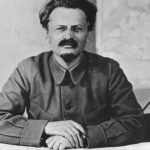
We explain who Lenin was and how he became the main leader of the Russian revolution. In addition, his role in the Communist Party and the Soviet Union.
Who was Vladimir Lenin?
Vladimir Illich Ulianov, popularly known as “Lenin”, was a communist militant and politician, Leader of the Russian Revolution (1917) who abolished the Tsarist monarchy and main leader of the Bolshevik faction which established communism and founded the Union of Soviet Socialist Republics (also called Soviet Union or USSR). Lenin followed Marxist thinking and contributed a series of ideas to political philosophy, linked to the socialist revolution in a country with little industrial development such as Russia.
Because of his political militancy, Lenin lived many years in exile or hiding . He was one of the main leaders of the Russian Social Democratic Workers Party (POSDR), which later became the Communist Party of the Soviet Union (PCUS). Before the Russian revolution, its main activities were linked to political analysis, the publication of their ideas and the party organization.
Lenin saw the opportunity to convert the 1917 antimonarch revolution into a socialist revolution. Led the October revolution, in which the Bolsheviks took power and replaced the provisional government moderated by a government government government. During the Civil War (1919-1921), he achieved that the Communist Red Army defeat the white opposition movement. As leader of the revolutionary government, He laid the foundations for communism in Russia and founded the Union of Soviet Socialist Republics (USSR) .
Lenin’s private life
Lenin’s childhood and first years
Vladimir Illich Ulianov was born on April 22, 1870 in Simbirsk, Russian Empire within an urban middle class family. His father, Iliá Uliánov, was an inspector of education and his mother, María Aleksandrovna, came from a German aristocratic family. He grew up in a cult environment and had a good school education. His older brother, Aleksandr, managed to enter the University of St. Petersburg, something unusual for the society of the Tsarist Empire.
His father died in 1886 due to health problems. His brother Aleksandr began military in an organization called “will of the people”, of antimonarchical revolutionary thought and in 1887 he was part of a conspiracy against Tsar Alexander III. However, before carrying out the attack, the police discovered them and Aleksandr, along with militants, was sentenced to death by betrayal.
A few months later, Lenin managed to enter the University of Kazan to study law thanks to the support of its Fiódor Kerenski School Director (Aleksandr Kerenski’s father, who would be the provisional government prime minister that Lenin will overthrow during the October Bolshevik Revolution).
Lenin was an excellent student and got the best notes. At the university he knew the revolutionary ideas and began to participate in the students’ demonstrations . He was arrested in a protest and expelled, although he was then allowed to continue his distance studies.
In the following years, he dedicated himself to deepen his revolutionary readings and to know the reality of the Russian Empire. His thought was especially influenced by the readings of To do? from Nikolai Chernishevski, Capital of Karl Marx and for the activism of Gueorgui Plejánov. In 1892 he managed to get his university diploma in law.
However, His political activity became priority and the exercise of law was in the background. During the 1890s, he lived in different cities, such as Moscow and St. Petersburg, and linked with different leaders and revolutionary groups, such as Yuri Martov. He began publishing his own writings and established the basis of his thought and political ideology.
In 1894 and 1895, he traveled through Europe. Upon returning to Russia, he founded with Martov a communist struggle organization that was dismantled shortly after and for which he was arrested and sentenced to several years in prison. Then, in 1897 he was banished to Siberia where he dedicated himself to continuing his writings.
In 1898, He married Nadia Krúpskaya, a Marxist militant whom I had met four years before. Nadia belonged to the “Group for the fight for the emancipation of the working class” that was informally directed by Lenin and Martov in 1895. In 1896, Nadia was arrested for his participation in the group and imprisoned. In 1897 he was given freedom under surveillance and, the following year, the authorities resolved to condemn it to the “inner exile” in northern Russia. At that time, Lenin was already banished in Siberia.
Nadia and Lenin told the authorities that they were a couple and asked to pass exile together . The Russian authorities granted them the order on condition that they contain religious marriage, which they did on July 10, 1898 in Krasnoyarsk, Siberia. Since then, they worked together for the workers’ revolution.
Nadia accompanied Lenin in her European exiles (1901-1905 and 1905-1917) and participated in the 1905 revolution. In the February Revolution she had a more moderate position than Lenin’s and decided to focus on the promotion of education and resign the organization’s tasks. After the October revolution, Nadia occupied various functions within the Ministry of Education And it was one of the main creators of the Soviet education system.
Lenin’s political life
The creation of the Social Democratic Workers Party of Russia (POSDR)
In 1900, after spending several years of exile in Siberia, Lenin illegally escaped from exile Together with Martov and Aleksandr Potresov, with whom he settled in Munich (and then in London and Geneva). From there, they founded the newspaper ISKRAwhich introduced clandestinely into Russia with the aim of turning it into a tool that allowed the organization of dispersed revolutionary groups that acted clandestinely.
On the other hand, They worked to join and congregate the different socialist organizations That, although two years before the I Congress of the Social Democratic Workers Party of Russia had been held, they were dispersed and failed to meet in a central institution.
In 1903, twenty -six organizations of the Base Obrera met at the II Congress of the Social Democratic Party of Russia, in London. For three weeks, the different organizations discussed the formation of the new party, their internal organization, the relationship between the party and the proletariat, and the road to the revolution. During Congress, Lenin and Martov differentiated themselves by their positions on the formation of a mass party and the admission of revolutionary militants.
Lenin believed that the revolution should be carried out by professional revolutionary militants integrated into a centralized organization . He argued that the party should be a centralized organization around a small core of experienced homogeneous ideology, chosen by the party’s congress. In addition, he said that it should be administered through the discipline and the hierarchy of its internal organisms.
Instead, Martov (like Leon Trotsky and other revolutionary leaders) argued that the basis of the revolution should be expanded and that the popular masses had to have greater participation in decision making. He believed that a party organization like the one that Lenin postulated would lead to the establishment of a “dictatorship about The proletariat “, instead of a” dictatorship of the proletariat”.
The majority of the revolutionary leaders defended the position of Martov. However, towards the end of the sessions, one of the socialist groups retired from Congress and, as a result, Lenin’s ideas were mostly. Since then, The defenders of Lenin’s ideas were called “Bolsheviks” (which means “majority”) and the defenders of Martov’s ideas were called “Mensheviques” (which means “minority”). Both factions were formally maintained within the game until in 1912, they separated formally.
Lenin’s ideology
Lenin developed his own ideas about Marxism and how to carry out a socialist revolution in Russia. These ideas are known as Leninism or Marxism-Leninism.
Lenin postulated that to transform the society of the Russian Empire into a socialist society It was necessary to carry out a revolution at the hands of a group of professional revolutionaries that guide the proletariat (A small portion of the Russian population of that time) and made it the avant -garde of the town. To end the Tsarist autocracy it was necessary to create a revolutionary institution that inspired the action of the proletariat, and this, in turn, would inspire the action of the rest of the Russian people.
Unlike Western societies (in which much of the population was a workers), in Russia The majority of the population was peasant and only a small proportion constituted the workers’ proletariat . However, Lenin argued that the path of Russian society to socialism implied a revolution that established the dictatorship of the proletariat.
Once the revolutionary government is established at the hands of a professional group, The proletariat should take care of accelerating the industrial development of a capitalist society . This, according to Lenin’s thought, would make the proletarian base of society grow and, ultimately, a society without classes would be achieved.
The 1905 revolution
In 1905, a spontaneous popular insurrection broke out which extended through various areas of the Russian Empire. It was a series of urban demonstrations, workers’ strikes, military riots and peasant disturbances that expressed their discomfort for different causes and differently.
It was a popular expression of discontent for the government of Tsar Nicolás II, which was generalized after bloody Sunday: the day the Russian Imperial Guard repressed a peaceful workers’ manifestation in St. Petersburg and left more than a thousand dead that included women and children).
The 1905 revolution was not an organized movement, and at that time, The socialist and left parties had very little influence on the population . When the riots began, Lenin was exiled in Geneva, Switzerland.
During those years I was more focused on developing theory and intra -party struggles, than in direct revolutionary action. In fact, in April of that same year, Lenin convened the celebration of the III Postdr Congress in London, with the aim of achieving the control of the party. In addition, I wanted to achieve the support of the Socialist Bureau (the main socialist organization at the international level).
In November, Lenin returned to Russia. He was guarded by the police, so in a short time he went to hiding. In December, all the Mencheviques leaders of the Soviet of St. Petersburg (the main labor organization of the city) were arrested. In response, The workers and Bolsheviks of Moscow declared a general strike and turned to the armed struggle. The repression of the Imperial Guard led to Trotsky’s arrest, and the escape into the exile of Lenin.
In 1906, Tsar Nicolás II decreed the “October Manifesto” in response to the revolutionary wave. With this decree greater civil liberties were granted (of religion, expression, meeting and association), the masculine universal suffrage and participation in the new Parliament, called Imperial Duma. This political maneuver calmed the revolutionary situation to the main claims of the population. However, during the following years the Tsar recovered its authority and more and more limited the actions of the new Parliament.
During the following years, Lenin remained in exile and returned to Russia on numerous occasions clandestinely, to participate in the party meetings.
Lenin during World War
The outbreak of World War I in 1914 led to the rupture of the socialist movement internationally. Socialist organizations lost their national unity: they divided between those who supported participation in the war and those who opposed it. On the other hand, international solidarity between socialist movements was interrupted by the nationalist feelings that enhancing different countries.
In that context, Lenin and the POSDR Bolsheviks were one of the few socialist organizations that They unanimously opposed the participation of war . They argued that it was an imperialist war that defended the interests of the bourgeoisie and in which the working class and the peasantry of all countries would be the main victims. In these years, various Mencheviques militants (such as Trotsky) approached the Bolshevik faction for their position against the war.
Lenin during the Russian revolution
In February 1917, Russia’s critical political and economic situation to the outbreak of a popular revolution and to the overthrow of Tsar Nicolás II . Popular discontent was especially concentrated in the low quality of life, poverty and hunger suffered by the population, factors that worsened with Russia’s participation in World War I.
The so -called “February Revolution” established a provisional government in the hands of the Duma, which was the Imperial Parliament. However, the “Soviets”, which were the advice of workers who mobilized a large part of the population during the insurrection, influenced the government and controlled many of the revolutionary militias.
This generated a dual power situation between the provisional government (which had the power of the State and the support of the middle classes and the bourgeoisie) and the Soviets network, led by the Petrograd Soviet (which had the support of the lower classes and nucleated the socialism and the various left -wing groups).
Lenin identified power vacuum and political instability as an opportunity for the socialist revolution. In April, he returned to Russia and concentrated on revolutionary action. He published the “April thesis”, in which he criticized the new provisional government and called the proletariat and the peasant of the Soviets to conquer power . In the following months, he managed to impose his ideas in the Postdr meetings and obtain greater authority.
Due to its initiative, a new revolution began to be organized against the provisional government, cooperation with non -socialist parties was rejected and the relationship with the Menchevique faction was tensed. Besides, Lenin was achieving the support of the Soviets of St. Petersburg and consolidating his authority over those of Moscow .
In the months following February, the provisional government could not control the political situation and popular discontent continued to grow. One of the main demands of the population was Russia’s departure from World War I, but clashes within the Duma and international political cost were relegating the decision.
In July, when Lenin was out of Moscow, another armed popular insurrection was unleashed (with the participation of Bolsheviques and other socialist organizations), which claimed the transfer of the power of the provisional government to the Soviets. These events were known as the “July days.” Consequently, The Duma government began to persecute the Bolshevik leaders and Lenin returned to clandestinity and exile .
In September, Lavr Kornilov, a counterrevolutionary commander, tried a failed coup against the provisional government. This favored the Bolsheviks, since the population feared the return of the Tsarist autocracy and saw the weakness of the moderate policies of the provisional government.
In that context, the following month, Lenin returned to Moscow and led an armed insurrection . Under the slogan “all the power to the Soviets”, the “October revolution” and the Bolshevik coup against the provisional government were unleashed. The night of October 24 (the date corresponds to the Julian calendar that was used at the time in Russia; in the Gregorian calendar corresponds to November 6) the armed workers occupied the winter palace and other government buildings, with low resistance of the weakened provisional government. In this way, the Soviets took power and Lenin was in command of Russia.
Lenin’s government
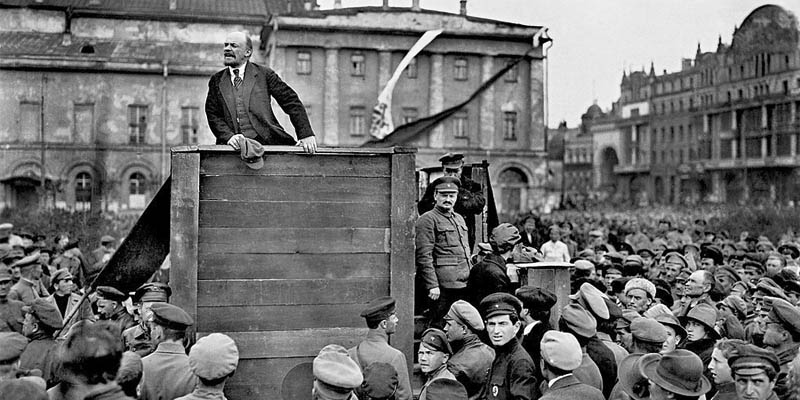
The day after the taking of power, the Soviets gathered in the second Panruso de los Soviets Congress, which lasted three days. There, Lenin presented the proclamation of the overthrow of the provisional government, the establishment of a new government that emerged from this congress and the two main decrees that would be The bases of the new government: the decree on peace (Russia’s departure from World War I) and the decree on Earth (who abolished the property of the land and delivered it to the peasant Soviets for its production).
The new government was organized based on a new institution, the Council of Commissioners of the People (also called Sovnarkom), chaired by Lenin and constituted by Bolsheviks Ministers.
Although in principle the government was committed to holding elections for the formation of a Constituent Assembly, soon the assembly was dissolved. The power was effectively in the hands of the Soviets controlled by the Bolsheviks and the opposition parties were denied political participation.
In March 1918, The new government signed the Brest-Litovsk treaty to achieve Russia’s departure from World War I . To do this, the Government gave the central empires a large number of territories that belonged to the Imperial Russia. The signing of the treaty was seen by many Russians as a shameful peace and an agreement that harmed the Russian nation.
On the other hand, Lenin established the bases to create the so -called “proletariat dictatorship” . He sought to create a system of government in which power was monopolized by the POSDR that, as of 1919, began to be called Communist Party of the Soviet Union (PCUS). The state organization was organized around the centrality of the party in decision -making and popular political representation through the Soviets of workers, peasants and soldiers, in turn controlled by the party.
To establish a communist regime, decreed the confiscation of land, the state monopoly of production and of the distribution of the main agricultural products, the nationalization of the main services, banks and means of transport, and the nationalization of the industry.
The absence of institutions and forms of opposition political participation led to The Russian Civil War will be triggered . The different opposition organizations allied and joined their forces in the White Army, which sought to recover control and defeat the Red Bolsheviks army.
The war lasted two years and consumed many of the new government’s resources. An economic regime known as “war communism” was established which led to the confiscation of agricultural production to the peasantry, the rationalization of food and the total intervention of the State in the economy.
In that context, the popular Soviets were losing participation and the PCUS consolidated their state power. In addition, the same PCUS began to suppress the internal dissent of the party. The press was censored and its own police agency was created, known as the Czech.
Once the white army was defeated and the civil war finished, Lenin proposed the development of the new economic policy based on a mixed economy that combined state central planning elements with market elements.
The new measures involved the replacement of the appropriation of the agricultural surplus for the payment of a tax by the peasants, the implementation of a monetary reform, the consolidation of a controlled market and the existence of various forms of property.
In 1922, the Union of Soviet Socialist Republics, the new Russian government, was formally founded . On the other hand, the Komintern (also known as the third International Communist) was created to bring together the different socialist parties of the world. Lenin believed that the common revolution in Russia could and should extend to the rest of Europe.
Lenin’s disease and death
Lenin suffered from health problems linked to nervousness, stress, insomnia and headache . Before assuming the government, it combined intense work periods with rest vacation to balance their physical discomfort. However, by assuming the Russian government its health deteriorated.
In 1921, he had to move away a few weeks from the capital to rest from government affairs and recover his state of health. The following year, the symptoms worsened and in May suffered a brain attack, which left him a partial paralysis . In December he had a second attack, which left him in a wheelchair.
In that context, Lenin wrote a letter to be read in the PCUS Congress and is known as his “political testament.” In it, Lenin argued that the government’s political organization should be reorient and reduce the influence of the PCUS on the State apparatus through the incorporation of more members into the central committee.
In addition, he criticized Trotsky’s actions against the central committee and denounced the concentration of the power that Iósif Stalin was achieving as general secretary of the party (after Lenin’s death, Stalin continued to consolidate his power and created a dictatorship in a unipersonal in the Soviet Union).
A third brain attack definitely moved him from politics and was officially relegated from his functions. Finally, Lenin died on January 21, 1924.
Continue with:
References
- Carr, EH (1981). The Russian revolution. From Lenin to Stalin, 1917 to 1929. Editorial Alliance.
- Fitzpatrick, S. (2005). The Russian revolution. 21st century editors.
- Miéville, C. (2017). October: The history of the Russian revolution. Akal.
- Resis, Albert. “Vladimir Lenin”. (2023). Britannica Encyclopedia
https://www.britannica.com/. - Palmowski, J. (2000). “Lenin, Vladimir Illich.” To Dictionary of Twentieth-Century World History. Oxford University Press.