We explain what atmospheric pressure is, why it varies and how it was discovered. Also, how it is measured and what units are used.

What is atmospheric pressure?
Atmospheric pressure or barometric pressure is the force exerted by the set of mixed gases that make up the atmosphere on the earth's surface and the elements that are on it. This force is given per unit area, that is, it is equivalent to the weight of the column of air that extends from a point on the Earth's surface to the upper limits of the atmosphere.
Atmospheric pressure and its variations over a period of time constitute a common data in the study of atmospheric climate. However, air varies in density as it moves away from the ground and is also affected by temperature, so it is not usually easy to calculate the atmospheric pressure of a given point with a high margin of certainty.
In ancient times, the very idea of atmospheric pressure was unknown, and its everyday effects, such as the practical limitation of the rise of certain materials, was understood as evidence of the horror vacuisthat is, the “terror of emptiness” that nature manifested, since it was thought that air was weightless and rose on its own.
This was like this until, In 1643, the weight of air was discovered by the Italian physicist Evangelista Torricelli (1608-1647), through the first experiments that led to the creation of the barometer. His most famous experiment consisted of comparing the behavior of mercury and water when introduced into a curved tube at the end, known today as the Torricelli tube.
His experiences helped the French polymath Blaise Pascal (1623-1662) to measure the weight of atmospheric air in different geographical locations and different altitudes, such as the top of the Puy-de-Dôme volcano in the south of France. But it was not until 1654, thanks to the experiments with the Magburg hemispheres of the German physicist Otto von Guericke (1602-1686), that the existence of atmospheric pressure was publicly demonstrated.
Atmospheric pressure units
Atmospheric pressure is, above all, a form of pressure, so It is measured in the International System of Units (SI) in Pascals (Pa) a unit that pays tribute to the French physicist and is understood as the pressure exerted by a force of 1 newton (N) on a surface of 1 square meter (m2) normal to it, that is: Pa = kg/ms2 .
However, to measure atmospheric pressure, It is common to use other types of units such as atmospheres (atm), bars (b), millibars (mb) or millimeters of mercury (mmHg). Each one deserves a separate explanation:
- 1 atmosphere It is the pressure exerted by air to balance 760 mm of mercury under normal conditions on the Earth's surface, and is equivalent to 101,300 Pa.
- 1 bar (coming from the Greek word for “weight”: baros) is equivalent to 0.986923 atm, and therefore 100,000 Pa.
- 1 millibar It is equivalent to 1000 bars, and therefore to 100 Pa and 0.0010197 atm.
- 1 millimeter of mercury It is equivalent to the pressure necessary to increase the height of one millimeter of mercury inside a Torricelli tube. It is equivalent to 133.3 Pa and is a unit widely used in medicine.
How is atmospheric pressure measured?
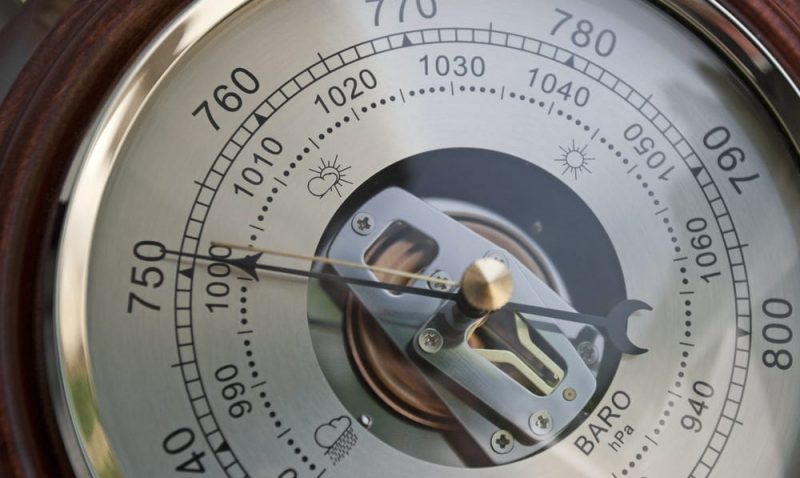
To measure the atmospheric pressure of a given location, we need a device called a barometer . Its fundamental principle, which reproduces the experiences of Torricelli in the 17th century, consists of a column of liquid (generally mercury) introduced into a tube whose upper portion is closed.
Thus, the weight of the air in the atmosphere exerts more or less force on the liquid forcing it to remain inside the tube to a certain point, equivalent to the force itself received.
References
- “Atmospheric pressure” in Wikipedia.
- “Atmospheric pressure” in educaLAB (Spain).
- “Experiments: atmospheric pressure” (video) on Canal U.
- “Atmospheric Pressure” in The Encyclopaedia Britannica.