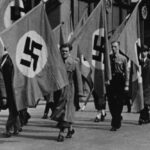
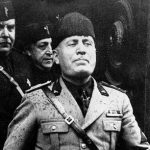
We explain what fascism and its characteristics were. In addition, what were the main fascist political movements of the twentieth century.

What was fascism?
Fascism is a political ideology that covers different practices and political movements of the twentieth century. It emerged in Europe after World War I and developed during the interwar period. Ideologically opposes democracy, socialism and anarchism .
The most important fascist political movements of the twentieth century were the German National Socialism led by Adolf Hitler and Italian fascism headed by Benito Mussolini. The Government imposed by Francisco Franco in Spain also had traits that relate the regime to fascism.
In different countries or political movements, fascism took different paths. However, a series of common features that characterize the fundamental elements of fascist ideology can be established.
Main fascist ideas
- Totalitarianism: citizens must subordinate the State controlled by a unique party.
- Antiliberalism: freedoms that generate political hazards, economic inefficiency and social disorder should be eliminated.
- Anti -capitalism: the government must control business associations and unions to prevent a group from benefiting at the general good of the nation.
- Antimarxism: society must reflect national unity and get away from class struggle ideas.
- Authoritarianism and militarism: social organization must follow the parameters of order, discipline and hierarchy established by the Government.
- Radical nationalism: the national unity must be the highest priority of the State.
- See also: fascism
Totalitarianism

The fascist state was a totalitarian state . The Government and the state bureaucracy sought to intervene in all areas of life, often restricting the freedom of individuals.
It was sought to control education at all levels, the activities of youth, working and business life, the roles of women and men in private life, the media, among other things.
Unlike the liberal state, based on individual freedom, in fascism people had to subordinate fully to a state that was based on the use of force, authoritarian leadership and hierarchy to exercise absolute control of society.
The official party (fascist, national-socialist) It was the only allowed political organization and controlled and regulated all the action of the State.
Antiliberalism
For fascist ideologues Liberalism was a weak ideology unable to stop the growth of communism and ineffective to maintain the course of the economy in crisis. Democracy and universal suffrage were considered artificial and useless methods that tried to match the natural inequality among men.
La Libertad, represented in the rights of expression, association or meeting was contemplated with absolute disdain by The fascist ideology, which defended the ideals of hierarchy, discipline and obedience .
Political parties were elements that led to disorder and social division. Therefore, in those countries where fascism reached power, they were illegalized and persecuted. The fascist state was based on the creation of a single party under the leadership of the chief or leader.
Anti -capitalism
Fascism originally had an anti -capitalist character. The national-socialist term is a reminiscence of these beginnings.
However, especially in the German case, Capitalism was identified with Jewish financial and bankers, qualified as negative elements of the bourgeoisie . Fascist propaganda tried to distinguish between the figure of the evil capitalist, synonymous with corrupt usurer (linked to the practice of professionals of Jewish origin), and that of the businessman, honest, laborious and solidarity with the community (linked to the professional of Ario origin).
Fascist anti -capitalism had its greatest expression in the corporate organization of the world of work . Entrepreneurs and workers were forced to belong to mandatory unions, controlled by the Single Party. The workers, who lost their free unions, were the greats harmed of this reorganization of the work world.
However, despite the ideological discourse and political propaganda, Hitler, Mussolini and other fascist dictators received the support of large capital in their rise to power and during the time their governments lasted.
Anti -mimicism
The class struggle, a key element in the Marxist vision of society, collided frontally with the unifying, nationalist and totalitarian ideology of fascism. Fascist paramilitary groups ( Squadristi or “Italian black shirts”, the SA or “brown shirts”) They harassed from the beginning to socialist, communist and anarchist organizations . The leftist unions and parties were immediately illegalized and persecuted by accessing the fascists and nationalist to power.
The attitude against workers’ organizations caused the middle classes to sympathy with fascist leaders, since they feared a communist revolution in their countries.
Authoritarianism and militarism

Fascism conceived society as a military organization, in which each individual had to occupy a certain place and develop a specific function. The hierarchy, command and discipline should govern social functioning. There was no place for discrepancies or dissensions. Disobedience should be solved with violence .
Fascist parties organized uniformed paramilitary groups from the beginning (such as the Nazi “Sa” and the “Black Shirts”), which from the beginning applied terrorist violence to political activity.
Upon coming to power, Italian fascism and German nationalism enhanced the role of the armed forces essential to implement your territorial expansion plans. The military spirit completely impregnated society through the great military parades, club activities in youth, military styles and clothing, and the demarcation of traditional gender roles.
Exacerbated nationalism
The fascism organized their totalitarian vision around the concept of nation. The national unity around the State, the Single Party and the leader formed the maximum aspiration of the fascist ideology. This extreme nationalism took different ways in different countries.
The nationalism of fascist parties led to the exaltation of territorial expansionist ideas. Mussolini I wanted to recreate the ancient Roman Empire and unify the entire Mediterranean region under Italian hegemony.
Hitler sought to create a new German empire, the “Third Reich” that considered the heir of the old German Roman Empire, under the direction of the Aryan race.
Even Franco proclaimed the return to the Empire, exalting the Spain of the Catholic Monarchs and the first Habsburg monarchs.
Leadership of a charismatic boss
The parties and, subsequently, the fascist states organized around the figure of a boss (Duce In Italy, Führer In Germanycaudillo in Spain) with absolute powers about the party, the State and society. The Italian slogan Il Duce Ha Sempre Ragione which means “the duce is always right” expresses the irrational position of total obedience to the leader .
The boss was endowed with a special charism and a personality that stood out among the other party militants. This charisma was fed by the Cult to personality organized from the State through a propaganda systematic leader exaltation.
Use of propaganda and terror
Fascist regimes put great effort in control the media especially, the radio and the press. After prohibiting freedom of expression and persecuting opposition media, fascist governments used political propaganda to instill the values of their ideology.
An outstanding figure in the use of propaganda for the control of the company was the Nazi propaganda minister, Joseph Goebbels. To those who did not let themselves be convinced by informative manipulation, fascism reserved The systematic use of terror: from the threat to imprisonment and murder .
Racism

The fascist ideology was totally contrary to the idea of equality (among human beings, among the sexes, among the nations). German fascism was the movement that led to the extreme racist ideas .
Nazi ideology was based on a racial vision of humanity in which the upper races had to control and govern the lower races. For Nazi Germans, There was a hierarchical order of the world’s races and the Aryan race (who considered a descendant of the ancient Germans) was on the cusp.
They argued that for the political, economic and social growth of Germany, the Aryans had to govern the State and control the actions, relations and intervention of the lower races, composed of Slavs, Gypsies and Jews.
People of practice or Jewish origin were at the lowest of the racist hierarchy and were considered a problem that the State should solve. With the growth of Nazism, anti -Semitism was constituted as a central axis of its ideology.
From the harassment, legal discrimination was passed (Nuremberg laws, 1935) to arrive, during World War II, the direct genocide. The Nazis called “final solution” to the systematic extermination of millions of Jews . Today the term of Holocaust is used to designate Jewish genocide at the hands of Nazism.
Continue with:
- Communism
- Axis powers
- Islamism
- Background of World War II
References
- Griffin, R. (2019). Fascism. Editorial Alliance.
- Hobsbawn, eg (1998). 20th century history. Criticism.
- Tato, Mi, Bubello, JP, Castello, AM and Campos, E. (2011). History of the second half of the twentieth century. Estrada