We explain what gravitational fields are and how their intensity is measured. Also, examples of gravitational field.

What is a gravitational field?
The set of forces that represents, in physics, a gravitational field is called a gravitational field. what we commonly call the force of gravity : one of the four fundamental forces of the universe. The gravitational force is an attractive force between massive objects.
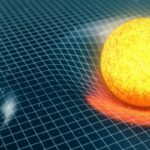
According to the logic of gravitational fields, The presence of a body of mass M generates a field of gravitational forces in the space around it yes which can alter the trajectory of massive objects under its influence.
In fact, if another body of mass M approaches M's gravitational field, we will notice that its motion is altered by the force of gravity. And, according to the theory of relativity, even time itself would be affected by these forces, distorting it and giving rise to singularities such as black holes, astronomical objects whose gravitational fields are so strong that not even light can escape from them.
The gravitational fields were for many years eminently theoretical in nature understood by classical (Newtonian) physics as a vector field, and by relativistic physics as a second-order tensor field, but the discovery in 2016 of gravitational waves by the scientists of the LIGO experiment seems to shed new light on this subject.
Gravitational field intensity

The intensity of the gravitational fields or, in other words, the acceleration of gravity (or simply gravity) It is represented in classical physics by the symbol g and as a field of vectors, that is, of lines endowed with meaning and direction.
It is commonly defined as the force per unit mass that a given particle will experience in the presence of a mass distribution. It is usually expressed in Newtons per kilogram (N/kg).
The formula for its calculation, then, would be:
g = lim m→0 F/m where m would be a test mass and F the gravitational force acting on it.
Gravitational potential
The gravitational potential of a gravitational field is, in Newtonian mechanics, a scalar magnitude measured in joules per kilogram (J/kg) and which is defined as the amount of work per unit of mass necessary to transport a body at a constant speed from infinity to a certain point in the gravitational field in question.
The gravitational potential is calculated based on the following formula:
V = – GM/r where V is the gravitational potential, G is the universal gravitation constant and r is the distance from the point where we want to calculate the potential to the position of the mass M.
Examples of gravitational field

A perfect example of a gravitational field is that of the Solar System, in which the planets orbit the sun attracted by the gravitational forces of its mass.
Another example is the earth's gravitational field the one generated by the planet Earth around it and that we can appreciate every time we drop an object to the ground. The mass of the Earth is approximately 5974 x 1024 kg, which generates a notable gravitational field around it.
It is known that the Earth's gravity is more or less 9.8 N/kg, that is, an acceleration of 9.8m/s towards the center of the Earth. This value may vary slightly depending on geographic location, but assuming it to be constant across the entire Earth's surface is a very good approximation.
Furthermore, the gravitational field will be more intense in the vicinity of the Earth's surface than in the outer layers of the atmosphere.