
We explain what Greek civilization was, how it originated and its forms of government. In addition, its characteristics, religion, art and more.
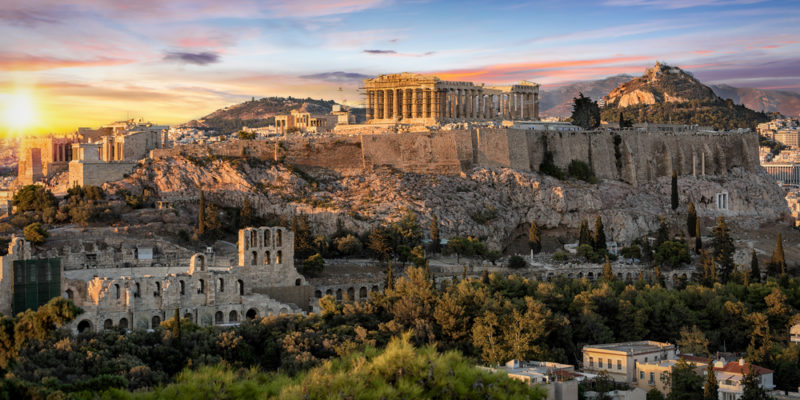
What was the Greek civilization?
Greek civilization It was developed at the northeastern end of the Mediterranean Sea in territories of the current Greece and western Turkey, next to the Aegean and Ionic seas. He also encompassed several islands, such as Crete, Chipre, Rodas, and Sicily (Italy), and some sites in the southern italic peninsula.
Chronologically corresponds to what is usually called ancient Greece, which is subdivided into the following stages: the dark age (1100-750 BC), Archaic Greece (750-480 BC), Classical Greece (480-323 a. C.) and the Hellenistic period (323-30 BC). The beginning of the Greek civilization coincides with the end of mycenaean civilization that he had erected great palaces in continental Greece and on islands like Crete, but suddenly ceased to exist around 1100 a. C. The Greek civilization concluded when the Romans conquered Greece in the second century BC. C. and annexed Egypt (last independent kingdom governed by a dynasty of Greek origin) in the year 30 a. C.
Greek civilization He stood out for his art (sculpture, architecture, ceramics, theater, literature) and for an important philosophical legacy, with thinkers like Socrates, Plato and Aristotle. His contributions exerted influence on the Roman Empire and, subsequently, on the artists and intellectuals of the Renaissance. It is usually considered as the basis of Western culture, which among other things adopted democracy (system of government created in Athens).
Greek civilization was initially Composed of small villages that, from the archaic era, formed cities-states called Polis . Among the most important polis stood out Athens and Sparta. Each polis had its own internal legislation and organization. In addition, the polis played a sports competition called Olympic Games, which is an antecedent of the Olympics that are currently played.

The origin of Greek civilization
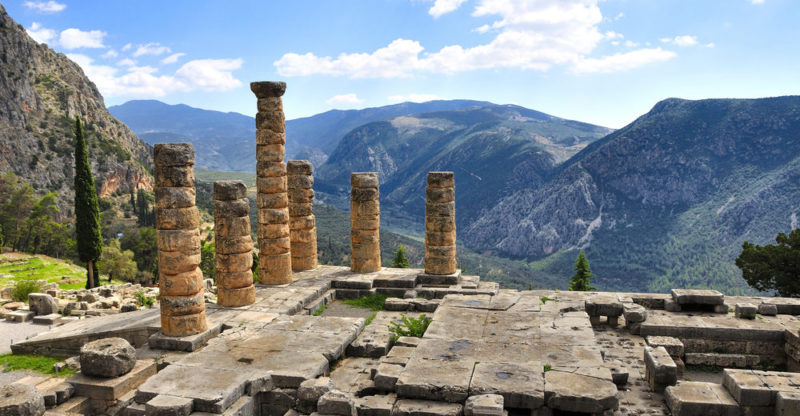
The geography of Greece significantly influenced the development of Greek civilization. Its inhabitants They had limited natural resources but they had access to the sea that, with their abundant water and its islands, was an important source of wealth.
The mountains occupied much of ancient Greece And a few rivers crossed the rocky landscape, so some areas were insufficient for the development of agriculture. These characteristics of the land forced the ancient Greeks to colonize several neighboring islands, where they could cultivate land, and became skilled sailors and merchants. Over time, they colonized other lands throughout the Mediterranean Sea.
The emergence of the polis is usually explained by these characteristics of the land, which facilitated the formation of small independent cities-states, separated from each other, which consisted of a walled city and an agricultural territory, and that shared some cultural guidelines with neighboring cities.

The forms of government in ancient Greece
There were several government systems during the history of Greek civilization, such as:
- The monarchy . It was the government that had as a central figure a king who received the throne through family heritage. In Athens a monarchy headed by a king who governed with a council of nobles, called eupátridas, until the reforms of Solon in the eighth century BC. C. established an oligarchy. In Sparta a diarchy worked, in which two kings were accompanied by an elderly council called Gerusia. The Kingdom of Macedonia, from which Alexander the Great conquered much of the world then known, and the Hellenistic kingdoms that formed after his death, had monarchical systems.
- The oligarchy . It was the type of government that concentrated power in a small group of individuals, usually of the same social class. In Athens, this system was implemented by Solon in the seventh century BC. C., who divided society into classes with different levels of political participation according to their economic income, against the previous system based on belonging to a lineage. The poorest could for the first time vote in an assembly that was called Ecclesia. Some writers of ancient Greece considered the oligarchy a degenerate form of an ideal government model called aristocracy (the “Government of the best”), although the term aristocracy is usually used by historians to refer to the social sectors that possessed lands and hereditary privileges.
- Tyranny . It was the type of government headed by an individual who had taken the power of a polis by force, after overthrowing the preceding government thanks to popular or military support. The tyrant stood out for assuming absolute power and, although some tyrants were unpopular (especially among the aristocracy), others were appreciated by citizens. In Athens, Pisístrato established a tyranny in the middle of the sixth century BC. C., when occupying the government of the polis by force, and although it was tolerated due to their moderation, their children and successors Hipias and Hiparco were repudiated.
- Democracy . It was the modality of government introduced in Athens at the end of the seventh century BC. C. and then adopted in other polis. After the overthrow of the tyrants in Athens, an aristocrat named Clístenes proposed a radical reform to avoid the return of tyranny. Established the principle of isonomy (that is, the legal and political equality of all citizens, regardless of their lineage and wealth) and the territorial division in demoswhose citizens participated in the assemblies. This gave birth to democracy, in which all free men participated politically (but women and slaves remained excluded).
The religion of Greek civilization
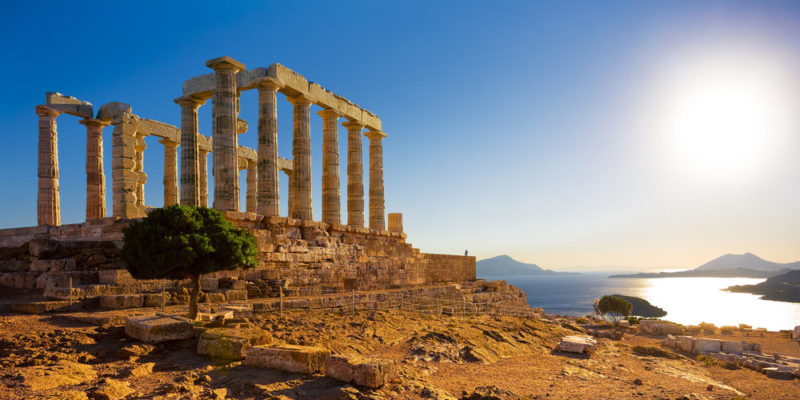
The Greek religion It was polytheistic that is, it was based on the cult of multiple deities that represented natural phenomena (such as thunder, seas and celestial bodies), human practices (such as war, arts and love) or abstract ideas (such as justice and wisdom).
The most important deities were the twelve gods of Olympus, which could vary in their composition but were always under the authority of A supreme god called Zeus God of heaven and thunder and “father of the gods”, who had his throne on Mount Olympus. According to Greek beliefs, the gods constantly intervened in human life. Among them were:
- Athena . Goddess of Arts, Wisdom and War, Patroness of Athens.
- Aphrodite . Goddess of love and beauty.
- Ares . God of war.
- Sagebrush . Goddess of the hunt.
- Apollo . God of art and archery, associated with light and healing.
- Demeter . Goddess of cereals and agriculture.
- Dionisio . God of wine, fertility and fun.
- Hephaest . God of fire and forge.
- Persephone . Goddess of the underworld.
- Poseidon . God of the sea and earthquakes.
The cult of these divinities used to be celebrated in temples and was chaired by priests or priestesses, although there were also domestic forms of worship. There were also the oracles that is, the practice of directing questions to divinities and receiving an answer with the intermediation of a priest or a prophete.
The Greek religion was reflected in art and literature, which allowed historians to know Greek mythology (myths and legends starring gods and heroes which were developed narratively in epopeyas such as Iliad and the Odyssey). In these works, the gods were represented with human bodies and characteristics, with passions and caprices, relating to human beings and half -year -old (such as Heracles, who was the son of Zeus and a mortal woman).
Greek medicine
From the beginning of Greek civilization, the disease was considered a divine punishment, and healing a gift from the gods. However, from the 5th century a. C. Methods were developed to understand the material causes of diseases .
The doctors studied the human body, the connection between cause and effect, which allowed us to relate certain symptoms to certain diseases, and dedicated themselves to testing various treatments. The main contribution was The belief that the patient could control their health based on their diet which contrasted with the fatalistic and spiritual mentality of previous times.
The doctor Hippocrates (460-370 BC) was especially important, and is considered the “father of medicine” . His therapeutic approach was based on the healing power of nature. This doctrine argued that the body contained, naturally, the intrinsic power to heal. Hypocratic therapy was concentrated, then, to facilitate the natural process. Many of Hippocrates’s procedures and classifications influenced posterior European medicine.
Art in ancient Greece

The art of Greek civilization, especially the one that was carried out during the Pericles century (Time of artistic splendor in Athens, when the politician and general pericles ruled, during the 5th century. C.), He exerted a lot of influence in Roman art and, from the Renaissance to the present day, in Western culture.
Different periods of Greek art can be recognized, which differ both by the materials used and by the way of working. For example, the first sculptures of the archaic era were worked in wood, then marble and bronze began to be used and, in the classical era, it was perfected Work with these last materials.
The realistic representation of human figures the influence of mythology on the subjects portrayed (which included the representation of gods), and the manifestation of an ideal of beauty were characteristic of Greek art, especially in sculpture (whose greatest exponent was fidias).
In architecture, The elegance of the proportions in buildings such as temples and theaters stood out which incorporated ornamental details in certain spaces. His styles differ in three orders: Doric, Ionic and Corinthian. However, most of the buildings and sculptures have not lasted to this day, because of wars, looting and earthquakes. A few temples that remain standing, such as the Parthenon and the Temple of Hefesto, in Athens, allow to appreciate the magnitude of their buildings. Many of the Greek sculptures are currently known thanks to copies made by the Romans.
Greek mythology
Greek mythology is a set of stories, myths and legends in which Greek authors They tried to explain the origin of the world and of the customs of ancient Greece. The stories, which often took the form of epic, were starring the gods of Olympus, minor divinities and heroes (humans or halftics), and dealing with rituals, phenomena of nature or aspects of political and social life.
In general, The mythical reasons were transmitted orally in the form of poetry or songs and were represented in sculptures and decorated ceramic containers. The stories that have reached us more completely are those that were collected in writing, such as the epic poems attributed to Homer (the Iliad and the Odyssey) or Hesiod’s works (Theogony and The works and days).
Philosophical thought in ancient Greece
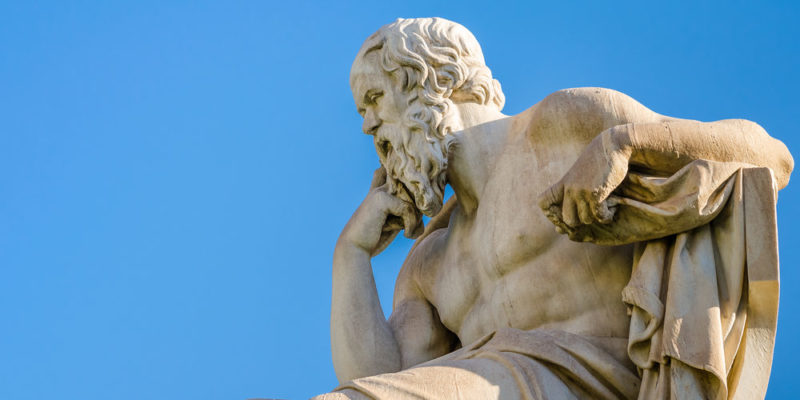
Together with sculpture and architecture, philosophical thought was Another of the great contributions of Greek civilization to the western world . It consisted of thinking based on reason to answer questions about the human being, nature and the universe. Its origins date back to the eighth century BC. C. And its history is divided into 3 stages:
- The presocratic philosophy . This stage was characterized by the resource to rational thinking (the Logos) and the formulation of theories to clarify natural phenomena, against explanations based on divine will. Philosophers were highlighted as Heraclitus of Ephesus and Thales of Miletus, whom Aristotle considered the first philosopher.
- Classical Greek Philosophy . At this stage the focus of the universe was changed to the human being and its institutions, and two trends were distinguished: that of the sophists (skeptics regarding the possibility of really knowing the human being) and that of Socrates and his continuators, such as Plato (disciple of Socrates) and Aristotle (Plato disciple), who believed in the possibility of reaching a true knowledge about the human being, justice, justice. The latter were the thinkers who established the philosophical tradition that most influenced Western culture.
- Hellenistic philosophy . This stage stood out for the concern about the relationship between ethical issues and personal well -being. Numerous schools of thought emerged, such as Platonism (inspired by Plato’s work), cynicism, stoicism or epicureanism.
Other thinkers intervened in other areas of knowledge, which although they did not constitute philosophical activities, were part of the Legacy of Greek civilization to western science and thought such as mathematics (for example, Pythagoras) or history (for example, heodot or thucidides).
References
- Cartwright, M. (2018). Ancient Greek Medicine. World History Encyclopedia. https://www.worldhistory.org/
- Gondek, RM (SF). INTRODUCTION TO ANCIENT GREEK ART. Khan Academy. https://www.khanacademy.org/
- Hornblower, S. (2022). Ancient Greek Civilization. Britannica Encyclopedia. https://www.britannica.com/
- Pollard, J., Thornhill, R. & Adkins, A. (2022). Greek religion. Britannica Encyclopedia. https://www.britannica.com/
- Pomeroy, S., Burstein, S., Donlan, W. & Tolbert, J. (2001). Ancient Greece. Political, social and cultural history. Criticism.


