We explain what inheritance is, the types of inheritance that exist and why it is important. Also, what are genotype and phenotype.

What is inheritance?
In biology and genetics, inheritance is understood as the sum of the processes through which the physical, biochemical or morphological characteristics of living beings are transmitted from parents to their descendants. This transmission It is thanks to genes minimal units of biological information contained in chromosomes and expressed molecularly in the DNA matrix.
The inheritance covers a apparently paradoxical process of constancy and variation : certain general characteristics of the species remain intact over the generations, while a wide variation occurs between individuals of the same species. This is possible because each of them has the same genetic framework (genome) determined by the species, but expressed in an absolutely unique configuration of genes, which only identical twins share.
The genetic content of individuals is replicated during cell division (specifically during nuclear replication) and is susceptible to mutations or alterations, some of which can be transmitted to offspring and others not. These alterations, typical of the random combinatorics of genetic processes, may include ailments, diseases, metabolic patterns and even, perhaps, behavioral traits.
Types of inheritance

Thanks to genetic studies from more than one hundred years of research, today we know that inheritance can occur in four different ways according to the way the genes are arranged inside the chromosomes. These forms are:
- Dominant Those inherited traits that demonstrate a preference for manifesting themselves and that, therefore, are present in the individual's phenotype.
- Recessive Those inherited traits that are present in the genome but not manifest. They can only manifest when they are not in the presence of a dominant gene.
- Codominant In certain cases both characters can be expressed at the same time in a kind of combinatorics, without one dominating and the other being recessive.
- Intermediate Also called partial dominance, it occurs when the dominant gene fails to manifest itself completely and does so only halfway, which results in an intermediate situation, a tie between the half-manifested genes.
Importance of inheritance

genetic inheritance It is vital to the existence and continuity of life as we know it . In fact, it could be said that it is a biological trait that gives purpose to life: the propagation of the species' genome and its gradual adaptation to the environment guarantee that the entire species survives, even if individuals perish.
The inheritance It also allows the evolution to the extent that acquired and successful advantages can be transmitted to offspring, which in radical cases can mean the creation of a completely new one (speciation).
Without inheritance, life would be prevented from growing in complexity and diversification, and species could only aspire to repeat themselves in a vacuum, without being able to transmit the genetic memory of the species to new generations. Without inheritance, reproduction does not make much sense .
Genotype and phenotype
The genome is the genetic framework of the species part of what remains unchanged throughout generations (unless, as occurs in evolution, a variation is produced so radical and successful that it gives rise to the appearance of a new species). Each individual has a unique and unrepeatable expression of said genome, that is, total genetic information of their organism, which we will call genotype.
All nucleated cells in the human body have the entire genotype of the organism in their DNA, except the sexual cells or gametes, which have half of the genetic load, since their purpose is to mix that half genotype with the other half genotype of the opposite gamete. during fertilization (eggs and sperm).
This genotype, on the other hand, is materialized in a series of physical and perceptible characteristics, which form the phenotype individual. However, even though The genotype is the genetic information that primarily governs the phenotype the latter will also be determined by the environment in which the individual develops, so that:
Genotype + Environment = Phenotype.
Thus, some specific conditions of each individual will be attributable to their genotype while others will be the product of the dynamics of changes brought about by their environment.
Examples of inheritance
If we want to see examples of inheritance, It will be enough to go to a genealogical album or to our own family . Those common traits with them (physical resemblance, common diseases or weaknesses, eye or hair color) are contained in our genome because we receive them from our parents, through the load of their DNA used to create ours.
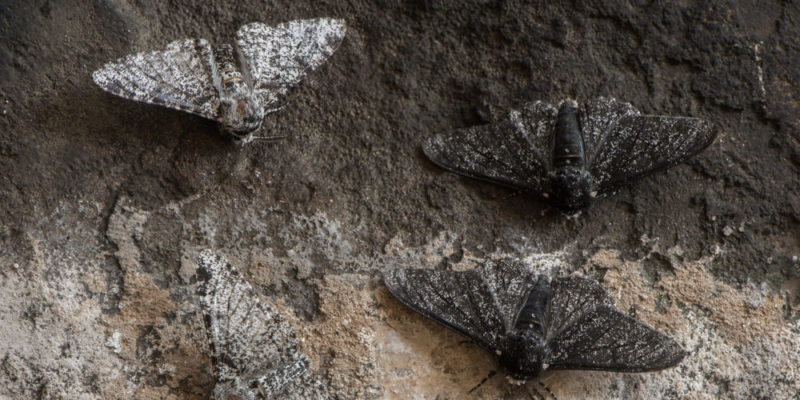
Another example of inheritance is evolution by natural selection . A famous case is that of the birch butterflies in England during the Industrial Revolution, when factories and smog began to fill the air and tree trunks. These pale-colored butterflies stood out on the walls darkened by soot and were therefore easier prey for predators. Such environmental pressure caused a change in the pigmentation of the butterflies, which thereafter changed their colors to a dull gray or brown. Being less detectable, the butterflies proliferated and reproduced, transmitting the dark color genes to their offspring, which in turn guaranteed them a greater probability of subsistence.
References
- “Genetic inheritance” on Wikipedia.
- “Genetic inheritance” (video) Educatina.
- “Types of inheritance” in lagenetica.info.
- “Introduction to heredity” (video) on Khan Academy.
- “Genetics: The Study of Heredity” on LiveScience.
- “Heredity” in The Encyclopaedia Britannica.