We tell you who the pre-Socratic philosophers were, their ideas and schools. Also, the origin of philosophy and logos.

Who were the pre-Socratic philosophers?
The pre-Socratic philosophers, such as Thales of Miletus or Heraclitus of Ephesus, were the first Greek philosophers. They are called “pre-Socratics” because they lived in the time before Socrates (470-399 BC). . Most lived in the 6th century BC. C., on the coast of Asia Minor, in the cities of Miletus, Samos, Colophon and Ephesus. They are also known as the philosophers of nature or the philosophers of logos.
His writings, although most have been lost, range from philosophy to astronomy, cosmology and physics. His thoughts reach us through the testimony of Plato, Aristotle and some doxographers (compilers of opinions) such as Diogenes Laertius (180-240 AD).
The most important contribution of the pre-Socratic philosophers is in having made the transition from myth to logos, that is, they sought a philosophical-scientific explanation for the origin of the world. To do this, they carried out a “rational” reading of the myths. This means that they asked about the nature or reason for being of things, their origin, form and effects.
The main concern of the pre-Socratic philosophers was with nature. They wanted to explain their origin, as well as the order of all things and their presence in the world. . This is the reason why they are known as the philosophers of nature, even though at that time they spoke of physiswhich is not natural but the totality of the world, of the cosmos.

The passage from myth to logos
The passage from myth to logos is an expression used to talk about the origin of philosophy. It is understood as the end of mythical and religious explanations and their replacement by rational thought, both philosophical and scientific.
Plato, in Theaetetusone of his dialogues, stated that the origin of philosophy was in the admiration that men had produced by the order that existed in the apparent chaos of the world.
Ancient philosophy emerged in Greece around the 6th century BC. C. The school of Miletus (Tales, Anaximander and Anaximenes) is credited with the first attempt to give a rational explanation of reality. These thinkers believed that behind the apparent chaos of world events there must be an order, a force that regulates all things.
However, in its origins, philosophy was close to other forms of knowledge, such as myth, religion or poetry. Myths, extraordinary stories about gods and heroes, sought to provide answers to different concerns that arose from questions about the divine or the nature of good and evil. The difference with philosophy lies in the fact that myths did not appeal to rational arguments to find their explanations of the world, but to the fantastic and different elements of the order of the marvelous.
The rise of philosophy in ancient Greece meant transforming mythical explanation into rational explanation, just as the pre-Socratic philosophers of the 6th century did. to. C., like Thales, Parmenides and Heraclitus. This did not mean that myths disappeared from Greek thought, but rather that they began to occupy a place of lesser importance.
Most authors specialized in pre-Socratic philosophy maintain that the passage from myth to logos did not occur due to a “Greek miracle”, as some authors such as John Burnet, a Scottish philologist, have suggested. On the contrary, it is assumed that the second version of the Theogony of Homer, where the struggle for order was not the work of the gods but of natural principles, functioned as a philosophical model for the abstractions of the Ionian physicists. Although philosophy is not reduced to a rationalization of myths, the influence they had on it is recognized, especially in its beginnings.
The pre-Socratic philosophers
The first philosophers lived during the 6th century BC. C., on the coast of Asia Minor. Cities such as Miletus, Samos, Colophon and Ephesus were the setting for the emergence of the first philosophical works, today attributed to the pre-Socratic philosophers, since their thinking occurred before that of Socrates (470-399 BC), in the 5th century.
The pre-Socratics are philosophers as well as physicists or cosmologists. Opposing epic and mythical thinking, their explanations of the world are often oriented toward physical conceptions of nature. However, there are some exceptions, such as Parmenides' poem on Being, or Heraclitus' speech on logos.
Although the thinkers of the time shared some common characteristics, such as trying to capture an explanatory principle of reality, concern for the order of the cosmos and the question of nature as physisthey cannot all be grouped under the same category.
Thales and the philosophers of Miletus
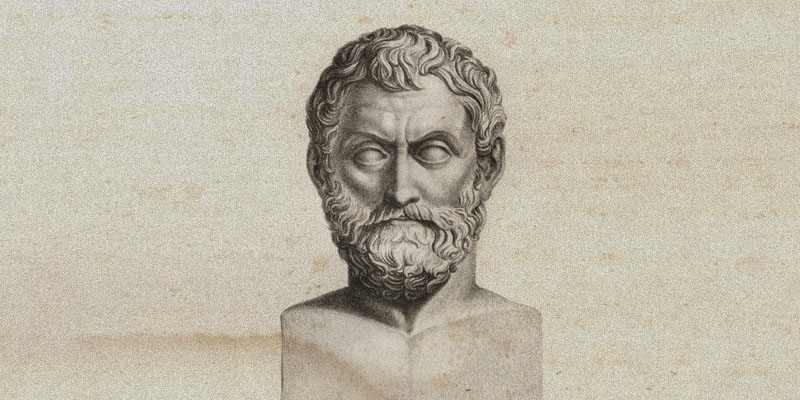
Thales, Anaximander and Anaximenes lived in the city of Miletus. All three searched for a principle or arkhé (“beginning” or “origin”) common to all things that could explain the changes and multiplicity observed in nature.
The best known among the thinkers of Miletus was Thales, considered by historians of philosophy to be the first philosopher. Thales was a legislator, mathematician and astronomer who was born in 640 BC. C. and is known as one of the seven wise men of Greece.
Thales is famous for having introduced the concepts of physis (nature as a whole) and arkhe (principle of things) to philosophy. While the physis indicates the natural process by which something becomes what it is, the arkhe It is the principle or origin from which that thing springs. For Thales, the arkhe of nature was water, an element that he postulated as the principle and origin of all things.
The Miletus or Ionian school was founded by Thales, Anaximander and Anaximenes. Anaximander (610 BC-545 BC) was a disciple of Thales and maintained that the constitutive principle of the world, or arche, was the apeiron, and he defined it as that which is indefinite and unlimited. For his part, Anaximenes (590 BC-524 BC) maintained that the constituent element of the universe was air.
This school is considered the oldest in Greece and was characterized by studying nature and the constitutive principle of the world, which is why these philosophers are known as “physicists.” The Milesian philosophers were the first to suppose that through the exercise of rational thought explanations could be found for the nature of things.
Pythagoras and the Pythagoreans
Pythagoras was a Greek thinker who was born on the island of Samos in 570 BC. C. He was the creator of the theorem that bears his name and founder of the Pythagorean school. It is believed that he was a disciple of Chaldeans and learned men from Syria. Also mentioned are Pherecydes of Syros, Thales of Miletus and, finally, his disciple, Anaximander.
Many myths and legends were formed around the life of Pythagoras, which were collected by some Neoplatonic and Neopythagorean philosophers. The most extensive work on his life dates from the 3rd century AD. C. and was written by Diogenes Laertius and Porphyrio. About Pythagorean lifeby Iamblichus, is also a valuable text on the life of Pythagoras.
In Pythagorean thought there are two very important concepts: the cosmos and numbers. The concept of the cosmos is what speaks of the order and harmony present in nature, whose origin or arkhé was in numbers. The Pythagoreans believed that the principles of mathematics were also the principles of all things.
Heraclitus of Ephesus
Heraclitus of Ephesus was born in 544 BC. C. and was a philosopher from the Ionian city of Ephesus. This thinker earned the nickname “the dark one” because of how difficult it is to understand his texts and opinions, since they are presented in an enigmatic and oracular way, as the fortune teller of Delphi did. From the work of Heraclitus, written in prose in a book called From nature130 short fragments are preserved.
He proposed that above all things there was logosa word that means “explain”, “speak”, “show what it is” or even “reason”. For the philosopher, the logos It was the truth behind nature. Due to its hidden essence, it was necessary to begin studying the logos to discover the truth.
On the other hand, and to explain the change in the future of the world, Heraclitus stated that “everything flows” (Πάντα ῥεῖ) and that “you will not be able to bathe twice in the same river.” He believed, when observing the change of the world, that in that change was the essence of all things.
Furthermore, he used the metaphor of fire to explain how everything could be transformed, which is why many thinkers believe that he postulated fire as the arkhe of the cosmos.
Parmenides and the school of Elea
Parmenides was born in 520 BC. C. and died in 450 BC. C. He is the author of the poem About Natureand 170 verses or fragments of his work are preserved, divided into three large parts according to their topic (the beginning of the journey, the doctrine of truth and the path to opinion). He opposed the theory of opposites attributed to Heraclitus and decreed that only what is exists.
Parmenides' poem speaks of two paths, that of truth and that of opinion. The path or way of truth is what will lead the philosopher to discover the doctrine of Being, which establishes that being is and non-being is not. There Parmenides deals with “what is” and argues in favor of the attributes of entities. The other way is that of the opinions of mortals, where it deals with astrology, meteorology and geography.
He is also known for being the teacher of Zeno, who wrote several aporias (among them, the most famous is that of Achilles and the tortoise). Zeno was part of the Eleatic school, which holds that sensible things are a single immutable substance. Xenophanes of Colophon and Melissus of Samos were also Eleatic.
References
- Guthrie, W. (1953). The Greek philosophers. From Thales to Aristotle. FCE.
- Guthrie, W. (1984). History of Greek Philosophy, vol. I. The first pre-Socratics and the Pythagoreans. Gredos.
- C. Edggers and V. Juliá (1975). The philosophers of Miletus. Buenos Aires.
- Marías, J., Zubiri, X., & and Gasset, JO (1941). History of philosophy (No. B94. M37 1974.). Madrid: Western Magazine.
- Reale, G., & Antiseri, D. (2007). History of philosophy. San Pablo Editorial.
- Hegel, GWF, & Terrón, E. (1971). Introduction to the history of philosophy. Aguilar.