We explain what the rural landscape is, its characteristics, elements and various examples. Also, differences with the urban landscape.

What is the rural landscape?
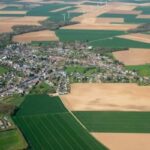
The rural landscape is a space formed by large extensions of land where humans carry out agricultural, livestock and forestry activities, which correspond to the primary economic sector.
It is a country area far from the city but easily accessible which allows maintaining a fluid connection between the two. It usually has few residential spaces where, for the most part, people who work in the fields live.
Every rural landscape is made up of a series of tangible factors (such as the type of crop) and intangible factors (such as the political and economic decisions that impact rural work). The combination of both factors produces different rural spaces or countryside areas that, however, maintain common characteristics.
Rural landscape features

Among the main characteristics of the rural landscape are:
- The cultivated land It is the space intervened by human work, both for cultivation and forestry production, which allocates very little space for the development of infrastructure or public services.
- The reduced public transportation The development of transportation services in rural areas is scarce and of low frequency. Its route usually connects the main routes with the closest towns.
- The low density of the population The rural area has few residential areas, and the homes are very far apart. They are mostly inhabited by employees who work in the fields.
- The abundant vegetation The large number of plants, grasslands and trees spread throughout rural territory uniformly, naturally or through human intervention.
- The division of the land. The rural area has delimited lands that can be minifundios (small agricultural properties that are not very profitable due to the type of soil) or large estates (properties that are large and very profitable due to their nutrient-rich soil).
- The low percentage of environmental pollution The rural area has a reduced level of carbon dioxide and sulfur dioxide emissions, compared to urban areas that have a high concentration of vehicles and transport.
- Rural tourism Country houses and farms are usually a destination requested by people who live in cities, to enjoy tranquility and recreation during the seasons or on weekends.
Rural landscape elements
Rural landscapes are conditioned by geographical features, since not all climates or all types of soil are conducive to the development of rural activity. Among the main elements that make up the rural landscape are:
- The relief It is the set of complex natural forms, for example, the mountain range, the plain, the hill and the valley, that present adequate natural conditions and allow the development of human work for the use of the land.
- The land It is the layer of the Earth's crust that is formed from the decomposition of rocks due to changes in temperature, wind erosion, the action of water, etc., and which, depending on its conditions, may or may not be suitable for the natural development of vegetation or for crops created by humans.
- The minerals They are substances (usually inorganic) that are found in certain portions of the earth, for example, the metal iron, copper and nickel, and non-metals such as sulfur, gypsum and salt. These contribute to giving value to the land because it is rich in nutrients necessary for crops.
- The weather It is the set of atmospheric conditions that characterize a certain region according to temperature, humidity, pressure, wind and precipitation, which make possible the growth of natural vegetation and the work of the land by man.
Examples of rural landscape

Below are some examples of rural landscape:
- Traditional landscapes. They are those rural areas that are characterized by reduced production, although sufficient for self-sufficiency. The land is worked using old techniques, given that the soil and work capacity are limited. They are common landscapes in underdeveloped countries in Africa, Asia and Latin America.
- modern landscapes. They are those rural areas that are characterized by the use of technology applied to the agricultural sector, which makes large-scale production possible. This type of landscape originated in Europe along with the Industrial Revolution and expanded rapidly first in the United States and then throughout the world.
- The revolutionary landscapes They are those rural areas with greater production capacity than modern landscapes, but not necessarily because they have larger territories. These are fields that are exploited to the maximum of their potential, where they work with agricultural practices and technologies applied through the use of fertilizers, pesticides and genetically modified seed varieties that achieve cereals that are more resistant to extreme climates. These practices originated in the United States in 1960 and allowed a notable increase in production, but without paying sufficient attention to nutritional quality.
Rural landscape and urban landscape
The rural landscape consists of an area of harvested fields (for agriculture, deforestation or livestock). These activities allow human development in cities, since they supply them with food and raw materials.
In contrast, The urban landscape is made up of cities of various sizes and population density. Although both landscapes are developed with a great distance between them, they need each other reciprocally for their development and growth.
References
- «Urban and rural landscapes» on ABC.com.py
- “Rural landscapes” at FHUC.unl.edu.ar
- «Characteristics of the natural landscape and its elements» in ABC.com.py
- «Elements of the physical and human landscape» in Cibertareas
- «Rural and urban landscape» in Monografias.com