We explain what Tehran conference was 1943 and what were its results. In addition, the historical context.
What was Tehran's conference?
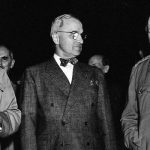
Tehran's conference was A meeting between US president Franklin D. Roosevelt, British Prime Minister Winston Churchill and Soviet leader Iosif Stalin held in the Iranian city of Tehran during World War II (1939-1945).
It took place between November 28 and December 1, 1943 and was the first conference in which the three great allied leaders met personally. They talked about The opening of a second front in Western Europe which was completed with the Normandy landing in June 1944, and on the postwar political order.
While there were some discrepancies between the Western powers and the Soviet Union (USSR), Tehran's conference resulted in several agreements and it was An important step in cooperation between the three major allied countries .

Key points
- The Tehran Conference was held between November 28 and December 1, 1943.
- The United Kingdom leaders (Winston Churchill), the Soviet Union (Iósif Stalin) and the United States (Franklin D. Roosevelt) participated, who headed the side of the allies in World War II (1939-1945).
- It allowed the consolidation of the alliance between the three countries and led to a series of agreements on the imminent allied invasion of France, the future creation of an international organization and the partition of Germany once the war is over.
- See also: Yalta Conference (1945)
The historical context
The German invasion of the Soviet Union in June 1941 caused the entry of the Stalin regime in World War II next to the side of the allies. In December 1941, the Japanese attack on Pearl Harbor caused the entrance of the United States.
Thus, The allies were led by the governments of the United Kingdom, the Soviet Union and the United States whose leaders were known as the great three: Winston Churchill, Iosif Stalin and Franklin D. Roosevelt.
In 1942, The Soviet government began to demand from the Western powers to open a new front in Western Europe to relieve the pressure of the Red Army on the Eastern Front. However, the United Kingdom and the United States decided to concentrate their military efforts in North Africa and, subsequently, in Sicily and Southern Italy.
In October 1943, a conference was held in Moscow attended by the Ministers of Foreign Affairs of the United Kingdom, the Soviet Union and the United States. The Soviet government insisted on the convenience of not delaying the invasion of France and the representatives of the three countries, together with the representative of the China Government, they agreed to form an international organization of countries .
- See also: World War II alliances
Tehran conference decisions

Shortly after the Moscow conference among the Foreign Ministers of the three great allied powers, between November 28 and December 1, 1943 A meeting between the three greats was held in Tehran for the first time that is, Winston Churchill, Iósif Stalin and Franklin D. Roosevelt.
The Tehran Conference It constituted one of the most important steps of cooperation within the Great Alliance (as the alliance between the United Kingdom, the United States and the Soviet Union) was called. The successes of the Soviet army in the Eastern Front and the imminent opening of a second front in Western Europe allowed the first meeting between Stalin, Churchill and Roosevelt to develop in an environment of cordiality.
The main decisions that were taken at the Tehran Conference were the following:
- A commitment from the United Kingdom and the United States to initiate the invasion of France in the coming months.
- An agreement on Germany's partition at the time Hitler's regime was definitely defeated.
- A commitment from the Soviet Union to declare war on Japan once Germany was defeated.
- An agreement for the displacement of Poland west. Despite the initial disagreement of the Western powers, it was finally agreed that the Soviet border would reach the Curzon line and, in return, Poland would be annexed by Eastern territories of Germany to the ODER-Neisse line.
- A debate on the creation of the future United Nations (UN), which continued in other future conferences and negotiations.
References
- Beevor, A. (2012). World War II. Past and present.
- Britannica, Encyclopaedia (2022). Tehrān Conference. Britannica Encyclopedia. https://www.britannica.com/
- Stone, N. (2013). Brief history of World War II. Ariel.
- United States Department of State (SF). The Tehran Conference, 1943. Office of the Historyn. https://history.state.gov/