We explain what food chains are, their characteristics and the types that exist. Also, what is the trophic level and examples.
What are food chains?
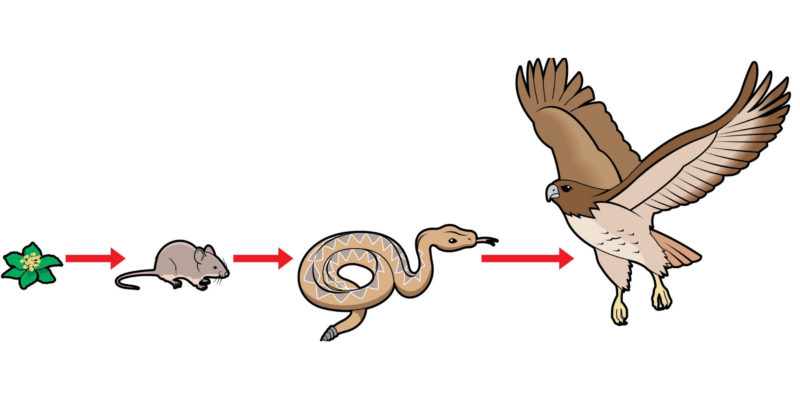
It is known as the trophic chain, food chain or food chain. to the transfer mechanism of organic matter (nutrients) and energy through the different species of living beings that make up a biological community or ecosystem. Its name comes from Greek trophos“feed”, “nurture”.
All biological communities are composed of diverse forms of life related to each other, which share habitat but compete to survive and reproduce, feeding on vegetation, other living beings or decaying matter in a circuit that is usually understood as a chain, since each link depends on the others to survive.
Thus, we can speak of producers, consumers and decomposers in a food chain:
- Producers. They are those that are nourished using inorganic matter and energy sources such as sunlight. This is the case of photosynthesis.
- Consumers On the other hand, they are those that feed on the organic matter of other living beings, whether they are producers (herbivores eat plants) or other consumers (predators eat other animals). Depending on the case, we can respectively speak of primary and secondary consumers (called final if they lack natural predators).
- Decomposers They are, finally, those who collaborate in the recycling of organic matter, reducing it to its most basic components and allowing it to be reused by producers. Fungi, bacteria and insects are the main decomposers.
Characteristics of food chains
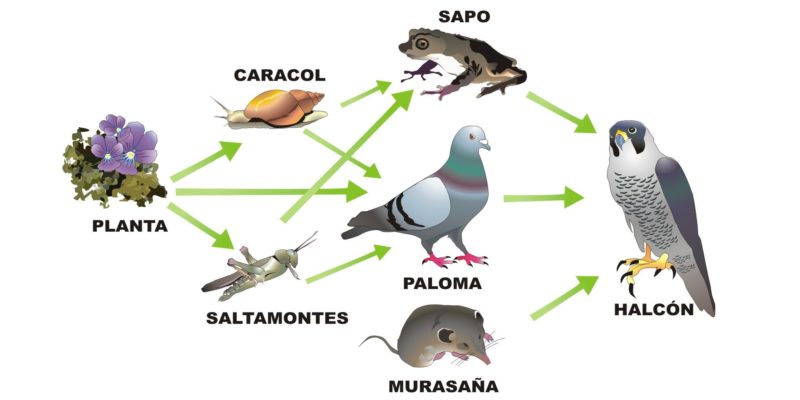
Food chains are, first of all, interdependent. That is, that Its links or trophic levels depend on each other in a cycle that maintains a certain balance, and if lost due to human interference or some type of natural accident, would cause an imbalance capable of extinct species or generating other ecological damage. This occurs especially when invasive species displace local ones, when a key predator becomes extinct to prevent the disorderly proliferation of smaller species, etc.
On the other hand, in food chains a percentage of energy is lost as it passes from one link to another of the chain. That is, when it reaches the final consumer, a significant portion of heat has been lost in the transmission of the material between producer and consumers. In exchange, chemical energy is transformed from one tissue to another: the wolf does not eat grass, but it does eat rabbits, which in turn eat grass. The energy of the grass has reached the wolf transformed, although a portion has been lost along the way.
This can be remedied in some cases, such as the human being, by skipping links in the chain: instead of eating the creature that eats cereals, eat the cereals directly.
Types of food chains
Food chains are generally classified according to the habitat in which they occur, which is why there are usually two different types:
- Terrestrial food chains. Those that take place in different places on the continental shelf, even under the Earth's surface. For example, the food chains of the desert, the humid tropical forest, etc.
- Aquatic food chains Those that occur in marine or lake environments, and that are composed of creatures adapted to aquatic or underwater life at its various levels, such as the coastal food chain or abyssal zones, etc.
trophic level
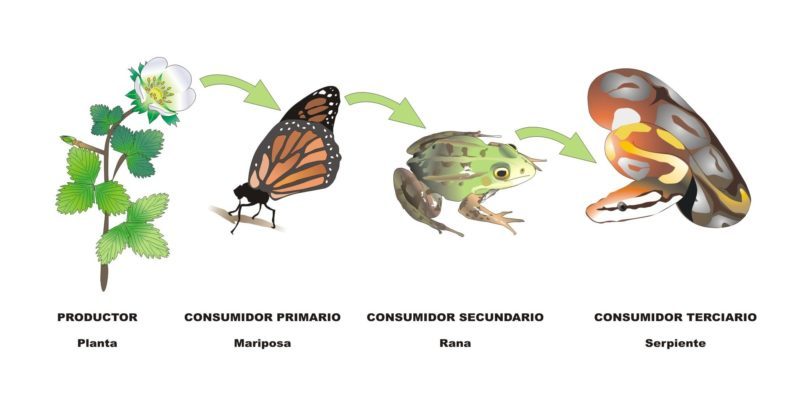
Each step of the food chain is known as a trophic level . In each one are located, imaginary or representationally, the different species that share a feeding activity or a mode of nutrition, and that therefore occupy the same place in the food circuit of the ecosystem.
Trophic levels can be:
- Producers or primary producers Life forms endowed with autotrophic nutrition, that is, capable of synthesizing their own food, such as plants.
- Consumers Those heterotrophic living beings, which must consume the organic matter of others to nourish themselves. They are usually classified into four sub-rungs, which are:
- Primary. Herbivores and other beings that feed on producers directly or on their derivatives (seeds, fruits, etc.).
- Secondary Small predators that feed on primary consumers.
- Tertiary. Larger predators that feed on secondary consumers.
- Quaternary or final Large predators that feed on tertiary or secondary consumers, and that do not have natural predators.
- Decomposers The recycling department of nature, which feeds on carrion, waste, organic matter in the process of decomposition and helps reduce it to its basic materials. They are also called detritophages or saprophages.
trophic pyramid
The trophic or food pyramid is nothing more than a way of representing the trophic chains of an ecosystem in a hierarchical and ordered manner placing the different trophic levels in rows arranged from the base to the top, usually going from the inorganic world of the decomposers to that of the final consumers. As you climb the pyramid, you move in the direction of the energy flow; and when it is lowered from the other side, it advances in the direction of decomposition or restitution.
This provision has the virtue that illustrates very well the numerical proportions between species that make up each step: the decomposers, producers and primary consumers are much more numerous than the final consumers, since otherwise the cycle could not be repeated.
food web

Another way to represent food chains is through a food or food web, in which all the species involved in a habitat or a segment of said habitat are connected through lines of consumption (that is, who eats what or whom). , as a scheme or organization chart.
This type of representation, different from the pyramid, allows tracking the flow of matter or energy between various species rather than general groupings of species.
Examples of food chains
A couple of examples of a food chain could be the following:
- Garden food chain
- Final consumers Toads and birds that feed on insects and caterpillars.
- Primary consumers Caterpillars, ants and other insects that feed on plants or fungi. Also hummingbirds and birds that feed on nectar and fruits.
- Producers. Garden plants that photosynthesize and generate flowers, fruits and seeds.
- Decomposers Fungi, beetles and other insects that feed on fallen leaves, decomposed fruits and the corpses of insects, birds and toads.
- Food chain of the abyssal zone
- Final consumers Larger abyssal fish, which hunt primary consumers.
- Primary consumers Small abyssal fish and jellyfish, which feed on decomposers.
- Producers. They do not exist, since there is no sunlight at such depths.
- Decomposers. Small crustaceans and mollusks that feed on the rain of organic matter that falls from the upper layers of the sea, as well as the corpses of abyssal fish.
References
- “Food chains” on Wikipedia.
- “Food chain” in Conicet Mendoza (Argentina).
- “The food chain” (video) in Happy Learning Spanish.
- “Food chain and food web; terrestrial and aquatic” in Ovacen.
- “Food Chain” in The Encyclopaedia Britannica.