
We explain what an angle is, its types and characteristics. Also, addition, subtraction, multiplication and division with angles and how to measure them.
What is angle?
The angle is the portion of the plane included between two rays (sides) with a common origin called vertex . The angles start from a point and have two lines that come out from that point and that generate an opening represented by an arc. The degree of opening of these arcs (and not their extension) is represented by the angle.
The concept of angle corresponds to geometry, one of the branches of mathematics, but it is also applied in other fields such as engineering, optics or astronomy.
The measurement of angles is carried out using the sexagesimal system which is expressed in degrees (º), minutes (') and seconds (''). One degree is equal to 60 minutes and one minute is equal to 60 seconds. The number of degrees may go up to 360, which is considered the complete rotation of a circle. For example: In the clock with hands, the hands form angles. At 12 o'clock, when the two hands point to the same side, the angle is 0°; at 3 90°; at 6 o'clock 180° and at 9 o'clock 270°.
The angles are represented by a magnitude that can be analyzed and compared with others, so there are operations between angles. You can add and subtract angles from each other or multiply and divide them by whole numbers.
The line that divides an angle into two equal parts is called a bisector and any point on it is equidistant from both sides of the angle.
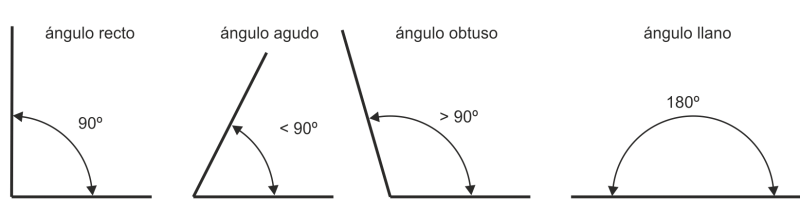
Types of angles

Angles can be classified according to certain criteria.
According to its amplitude:
- Null angle . It is the one that measures 0°.
- Acute angle . It is the one that measures between 0° and 90°.
- Right angle . It is the one that measures 90°.
- Obtuse angle . It is the one that measures between 90° and 180°.
- Flat angle . It is the one that measures 180º.
- concave angle . It is the one that measures more than 180°.
- Full angle . It is the one that measures 360°.
According to the relationship with another angle:
- Supplementary angles . They are angles that add up to 180º.
- Complementary angles . They are angles that add up to 90°.
Depending on your position:
- Consecutive angles . They are angles that share a side and a vertex.
- Adjacent angles . They are consecutive angles and the side they do not share is part of the same line.
- Angles opposite at the vertex . They are angles that share the vertex but none of the sides.
Operations with angles
- Sums between angles . When two or more angles are added, the degrees (and also the minutes and seconds if applicable) of each of the angles must be added. For example:
angle α + angle β = angle γ
90º + 70º = 160º - Subtractions between angles . When subtracting two or more angles, you must subtract the degrees (and also the minutes and seconds if applicable) from each of the angles. For example:
angle γ – angle β = angle α
160º – 70º = 90º - Multiplications with angles . When you multiply an angle by a natural number, you must multiply the degrees, minutes and seconds by that number. In the event that the values of the minutes or seconds exceed 60, those units must be moved to the next scale. For example:
angle α = 40º 10' 20”
angle α x 2 = 40º x 2 + 10' x 2 + 20” x 2 = 80º 20' 40” - Divisions with angles . When you divide an angle by a natural number, you must divide the degrees, minutes, and seconds by that number. At the beginning, you divide the degrees by the number and the remainder obtained is transformed into minutes (by multiplying it by 60) and added to the minutes you already had. The minutes are divided and the rest is added to the seconds that were already there, which are then divided.

How do you measure an angle?
To measure the amplitude of an angle, a measuring instrument called a protractor is needed . The protractor is graduated, can be circular or semicircular and is usually made of plastic. The steps to measure an angle are:
- 1 . The center of the protractor, usually indicated by a slot, should be placed at the vertex of the angle (the origin of the angle).
- 2 . Then it must be confirmed that one of the sides of the angle coincides with the base of the protractor.
- 3 . The graduation of the remaining side is marked on the protractor and that is the amplitude of the angle.
References
- “Angle” in Oxford Learners Dictionary.
- “Angle” on Wikipedia.
- “Angles” in GCF Global.
- “Sexagesimal system” in Hiru.


