
We explain what the bourgeois revolutions, their political and institutional aspects were and what their main characteristics were.

What were bourgeois revolutions?
The bourgeois revolutions were revolutionary movements led by sectors of the bourgeoisie that took place in different scenarios from the end of the 18th century to World War I (1914-1918) and consolidated the political power of the bourgeoisie. The term was adopted by Marxist historians to group a series of phenomena that had similarities but also differences.
The paradigmatic example was the French Revolution (1789) although the revolutions of 1820, 1830 and 1848 in different areas of Europe or the processes of independence in the American regions under English or Hispanic domain were also included in this historiographic category. Some currents argue that their origin can even go back to some revolts of the nascent European bourgeoisie in the medieval urban.
The end of the bourgeois revolution period is marked by some historians in the first stage of The Russian Revolution in 1917, which had an outstanding role of the proletariat and was followed by a second stage in which the Bolshevik party was imposed.
The purpose of bourgeois revolutions, inspired by the ideas of Enlightenment and liberalism, was The conquest of political power by bourgeois sectors with liberal ideas with the objective of ending the limitations imposed by monarchical absolutism to the development of commerce and business, abolishing the privileges of the nobility and clergy, establishing unrestricted respect for private property, and constituting democratic and representative forms of government.
History of bourgeois revolutions
The bourgeois revolutions of the 18th century
While the term “bourgeois revolutions” usually applies to the revolutionary processes that took place from the end of the 18th century, An antecedent is the glorious revolution of 1688 in England . This episode consolidated a system of parliamentary monarchy, promoted a declaration of rights that established limits to the monarchy and the nobility, and promoted freedoms such as religious tolerance and freedom of the press. In addition, it facilitated measures favorable to the interests of merchants and bankers, such as the creation of the Bank of England.
The bourgeois revolutions of the end of the 18th century They are sometimes grouped in an “Atlantic Cycle” . According to this interpretation, the first one was the independence of the United States (1776), which broke the political dependency ties with respect to the British empire and formulated a Republican and Federal Constitution (1787), related to liberal ideas and the economic interests of US settlers.
The French Revolution (1789) was the other prominent episode of this cycle . Bourgeois and peasants rose against the old regime represented by the absolutist monarchy and the feudal socioeconomic order. Influenced by the ideas of the Enlightenment and the nascent liberalism, the French bourgeoisie (merchants, manufacturers of manufacturing, professionals and intellectuals) aspired to hold political power and to establish an order based on the inviolability of private property and in political and economic freedom. Although there were different political movements and trends during the years of the French Revolution, the motto of “Freedom, Equality, Fraternity”, which was adopted by the Republic established in 1792.
The revolutionary wars extended until General Napoleon Bonaparte, who had led French troops in the name of the Republic, ended with the Republican government in 1799 and proclaimed himself Emperor in 1804. When Napoleon was defeated in 1814 by a coalition of European monarchies, France and other nations lived a period of absolutist restoration.
Also It is usually included in this Atlantic cycle of bourgeois revolutions to the Haitian revolution (1791) Already the revolutionary and independence processes Spanish -American from the beginning of the 19th century.
The bourgeois revolutions of the nineteenth century
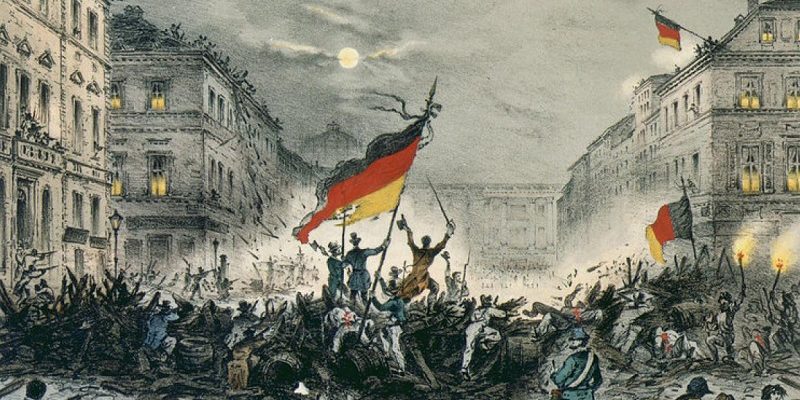
The revolutionary waves of the nineteenth century, recognized by some historians as bourgeois revolutions, were:
- The revolutions of 1820 . They were a liberal reaction against monarchical restoration that had followed Napoleon’s defeat in 1814. This revolutionary phenomenon had its main manifestation in Spain against Bourbon absolutism, which resulted in the liberal triennium (1820-1823) that was later replaced by a new absolutist restoration. In Greece, the War of Independence (1821-1830) began against the Ottoman Empire that had the support of European powers and left the path open to the establishment of a constitutional monarchy.
- The revolutions of 1830 . They were a succession of movements with liberal and nationalist tendencies that spread in countries such as Belgium (which obtained their independence from the Netherlands), Italy, Germany and Poland, most of them failed. These episodes originated in France, where the so -called “Julio Revolution”, starring bourgeois and popular sectors of Paris, overthrew the monarch of Bourbon’s house, established a constitutional monarchy chaired by Luis Felipe de Orleans, and proposed to restore rights and freedoms that had been conquered during the French revolution, among them the principle of national sovereignty.
- The revolutions of 1848 . They were a series of uprisings against European monarchies, generically known as “the spring of the peoples”, which were inspired by nationalism and liberalism and involved bourgeois and popular sectors. For example:
- The struggle for the unification of Germany, which led to the drafting of a Constitution to establish a constitutional monarchy, but was frustrated when the king of Prussia refused to be appointed Emperor of Germany.
- The revolutions in Italy against the Austrian domain and favor of a republican and unification model, which were soon defeated.
- The Hungarian revolution against the Austrian Empire, which came to proclaim independence but was finally defeated.
In France, a coalition of sectors of the little bourgeoisie and the proletariat manifested himself against the monarchy of Luis Felipe de Orleans and managed to establish the Second French Republic. This initially echoed social demands and, after the celebration of elections with masculine universal suffrage, the triumph of conservative sectors caused changes in the government direction that encouraged protests from the lower classes and a repressive reaction of the government. In 1852, the president -elect, Luis Bonaparte (brother of Napoleon), left the republican system and proclaimed emperor.
The February 1917 revolution in Russia (which took place in March, according to the Gregorian calendar) is also considered by some historians as a bourgeois revolution, for its liberal tendency that led to the establishment of a provisional government composed of moderate liberals and socialists.
However, in November of the same year, An insurrection led by the Bolshevique Party, known as October Revolution (According to the Julian calendar), it established a regime change related to the Marxist idea of ”dictatorship of the proletariat.”
Characteristics of bourgeois revolutions
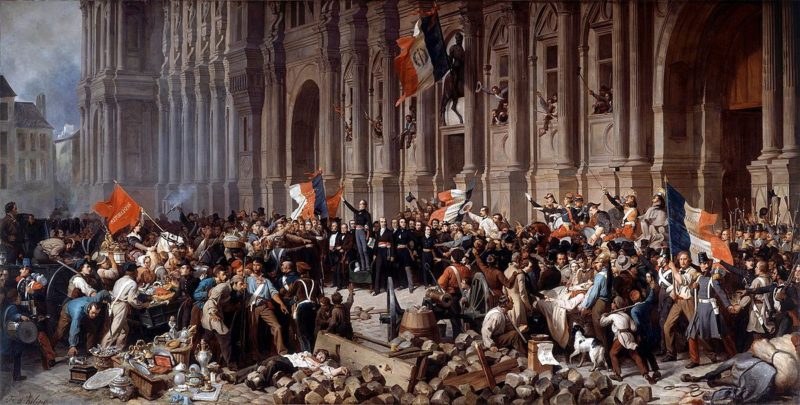
While each revolutionary process had its peculiarities, some general characteristics of bourgeois revolutions can be summarized:
- The bourgeois revolutions were starring bourgeois sectors and, in some cases, also by popular sectors (such as farmers or urban workers). The general objective was the conquest of political power by the bourgeoisie and the implementation of liberal reforms.
- The bourgeois revolutions failed in some cases and triumphed in others, but in general they led to changes in the legal and institutional order, so they allowed the change of the old regime (sustained in the feudal privileges of the nobility, the clergy and the absolute monarchies) by a liberal or bourgeois state.
- The forms that acquired liberal and democratic regimes, established by bourgeois revolutions, were the Republic (with the election of a president through suffrage) or the constitutional monarchy, which retained the figure of a king but limited his power through Parliament.
- The bourgeois revolutions led to a change in the legal structure, which extended political, economic and social rights. Constitutions were drafted that became the supreme law of the State and that proclaimed the rights and duties of individuals, equality before the law, the division of powers (executive, legislative and judicial), and civil and economic freedoms such as the defense of private property.
- The bourgeois revolutions promoted the principle of national sovereignty, which denied the divine right to govern assumed by the absolutist monarchs and, instead, deposited power in citizens. This justified the celebration of democratic elections to the detriment of hereditary rights. However, on many occasions the exercise of this sovereignty did not reach the most disadvantaged sectors of society, because although there were times when the male universal suffrage was implemented, the census suffrage was very common (that is, limited to the people who had a certain amount of properties or who knew how to read and write).
- In some cases, the bourgeois revolutions achieved the satisfaction of social demands of popular sectors, but in the long run the separation of interests between bourgeois and workers (such as workers and day laborers) was extended, which motivated the labor organization and the dissemination of socialism.
- The bourgeois revolutions could or may not resort to the use of violence, but most of the time this was usual. On the other hand, the changes could be implemented immediately or gradual, but given the difficulties of their application due to the restorative reactions, in general they gradually concretized.
Consequences of bourgeois revolutions
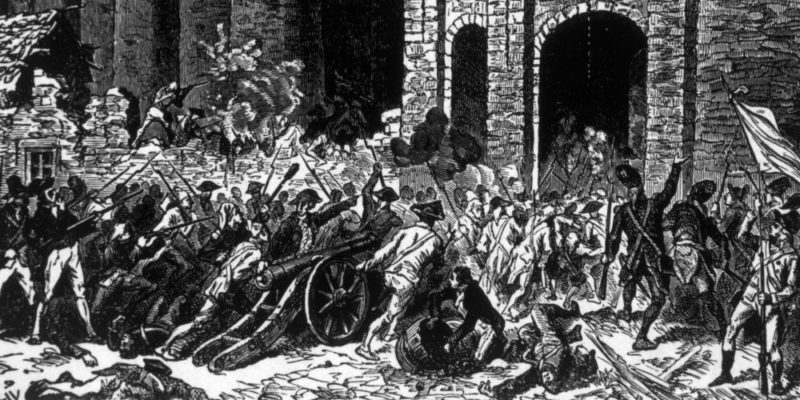
In the United States, Independence regarding the British Empire established a republican and federal regime That he was not exempt from military conflicts, such as the Secession War (1861-1865) that faced the industrial states of the North against the slave states of the South. The triumph of the north allowed the abolition of slavery and the consolidation of the industrial bourgeoisie.
In Europe, some of the bourgeois revolutions were successful at first, But conservative reactions made revolutionary triumphs ephemeral (As demonstrated by the proclamation in France of the first empire in 1804 and the second empire in 1852, or the victories of the absolutist restoration after the revolutions of 1820 and 1830 in various countries).
However, in a context of modernization of the economy and worldwide expansion of capitalism (by the effect of the industrial revolution and the second industrial revolution), The growing political prominence of the bourgeoisie became an irreversible phenomenon . After 1848, some monarchical regimes were forced to adopt liberal or democratic measures, and feudal privileges were generally suppressed, which for some historians marked the end of the time of restoration in Europe.
Some change processes, such as the respective unifications of Italy and Germany or the formation of a Republic in France, were completed in the 1870s. The political participation of bourgeois sectors (liberal or conservative) characterized the final decades of the nineteenth century and the twentieth century.
The bourgeois revolutions were also important for the history of socialism and the labor organization. According to some interpretations, the joint participation of workers and bourgeois sectors in some episodes such as the 1848 revolution in France, and the subsequent separation of these sectors when the Republican government took a conservative turn, contributed to granting a consciousness to the proletariat as a class with interests contrary to those of the bourgeoisie. This could influence the deployment of the political activity of the labor movement during the second half of the nineteenth century.
- Continue with: Contemporary age
References
- Britannica, Encyclopaedia (2022). French Revolution. Britannica Encyclopedia. https://www.britannica.com
- Britannica, Encyclopaedia (2022). Revolutions of 1848. Britannica Encyclopedia. https://www.britannica.com
- Hobsbawm, E. (1997). The Age of the Revolution (1789-1848). Criticism.
- Jones, P. (1991). The 1848 Revolutions. Routledge.


