We explain what the cause and effect relationship is, what linguistic connectors indicate it and how to make an Ishikawa diagram.

What is the cause and effect relationship?
The relationship between cause and effect refers to the concept of causality . The notions of cause and effect are among the most fundamental in our way of thinking, and they help us understand the reality that surrounds us.
However, there is really no single concept of “cause” or “effect,” other than that the cause is that which produces the effect and logically the effect will be that which depends on the cause to exist or occur.
However, there are causality (or cause-effect) relationships in nature, and we usually recognize them because the cause precedes the effect in time. However, the relationship between the two is not necessarily obvious, or simple, and the same effect can have numerous causes, or the same cause can have numerous effects .
Since ancient times, the notion of causality has attracted our attention. The philosopher Aristotle, from Classical Greece, already asked about this in his book of the Analytical seconds (part of Organon), where he distinguished four types of causes:
- material cause
- formal cause
- efficient cause
- final cause
The very concept of causality suffered attacks at the hands of much later philosophers, such as David Hume in the 18th century. However, was an indispensable part of scientific reasoning under the name of Concept of causality: Absolutely everything in nature has a cause and an effect, even when some of the two (especially the causes) are not easily discernible.
Examples of cause and effect

Virtually everything is a possible example of cause-effect in the world. However, it becomes more evident in cases such as the following:
- A lightning (effect) occurs due to a electric potential difference between the atmosphere and the ground (cause).
- death by drowning (effect) is produced by the lung incapacity of extracting oxygen from the water (cause).
- He fire (effect) can occur in a variety of situations involving chemical reactions combustion (causes).
- He pregnancy unwanted (effect) is a consequence of the intercourse without protection (cause).
Cause and effect connectors
Already at the linguistic level, the cause-effect relationship occurs as a logical order within the text. That is, that we can establish it by using certain connecting particles (connections) that indicate to the reader that something is the effect of something else. These particles are known as causal links and are:
| Cause | Effect |
|---|---|
| because | therefore |
| well | therefore |
| since | therefore |
| given that | luckily |
| because of | so that |
| considering | so that |
| in the assumption that | because |
| so that | by |
Recognize cause and effect in a text
Once we have seen the above, it is not difficult to find the cause-effect relationships in a text, since it is enough to look for the presence of the indicator links . For example, in the following text:
«The Meiji Restoration Bakumatsu no Dōran (end of the shōgun regime) was the political succession that brought the Tokugawa Shogunate to its end, so that the power of government of Japan was renewed to the emperor, because had given in to the figure of the shogun. This regime was very similar to European feudalism: the emperor did not have real power but depended on the most important daimyō (feudal lord or landowner of important families). This was titled shogun, which is the highest rank that a daimyō could obtain. That's why The political regime was called shogunate.
Ishikawa cause-effect diagram
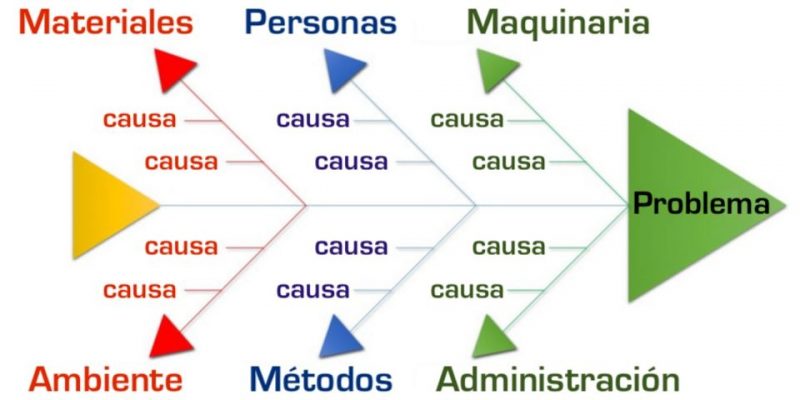
Cause-effect diagrams, also called Ishikawa diagrams or fishtail diagrams, They are simple graphic representations of the set of cause-effect relationships that intervene in the same process. from its variables.
It is a tool used in General Systems Theory, which represents the causes and effects as inputs and outputs that intervene in the process, as well as the feedback dynamics (feedback) that they produce and that are necessary for the control of the system.
Its name comes from its creator, Kaoru Ishikawa, who deduced that all the causes of a company's problems can be summarized in four categories: people, materials, machinery and processes or methods, and proceeded to graph them in a way that allowed them to be understood. more complete and simple.
How to make an Ishikawa diagram?
To make an Ishikawa diagram, simply follow these steps:
- HE copy the diagram -blank mold.
- It is written on the head of the fish (that is, on the right side of the diagram) the problem that you want to analyze.
- They identify the causal categories of the problem whether the four proposed by Ishikawa, or other new ones.
- They are written in each category the different causes specific to the problem that correspond to each specific category. For example, if one of the causes of the problem is the lack of availability of trained personnel, this is noted under “people.”
- The different causes are organized between causes and subcauses, that is, they are hierarchized to know which ones generate which others. Like this until the diagram is completed.
- Once the diagram is complete, the causes that are under our control are chosen and those that don't. The first will be the only ones that we can solve, taking into account their position in the diagram so as not to generate new problems.
References
- “Causation (philosophy)” on Wikipedia.
- “Ishikawa diagram” on Wikipedia.
- “Connectors (linguistics)” on Wikipedia.
- “Cause-effect relationship” in Parles.upf.
- “Cause and effect diagram” in Administrative Science and Technique (CyTA).