We explain what Greek mythology is and which gods make up these ancient stories. Also, its origin and main characters.
What is Greek mythology?
Greek mythology is made up of the set of stories, myths and legends which were created in Ancient Greece (c. 1200 BC-146 BC), considered the cultural cradle of Western civilization.
It is collected in a diverse set of texts that survived until today, in which it is evident How the ancient Greeks explained the world they practiced their religion and represented their culture and values. Many themes from Greek mythology also survived in sculptures, illustrations, ceramic decorations, and other forms of art.
The stories that make up Greek mythology were initially disclosed orally since in many cases they were prior to the invention of writing. These stories were recited by aedos (artists who sang epics accompanied by the lyre).
The myths were transmitted from generation to generation, and were later captured and versioned in writing.
Some mythological stories founded Greek literature, in particular the epic poems attributed to Homer: the Iliad and the Odyssey whose events occur during the Trojan War and the years after the conflict. Also Hesiod's poems about the genesis of the world, the gods and the Greek kingdoms: the Theogony and the Jobs and days.
Another important source to learn about these myths is the plays of the great playwrights of Ancient Greece: Sophocles, Euripides and Aeschylus. In these pieces, episodes relating to the mythical and heroic tradition are recounted, particularly in the form of tragedies: stories about the fall from grace of heroes, in which the gods usually intervene.
Key points
- Greek mythology is the set of stories that deal with the gods, heroes and other mythical characters of the ancient Greek worldview.
- The main figures of Greek mythology are the gods of Olympus, headed by Zeus, and heroes such as Heracles, Achilles and Odysseus.
- Originally the Greek stories were oral but later they were written down in literary works such as those of Homer and Hesiod.
- Some of its themes are the origin of the world, the genealogy of the gods, the fights between gods and between humans and certain reflections on morality and values.
Origin of Greek mythology
There are various theories about the origin of Greek mythology. Some establish that the narrated events come from real events that were narrated in a way that was increasingly linked to the divine. Others propose that they were simply interpretations of myths included in older sacred texts, or even that they were allegories of a natural cult.
However, it is known that the ancient Greeks were partly inspired by the imagination of other neighboring civilizations of the Asia Lesser and the Middle East and of civilizations prior to the Hellenic in the Aegean, such as the Mycenaean and the Minoan.
Gods of Greek mythology
The ancient Greeks believed in a varied pantheon of gods. According to mythology, The most important gods resided on Olympus the highest mountain in Greece. After defeating their progenitors – the previous generation of gods, known as titans – the gods of Olympus assumed control of the world.
The main Olympian gods were twelve although this list varies according to different sources, so there are more than twelve names associated with Olympus. These gods had their counterpart in Roman mythology, where they adopted other names. Although they were gods, they had attitudes and desires that matched those of humans.
| greek god | Name of the god in Roman mythology | God of… | Characteristics |
|---|---|---|---|
| Zeus | Jupiter | God of sky and thunder | King of the gods of Olympus and father of many of them, brother of Hades and Poseidon. He was Hera's husband and had many human and divine lovers. |
| Hera | Juno | Goddess of marriage, family unity and female fertility. | Wife of Zeus, she often exacted revenge for her husband's infidelities by punishing her lovers or illegitimate children, making her the antagonist of many heroes. |
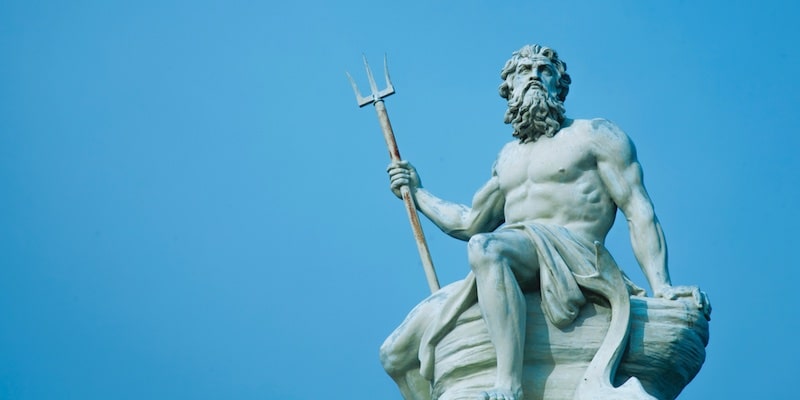
| Poseidon | Neptune | God of water and oceans, earthquakes and horses | He was represented with a trident in his hand. |
| Dionysus | Bacchus | God of wine, celebration and ecstasy. | Patron of the theater and one of the youngest gods of Olympus, son of Zeus and a mortal woman. |
| Apollo | Phoebus | Solar god, of light, knowledge and medicine, archery, music and prophecy. | Son of Zeus and brother of Artemis, he was also associated with beauty. |
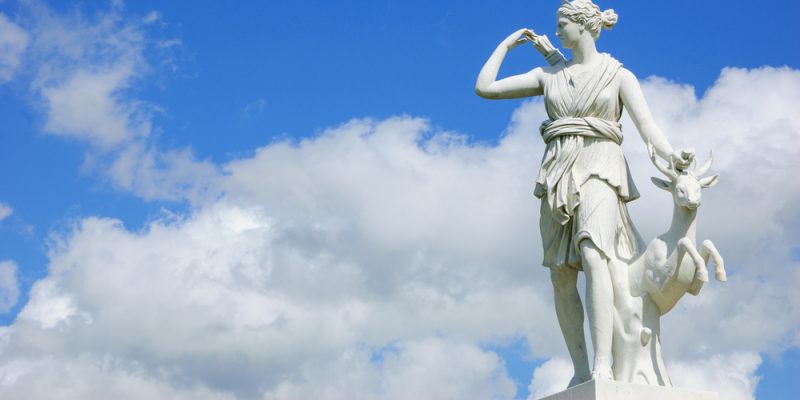
| Sagebrush | Diana | Virgin goddess of hunting, nature, childbirth and wild animals. | Twin sister of Apollo, she lived surrounded by nymphs and was represented accompanied by a fawn. |
| Hermes | Mercury | God of travel, messages, borders, commerce and flocks. | The messenger of the gods, patron of commerce, rhetoric and thieves, guide of souls to Hades, represented with a helmet and winged sandals. |
| Athena | Minerva | Goddess of war, wisdom and crafts, patron saint of Athens | Often depicted with armor, helmet, shield and spear, and sometimes with an owl. He was born from the head of Zeus, after he swallowed the nymph Metis, pregnant with Athena. |
| Ares | Mars | God of war, violence and bloodshed | Many times despised by the other gods except for Aphrodite, with whom he had an affair. |
| Aphrodite | Venus | Goddess of carnal love, beauty and desire | Born from the foam of the sea after the titan Cronus cut off the testicles of her father Uranus and threw them into the water. Wife of Hephaestus, she was unfaithful to him with many, including Ares. |
| Hephaestus | Vulcan | God of the forge and fire, of blacksmiths and craftsmen and of metal | Son of Hera (with Zeus, in some versions of the myth). He was thrown from Mount Olympus at birth, he later returned but was left with a limp. |
| Demeter | Ceres | Goddess of agriculture, fertility, climatic seasons and nature. | His daughter Persephone was kidnapped by Hades and forced to spend half the year in the underworld and the other half on earth. Demeter's sadness when she lost her daughter brought winter, her joy when she got her back ushered in spring. |
| Hades | Pluto | God of the kingdom of the dead, the underworld, mining and earthly riches. | He is often not included among the Olympians because he resides in a separate kingdom. |
Other characters from Greek mythology
Apart from the gods of Olympus, some of the most important characters in Greek mythology were:
- Heracles (Hercules in Roman mythology) . Son of Zeus and a mortal princess, he was a demigod hated by Hera, wife of Zeus, who pushed him to have to do twelve jobs. He was the most admired of the Greek heroes, noted for his strength.
- Helen of Troy . Daughter of Zeus and considered the most beautiful woman in Greece, she was kidnapped or fled from the palace of her husband Menelaus with the young Trojan Paris, an event that triggered the Trojan War.
- Achilles . Son of the mortal Peleus and a nymph, he was invulnerable except for one of his heels. He was one of the heroes of the Trojan War, where he died when an arrow hit him in his heel.
- Persephone . Daughter of Zeus and Demeter, she was kidnapped by Hades to be his wife, and he reached an agreement with him: part of the year she would spend in the underworld and the other part on earth with her mother, which gave rise to the seasons.
- Odysseus (Ulysses in Roman mythology) . He was a king and hero of Ithaca who participated in the Trojan War and undertook a long journey back to his home that was recounted in the Odyssey attributed to Homer.
- Oedipus . He was king of Thebes after mistakenly murdering his own father and marrying his mother, with whom he had children. Upon learning of his crimes, he gouged out his eyes and went into exile.
References
- Graves, R. (1985). Greek myths. Hyspamerica.
- Grimal, P. (1981). Dictionary of Greek and Roman mythology. Paidós.
- Pollard, J.R.T. & Adkins, A.W.H. (2023). Greek mythology. Encyclopedia Britannica. https://www.britannica.com/
- Pomeroy, S.B. et al. (2001). Ancient Greece. Political, social and cultural history. Criticism,