We explain what growth is and its specific meaning in human development, economics, demography and mathematics.
What is growth?
If we look up the term growth in a dictionary, we will see that basically is synonymous with increase, increase, promotion or accumulation . It is used in many different specific fields, such as biology, economics, mathematics or demography, to name just the most common cases.
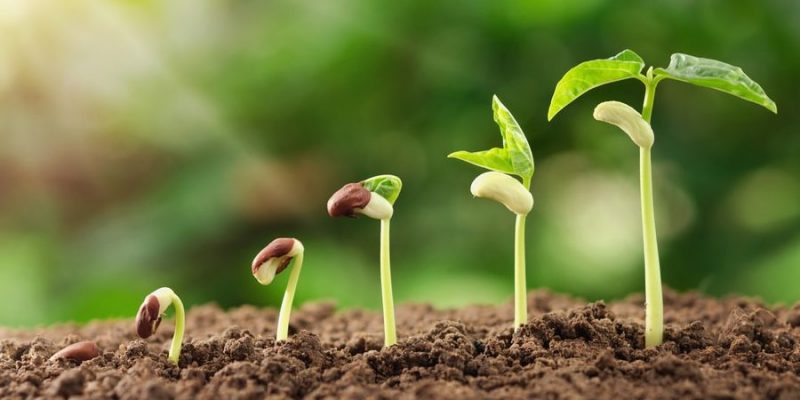
We all know, in one way or another, the experience of growth, which It is inherent above all to living beings : As time passes we increase in size, capabilities and change irreversibly.
It happens with plants that emerge from the seed, animal puppies that soon reach the size of their parents, and even cells grow, as they have nutrients, until they reach the ideal size to reproduce. Growth is a stage of life, contrary, if you will, to aging.
Human growth and development
Human beings begin to grow even before we are born, in our mothers' wombs, as the cells of our body reach the level of development and organization necessary to properly be called a human being. This occurs in the final months of pregnancy, and from birth, the moment in which our independent existence begins, it can be classified into four different stages:
- Breastfeeding which goes from birth to the first years of age, in which the infant receives suckling from the mother's breast. This stage initially presents a momentary weight loss in the newborn (between 5% and 10% of its weight), but after a couple of weeks the human body normally begins a process of rapid and sustained growth, increasing almost to double its weight between the first 4 and 6 months of life.
- The preschool years in which the child will gradually gain autonomy in his actions, learning to walk, communicate and socialize, as he grows at a constant rate and his dietary and nutritional requirements increase, since his brain and metabolism are working at full speed .
- The middle stage of childhood which is between 6 and 10 years old, is a stage of plateauing of the child's growth, in which they are normally immersed in school interaction and in the initial definitions of their personality. This is the stage of preparation for the radical changes of adolescence.
- adolescence the stage of the most profound and radical changes in human life, acts as an intermediate step between childhood and adulthood. Normally, adolescence extends between 12 and 18 years, during which the body experiences changes in its physical appearance, its internal functioning and its sexual preparation or reproductive maturation. The differences between men and women become present from this moment on, becoming accentuated with the passage of time, and the gigantic hormonal discharge of the developing body implies a more complex, risky and, occasionally, painful socialization. Finally, adolescence ends with the entry into adulthood, at which point an individual is considered to have fully grown.
Economic growth
In the field of economics, we speak of growth to refer to the increase in the value of the final goods and services produced by a country or region or to the increase in their income, during a certain period of time.
Generally, this increase is expressed in certain economic indicators, such as production, energy consumption, savings, investment or increased consumption per capita, among other factors that reflect greater commercial activity, and It is usually measured through a figure, known as Gross Domestic Product. (GDP).
Thus, an economy experiencing growth is one that increases the volume of its commercial and financial operations, while one experiencing the opposite is considered to be in “decrease” or at least in “stagnation.” A growing economy is expected to bring with it an improvement in the population's living standards. .
Economic growth can be caused by various economic reasons, such as the discovery of new exploitable resources, technological change, capital accumulation or socio-political stability, and depending on the way in which these factors are articulated, we may be talking about long-term or short-term growth.
Population growth
Regarding the field of demography, that is, the study of populations, population growth is the extent to which a society increases its number of inhabitants . That is, a growing population is one that increases in number over a period of time, which can occur through certain and different processes:
- The increase in birth rate that is, the number of births is greater than the number of deaths in a measured period of time. This occurs when the material conditions are conducive to the formation of families, especially those with numerous offspring.
- Sustained immigration that is, the arrival of new settlers from neighboring nations, cities or regions, attracted by better living or working conditions, or simply fleeing traumatic events in their respective origins.
- Increased longevity which means that people live longer, being able to have more offspring or simply share more time with them. A long-lived population requires more resources and tends toward stability, while populations that experience death at an early age tend to find themselves in conditions of poverty, war, or similar risks that shorten their lives.
Exponential growth
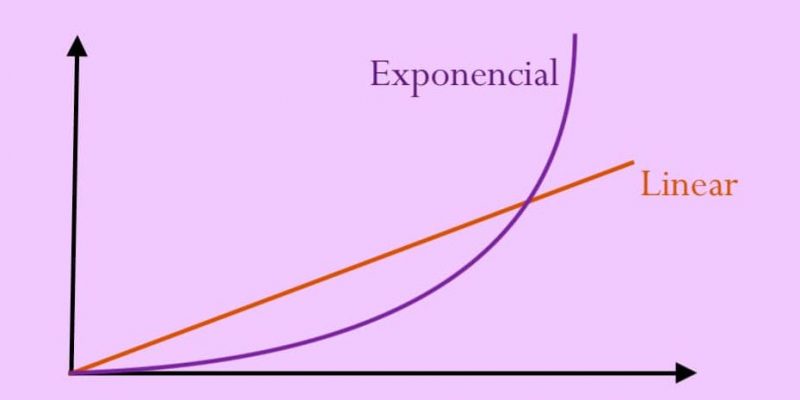
Finally, in mathematics and calculus it is common to speak of exponential growth or continuous growth, when we are in the presence of a magnitude that, over time, experiences an increase proportional to its value that is, it grows faster and faster as time passes.
In the latter It is distinguished from linear growth or constant growth which occurs when the magnitude increases over time at a regular and invariable rate, that is, by adding a constant amount.
As an example, let's imagine a population of bacteria in a culture broth. Normally, microorganisms live 24 hours, a time that allows them to grow and reproduce once, so that where there are 100 bacteria, after 24 hours, another 100 are born (+100%), but at the same time 50 die (- 50%).
This means that the bacteria experience exponential growth: the first day there will be 150, the second 225, the third 338, the fourth 507, etc., since the added amount of new bacteria increases despite being the same unit of time. (24h).
References
- “Human growth” on Wikipedia.
- “Development (biology)” on Wikipedia.
- “Population growth” on Wikipedia.
- “Economic growth” on Wikipedia.
- “Normal growth and development” in Medplus.
- “Economic growth” in The Encyclopaedia Britannica.