
We explain what the Hellenistic period was, how it originated and its main events. In addition, its characteristics, sciences and arts.

What was the Hellenistic period?
It is known as Hellenistic period, or Hellenism to Ancient age stage which covers from the death of Alexander the Great in 323 a. C. until the conquest of the Eastern Mediterranean and Asia Minor by the Roman Republic, in 31 a. C.
This period is marked by the fragmentation of the Alexandrian Empire and the appearance of different independent kingdoms in the territories of Greece, Egypt, Anatolia, Levante, Mesopotamia and Central Asia. In turn, the fusion of Greek culture with Eastern cultures resulted in the creation of a type of new culture, crossed by traditions of different origin. It is a period in which the arts, philosophy and applied sciences had great development, since patronage and stimulus policies were implemented for artists and scholars in different kingdoms.

Characteristics of the Hellenistic period
The main characteristics of the Hellenistic period are:
- The political fragmentation of the Alexandrian Empire.
- The expansion of Greek cultural elements in Asia Minor and the next East.
- The appearance of New cities as political and cultural centers of the ancient world.
- The conformation of New kingdoms under the power of antigónida, ptolema and sealicidal dynasties.
- The development of a religious syncretism which combined beliefs and myths of Greek culture with eastern cults and customs.
Origin of the term “Hellenistic”
The term “Hellenistic” was First used in the work of German historian Johann Gustav Droysen (History of Hellenism1836). “Hellenistic” comes from “Heleno”, a name with which the ancient Greeks called their cultural identity.
The author used this concept to name the Historical process developed from which Greek language and culture extended to the populations of the next east . Chronologically, this process is between the death of Alexander the Great (323 BC) and the Roman conquest of the last Hellenistic kingdom (31 BC). Geographically, it includes the Mediterranean world inhabited by the ancient Greeks and the territories conquered by Alexander the Great and, since then, Hellenized: Asia Minor, Egypt and the next East (from the Levante to the Indo River).
Background
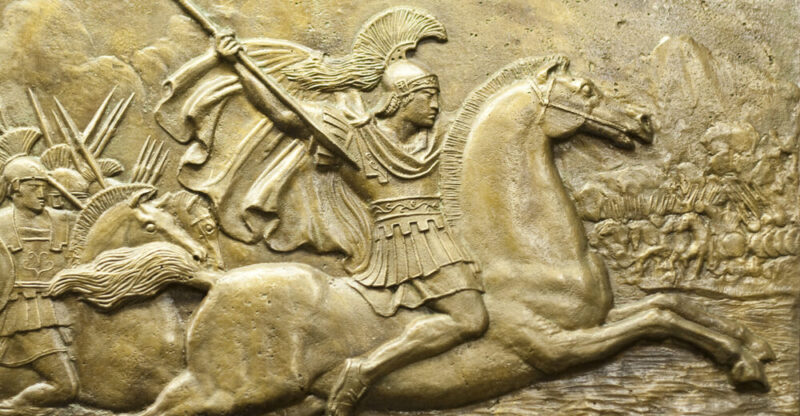
Between 336 and 323 a. C., Alexander the Great, king of Macedonia, built an empire that brought together, for the first time, the most important civilizations in the ancient world . Through a series of military campaigns, he conquered the Greek world, Egypt, the Phoenician cities of Levante, Babylon and the Central Asia Plateau to the Indo River.
During his reign, Alejandro allowed the conquered peoples to maintain their gods, their culture and their traditions ; But, in turn, he launched a policy to try to merge them. He incorporated Persian soldiers and officers to his armies and encouraged the marriage between members of the Macedonia nobility with the local elites of the different regions.
In the year 323 a. C., Alejandro became seriously ill and died within a few days without leaving a defined succession line and with great empire without organizing. After his death, the Macedonian, Egyptian and Persian generals who had formed their core of closest collaborators faced the succession and, consequently, the empire began to disintegrate.
The political organization during the Hellenistic period
After the death of Alexander the Great, The problem of the succession of the throne arose and the difficulty of organizing, managing and integrating such a great empire.
At first, the Diedocos (Macedonian General) and the Army supported the joint designation of Alejandro IV (the newborn son of Alexander the Great) and Philip III (the half -brother of Alexander the Great, who suffered from mental limitations), under the regency of collaborators close to the family group.
However, in fact, this group had no real power and, over time, The personal aspirations of many of the Diedocos led in an internal war by imperial power.
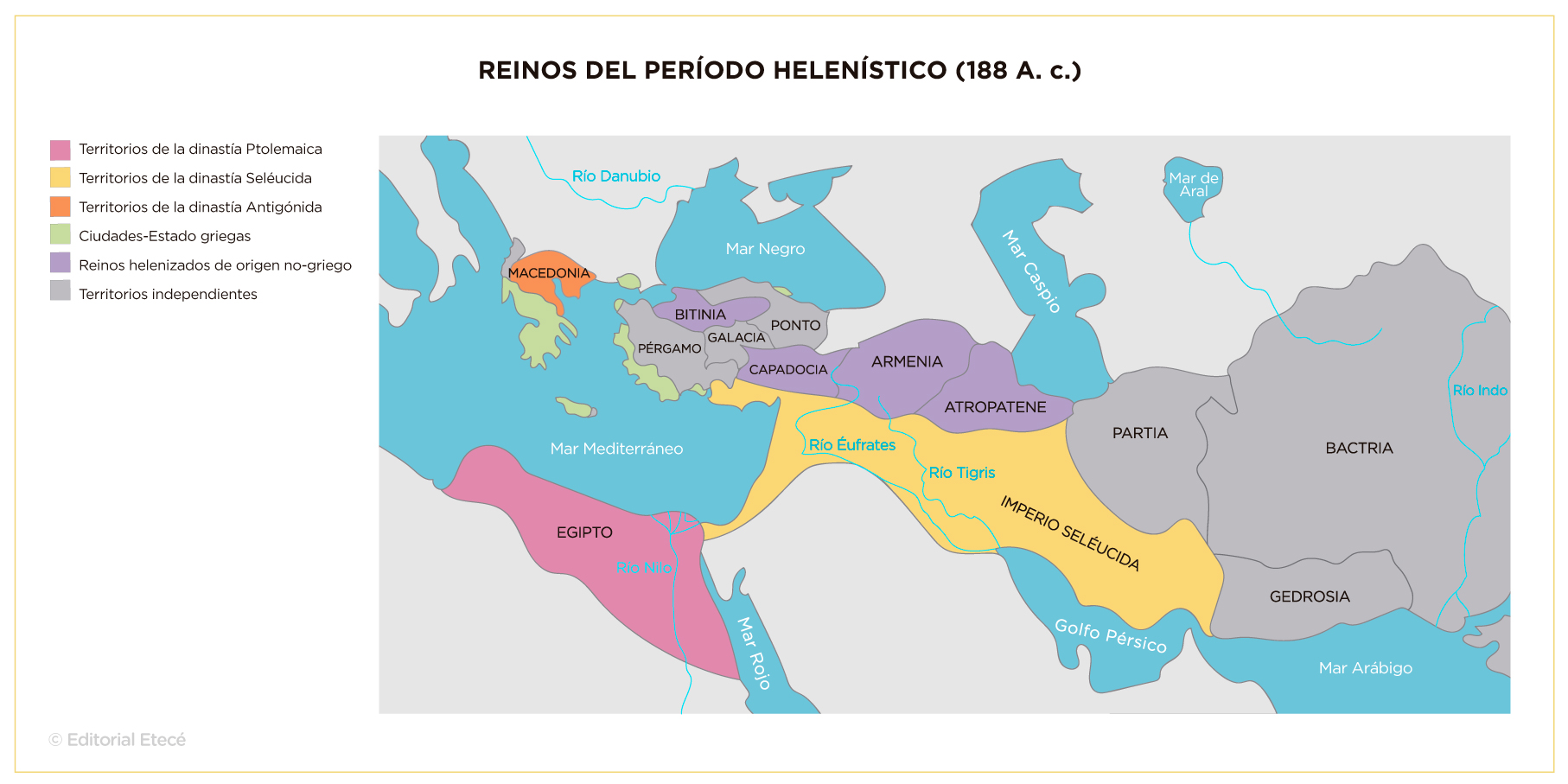
Towards 281 a. C., the internal unit had disintegrated and, instead, several independent states were founded:
- Macedonia which also controlled part of the Greek cities and that was where the antigónidal dynasty was established.
- Egypt with capital in Alexandria, under the Ptolemaic dynasty.
- Seed Empire which integrated the territories of Levante, Mesopotamia and Central Asia, with capital in Antioch.
In addition, other smaller kingdoms were created, such as Pergamum in Anatolia, Armenia and Capadocia.
In the Hellenistic kingdoms, there were no precise rules of succession and Power was achieved through strength and personal imposition . Therefore, conflicts between the various throne candidates and throughout the period were very frequent and the borders were changing.
When the Roman Republic began its territorial expansion towards the East, we found Hellenistic kingdoms weakened by internal disputes and the continuous war between neighboring states.
Hellenistic culture
During the reign of Alexander the Great, the Greek culture was spread that, in turn, was influenced by the cultures of the various civilizations integrated into the empire. There was a fusion of western and oriental elements which led to the appearance of a new hybrid culture, called Hellenism either Hellenistic culture.
The characteristic features of the Hellenistic culture were:
- Religious syncretism . The Hellenistic religion was syncretic, that is, mixed and made the Greek classic pantheon live with gods and deities from the East, such as Tique, Serapis, Isis or Cibeles.
- Promotion of Sciences . The different kingdoms, especially the Egypt of the Ptolemaic dynasty, fostered through the patronage the study and development of different sciences. From this era they date the mathematician and geographer Eratostenes (he established the principles of scientific cartography and calculated the circumference of the earth), the ctesibio physicist (he was a pioneer of ballistics studies), the Herophilic and Erasistrate doctors (they discovered fundamental elements of the anatomy and the nervous, optical and reproductive systems).
- Literature . Literary scholarship, critical study of Greek language and literature was deepened. From this period they date the works of Calimaco, Zenodoto and Aristarco, who prepared the canonical texts of Homer and other poets, which remained studied for centuries.
- Plastic arts . The Hellenistic style reflects the combination of the old and the new. Its main characteristic is variety and experimentation. Hellenistic sculptors perfected the idealized human figure of the classical Greek period, but also produced realistic images of individuals of all ages, gender and social category. There is a deep interest in the individual as a special and unique subject. The production of thousands of terracotta figurines stands out from this period, with a job and a material that made them accessible to much of the population.
- New cultural capitals . The Ptolemaic dynasty of Egypt insisted on making Alexandria the cultural center of the Greek world. The different rulers and their court offered their patronage to the intellectuals, promoted art and founded cultural institutions. Among them, a cultural research center called Museum was created (because it was dedicated to the nine muses, divine patrons of art) and a great library, with the aspiration to possess copies of all books written in Greek. It is believed that the Alexandria library came to house 700,000 papiro rolls. Other important cities for their cultural institutions were Athens, Antioch and Rhodes.
})
References
- Grimal, P. (1992). “Introduction” in The Mediterranean world in the ancient age: Hellenism and the rise of Rome (pp. 3-20). Twenty -first century editors.
- Burstein, SM, Donlan, W., & Pomeroy, SB (2003). “The successors of Alejandro and La Cosmópolis” in The Ancient Greece. Political, social and cultural history (pp. 452-495). Criticism.
- Roldán Hervás, JM (1998). “Introduction” in The Hellenistic world. University of Salamanca.


