We explain what the Industrial Revolution was and why it was so important. Causes, consequences, and inventions that he left us.

What was the Industrial Revolution?
The Industrial Revolution is known as a historical process in which changes in the forms of production generated a profound transformation of the economic and social organization of Western societies.
You can differentiate between the First Industrial Revolution (1760-1850) and the Second Industrial Revolution (1850-1914) to talk about this process. The first began in the United Kingdom and spread throughout Europe and the United States. The introduction of the steam engine and other technologies allowed the mechanization of some production processes. This led to the emergence of the urban factory as a workspace and a new labor organization.
During the First Industrial Revolution, there was a massive migration of peasants to the cities, where they found the opportunity to subsist as wage workers in new factories. As a consequence of these changes, a new type of society was defined characterized by the opposition between the bourgeoisie (social class that owns factories and capital) and the proletariat (social class that depends on wage labor for its subsistence).
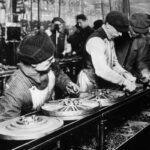
The Second Industrial Revolution was characterized by the increase in industrial productivity from the introduction of the assembly line (separation of the production process into different stages) and new energy sources. In this second stage, Germany experienced the greatest economic growth, and the transformations spread to the United States and Japan.

Causes of the Industrial Revolution
The transformations of the Industrial Revolution were caused by a set of factors.
On the one hand, the growth of agricultural productivity in the 18th century led to a series of modifications in rural organization that, in turn, left a large number of peasants without land to work on. Consequently, There was a massive migration of workers from the countryside to the city .
On the other hand, since the end of the 17th century, The bourgeoisie was strengthening its political influence and managed to introduce legal changes that especially favored bankers and merchants. This allowed them to consolidate their economic power and accumulate wealth.
In the Industrial Revolution The investment of bourgeois capital was fundamental for the creation of factories and the implementation of new forms of production.
Consequences of the Industrial Revolution

Among the main consequences of the Industrial Revolution are:
- Radical change of way of life. Improvements in production and trade systems laid the foundation for the mass production of goods. This generated new consumer habits, but at the same time deteriorated the living and working conditions of the proletariat. The workers' homes were small and often housed several families. The workdays lasted more than 12 hours, the salaries were low and they had almost no time to disperse.
- Social organization. With the Industrial Revolution, the old premises that differentiated social groups were eliminated and industrial societies were basically divided into two classes: the bourgeoisie and the proletariat.
- New means of transportation. Steam technology, initially, and then the combustion engine and electricity enabled new methods of transportation that significantly reduced waiting times for goods and improved human mobility.
- Rise of leftist ideologies . The predominance of the bourgeoisie as owners of the means of production and its exploitation of labor (industrial workers and impoverished peasants) marked the emergence of unionism, socialism, anarchism and communism.
Inventions of the Industrial Revolution

Some of the most important inventions that took place during the Industrial Revolution were:
- The steam engine . First built in 1768 by James Watt, this machine was capable of converting heat from a coal-fired boiler into moving power. This invention gave rise to trains, steamships and other much more powerful and faster production mechanisms.
- The trains . An emblematic and fundamental figure of the Industrial Revolution, the train shortened the transfer times of personnel and merchandise, connected distant towns and forever changed the concept of distance.
- The light bulb Devised in the early 19th century, it was a practical application of electricity that impacted European homes. Until then, lighting was produced by burning gas or fuel, and the electric light bulb provided the possibility of illuminating the nights and extending the useful periods of work and life.
- The spinning machine. This device allowed us to increase the supply of threads, which was essential for textile production. Until then, the transformation of cotton and linen fibers into threads was done manually using a spinning wheel (a rod). The creation of the spinning machine made it possible to make thinner and longer threads and improve spinning times. This was essential to supply the textile industry that was in full growth.
Second Industrial Revolution
The Second Industrial Revolution occurred between 1850 and 1914, and led to the development of great and revolutionary inventions in transportation (combustion engines, airplanes) and telecommunications (telegraph, telephone, radio). Its impact was even greater than that of the First Industrial Revolution and forever changed the models of work, education and citizen coexistence .
Among its main causes is the introduction of the assembly line in factories. The assembly line is a form of production in which tasks are separated and simplified so the need for qualified workers decreases and a large part of the production process can be left in the hands of workers without specific knowledge.
Furthermore, the Second Industrial Revolution led to a so-called first globalization: the economy became internationalized and expanded its influence over territories not reached in the previous industrialization.
References
- Ackermann, M.E., Schroeder, M.J., et al. (2008). “Industrial Revolution”. Encyclopedia of World History. Age of Revolution and Empire. Vol IV. Facts on File.
- Britannica, Encyclopaedia (2022). Industrial Revolution. Encyclopedia Britannica.
https://www.britannica.com/ - Raiter, B., Rizzi, A., Grau-Dieckmann, P. (2008). “The Industrial Revolution”. A story to think about. Modern and Contemporary. Kapelusz Norma