We explain who Tito was and how he became the most important leader of Yugoslavia. In addition, communism and its relations with the Soviet Union.
Who was Josip Broz “Tito”?
Josip Broz “Tito” was a communist politician who ruled Yugoslavia from 1945 until his death in 1980. His government was characterized by the implementation of communism the repression of separatist nationalist movements and the creation of a political-economic system that integrated the nationalization of companies with the formation of small private companies.
During World War II, Tito led the resistance struggle of partisans against the occupation forces . Thus, it became a fundamental figure of Yugoslava politics and won the popular support of the population. At the end of the contest, he managed to keep the country attached as a federation of nations, against separatist movements. Within the framework of the Cold War, Tito maintained the autonomy of Yugoslavia with respect to the directives of the Soviet Union and the pressure of the rest of the countries of the East Block. Promoted neutrality with respect to the rivalries of the superpowers and led the formation of the movement of non -aligned countries . It is recognized as one of the greatest leaders of the twentieth century.
The private life of Josip Broz Tito
Josip Broz Tito was born on May 7, 1892 in Kumrovec, a small town near the city of Klanjec in Croatia. Some sources indicate that he was born on May 25, but it is because during his childhood he did not get used to celebrating birthday socially and, when later in Life Tito he was becoming a national hero, his colleagues decided to celebrate it on May 25.
Tito was the son of Croatian father and Slovenian mother. His family was peasant and had six older brothers. During his childhood he lived several years with his maternal grandmother in Podsreda, Slovenia. He attended primary school a few years and in 1905 he abandoned it.
In 1907, he went to live in Sisak, where began to link with the urban labor environment . In 1910 he joined the Union of Metallurgy Workers. Then, he changed several times of employment and lived in different cities in Slovenia, Germany and Austria.
In 1913 he was recruited by the Army of the Austro -Hungarian Empire and, during World War I was sent to the Russian Front. Over there He was injured, captured and taken to a prison field, from which he escaped In 1917 towards Siberia. In the context of the Russian revolution, he enlisted in the Red Bolshevik army.
In 1919, he joined the Russian Social Democratic Workers Party (which later became the Communist Party of the Soviet Union) and the following year he returned to Croatia, which by then was part of the newly created Yugoslavia.
During the 1920s, he began military in the Socialist Party of Yugoslavia, which was declared illegal by the Government, and due to its manifestations and political activity was arrested between 1928 and 1934.
When he was released, he remained in exile and collaborated in different instances with the Communist Party of the Soviet Union (PCUS). In 1940, He was appointed general secretary of the Communist Party of Yugoslavia and returned to Croatia . In this way his political ascent began.
Josip Broz Tito’s political life
Tito’s political rise
After the German Invasion of Yugoslavia in April 1941 and the USSR in June of that same year, it was organized a powerful guerrilla movement that concentrated the resistance struggle against occupation .
Tito was appointed as Supreme Commander of the Popular Army of Liberation and Partisan separation of Yugoslavia (whose members are known as “the partisans”), and He achieved the gradual recovery of territories occupied by the Nazi-Fascist army . The German troops several times to capture Tito, who had become the main leader of the resistance.
By 1943, the partisans began to receive help from the side of the allies and, in 1944, they coordinated a joint attack to recover Belgrade (the capital of Yugoslavia) that was still occupied by the Nazi-Fascist troops. The following year, with the additional aid of the Red Army of the Soviet Union finally The war against Nazi occupation and German troops were won were ejected .
In March 1945, Tito exercised as a provisional government minister and managed The repression of political dissidents and separatist movements . He was responsible for the persecution and murder of thousands of nationalist militants.
However, Tito was considered by the majority of the population as the leader of Yugoslava resistance and liberation and, in November of that same year, he won the elections with great margin (in front of the defenders of the monarchy) to assume the government of Yugoslavia.
Presidency of Yugoslavia
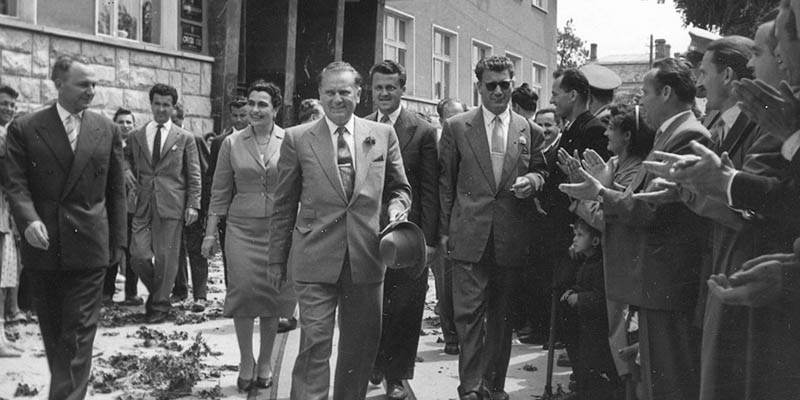
During the first months of government, the political bases of the New Yugoslavia were established: the deposition of the monarch Pedro II, the creation of a republican government system and the drafting of a new constitution.
Yugoslavia ceased to be a kingdom and became the socialist federative republic of Yugoslavia and integrated the republics of Bosnia and Herzegovina, Croatia, Macedonia, Montenegro, Serbia and Slovenia.
During the 1950s, the Government was characterized by the consolidation of communist power and unippartidism, The repression of separatist nationalist movements, the censorship of religion and freedom of expression .
Tito established a communist economic regime called “self -managed socialism” that integrated the predominance of public companies with the formation of small businesses for production in certain sectors of the economy.
In Yugoslavia, economic planning was not centralized as in the rest of the countries of the East Block. Instead, the Government controlled the main companies, but lived with small -scale management and private property.
During the 1960s, Tito began to soften the limitations to freedom of expression and religious practice. In 1967 he opened the borders of the country and became the First communist state to allow the entry of foreign tourists .
However, these years were also marked by the repression of separatist nationalist movements. Before the “Croatian spring” movement, Tito established the political and police sentence: he responded with arrests and persecution not only of the separatist militants, but also of the communists who had supported the movement.
During the 1970s, Tito undertook a series of reforms with the aim of consolidating the central power of Yugoslavia from the concession of greater autonomy in the constitutive republics. Promoted the formation of a collective presidency that would integrate representatives of the different republics. In addition, he sought to become the legislative power of the Communist Party.
Yugoslavia during the Cold War
In the first years of the Cold War, Tito aligned with Stalin and the formation of the Eastern Block. However, relationships were tense since Tito sought an autonomous political and economic development of the directives of the Soviet Union .
The definitive break with the Soviet Union occurred in 1948, when Stalin and the other satellite countries of the Soviet block They condemned the Yugoslav regime and expelled him from the Kominform (The organization that nucleated communist countries).
With the support of much of the Yugoslav people, Tito resisted the Soviet and, instead, He approached Western powers of which he received credits and weapons through the Marshall Plan (in fact, Yugoslavia was the only country in the eastern block that agreed to this economic aid from the western bloc)
When Stalin died, the new leader of the Soviet Union, Nikita Jrushchov, tried an approach to Yugoslavia and visited Belgrade in 1955. Although the tensions with the Soviet Union were reduced, Tito refused to integrate the Soviet block and chose to diplomatically unite the new Third World countries.
In 1955 he participated in the Bandung Conference and Position to Yugoslavia as one of the main movement leaders of non -aligned countries. During the rest of his government, he maintained a neutrality policy in the Cold War.
Although Yugoslavia was a communist country, he maintained his autonomy with respect to the East Block and his diplomatic relations with the different countries of the world were different from the proposals from the Soviet block.
Last years of Tito
Tito remained nominally in power until his death, but during the second part of the 1970s was reducing his political activity . His state of health began to get worse around 1979, and the following year he was admitted to blood circulation problems.
Finally, he died on May 4, 1980 in Liubliana, Yugoslavia. Its funeral was a public act attended by presidents and politicians around the world, both of the western bloc, of the eastern block and the neutral countries.
After Tito’s death, internal competition for power led to the outbreak of the “Yugoslav Wars” (1991-2001), which ended with the dissolution of Yugoslavia and the creation of independent nations.
Continue with:
References
- Banac, Ivo. (2003). “Josip Broz Tito”. Britannica Encyclopedia:
https://www.britannica.com/ - Barnett, N. (2022). Titus. Haus Publishing.
- Palmowski, J. (2000). “Josip Broz Tito”. To Dictionary of Twentieth-Century World History. Oxford University Press.
- Van Dijk, R., Gray, WG, Savranskaya, S., Suri, J., & Zhai, Q. (eds.). (2013). “Mao Zedong.” Encyclopedia of the Cold War. Routledge.