We explain what the Liberating Revolution was, its main events and its general characteristics.
What was the Liberating Revolution?
The liberating revolution was An Argentine civic-military movement that overthrew the government of Juan Domingo Perón on September 16, 1955 and ruled the country until May 1, 1958. The Government of the Liberating Revolution was a military dictatorship that set out to “spray” Argentina, restore the constitution of 1853 and convene new elections in 1958 that, with the proscription of Peronism, gave the victory to the radical Arturo Frondizi.
The term “liberating revolution” was used by the movement that gave the coup d’etat with the meaning of a liberation with respect to the authoritarianism of the previous regime, whose legislation and political structure proposed to disarm. His main architects were Admiral Isaac Rojas, retired general Eduardo Lonardi (who served as president in 1955) and Lieutenant General Pedro Eugenio Aramburu (President between 1955 and 1958).
Although the motto after the coup was “neither victors nor defeated” the government of the Liberating Revolution applied repressive measures such as the imprisonment of Peronist trade union officials and leaders. After an attempted Peronist military coup in June 1956, the Aramburu government ordered the shooting of about thirty military and civilians involved.
In the cultural field, During this period there was an important promotion of science with the creation of the National Council of Scientific and Technical Research (CONICET) and the installation of Argentina’s first nuclear reactor.
In 1957, radicalism was divided into two factions: a more related to the military government, which formed the radical civic union of the people, and a faction more prone to an approach to Peronism, which formed the intransigent radical civic union and won in the 1958 elections. This ended the stage of the liberating revolution.
Background of the Liberating Revolution

Since 1946 Argentina ruled General Juan Domingo Perón who thanks to a reform of the Constitution in 1949 could be re -elected for a second term initiated in 1952.
The labor legislation of the Peronist government caused the adhesion of much of the labor movement to Peronism, but the political persecution and state control of the economy caused the opposition of broad social sectors. The effects of the economic model implemented by Perón were felt especially since 1949, when inflation and scarcity of currencies began to aggravate.
In 1951 there was a coup attempt, starring some officers of the Armed Forces which failed rapidly and led to the imprisonment of the participants. In 1953, some explosions during an act of the CGT (General Confederation of Labor) caused in response a series of fire of opposition premises and the imprisonment of thousands of political leaders.
In this climate of violence, the opposition of the student sectors was increased and a confrontation between the Government and the Catholic Church began. A Catholicism sector supported The bombardment of the Casa Rosada and the Plaza de Mayo held on June 16, 1955 by Marine Airplanes with the aim of murdering Perón. The result was the death of around three hundred civilians. The Peronist reaction was the burning and looting of Churches . Two months later, Perón pronounced a famous speech in which he warned that “when one of ours falls, five of them will fall.”
The blow of September 16, 1955
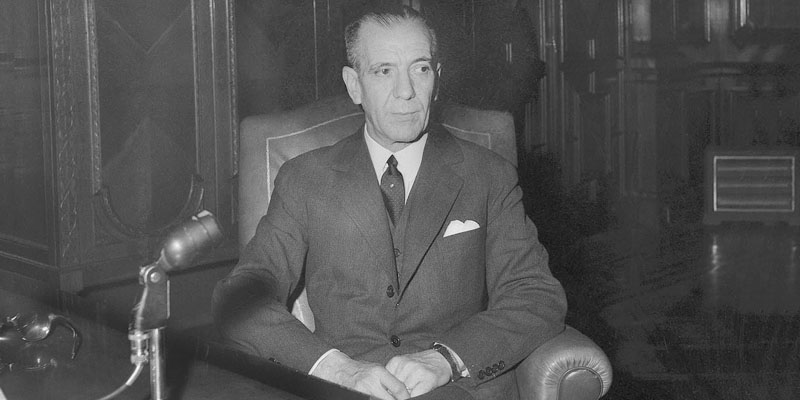
Military uprising began on September 16, 1955 in Córdoba headed by the retired general Eduardo Lonardi, and in other places such as Puerto Belgrano (province of Buenos Aires). The Navy supported Lonardi while the rest of the Armed Forces was divided between those who supported the rebels and who defended the government.
The troops loyal to the government acted with reluctance. On September 20 Perón sent his resignation and took refuge in a Paraguayan ship . On September 21, the coup triumphed and two days later Lonardi assumed the provisional presidency of the Nation. Perón traveled to Paraguay in October, where the Alfredo Stroessner government granted him political asylum.
Lonardi exercised the presidency de facto For two months, with Admiral Isaac Rojas as vice president and with the support of Catholic and nationalist groups. During that time he tried to apply measures related to the motto “Neither winners nor defeated”, which involved not treating Peronism as an enemy, maintaining part of current social legislation and reaching an agreement with Peronist political and union leaders.
However, the most antiperonist sector of the movement exerted pressure to overthrow Lonardi and this It was replaced by Lieutenant General Pedro Eugenio Aramburu on November 13, 1955 . The vice presidency continued occupied by Isaac Rojas, who also presided over the National Advisory Board, which was made up of representatives of most of the country’s political forces (except for Peronism and communism). At this time, the term “gorilla” began to be used to identify antiperonists.
The presidency of Pedro Eugenio Aramburu
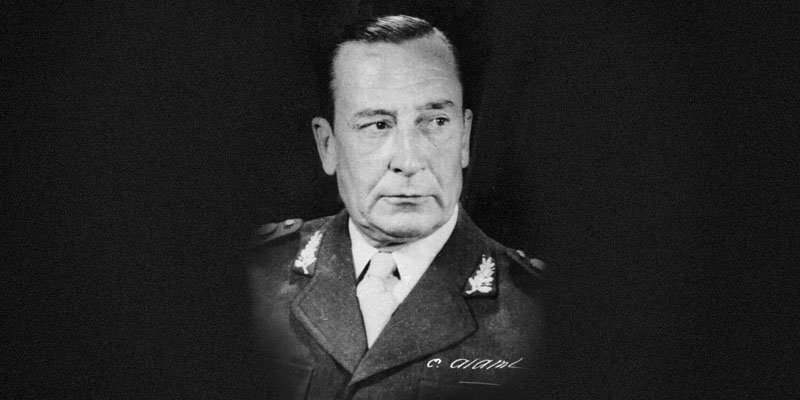
In the Peronist sectors This revolution is considered in a negative way define it as the ‘Fusilator revolution‘Following the civilians and military who were shot in 1956 in punishment for their rebellion during the uprising of General Juan José Valle, emerged from the Peronist resistance. These executions were published by journalist Rodolfo Walsh.
Aramburu reached the presidency on November 13, 1955 with the support of the most antiperonist sectors of the Armed Forces and the liberal groups of civil society. His assumption implied an important change regarding the provisional presidency of Lonardi, because The Peronist party banned, the CGT and most unions intervened, imprisoned Peronist trade union leaders and leaders and prohibited the use of symbols associated with Perón. Even by Eva Perón, which was just returned in 1971.
Despite these and other measures, Peronism preserved the adhesion of broad sectors of society and continued to influence national politics . In this way the Peronist resistance was born, as attempts to resist proscription through strikes, sabotages and acts of violence, with the stimulus of Perón himself from exile. There was also a call from Perón to vote for Arturo Frondizi (of the Intransigent Radical Civic Union) in the 1958 elections, against the candidate of the Radical Civic Union of the People, Ricardo Balbín.
Politics and Economics of the Liberating Revolution
The triumph of the 1955 coup led The closure of the Congress, the intervention of the provinces and the dismissal of the members of the Supreme Court of Justice which had been appointed by the Peronist government. Other institutions previously controlled by the Peronist regime, such as universities, to which autonomy was returned, were also intervened.
Together with the positions of President and Vice President, A National Advisory Board composed of civilians from various political parties was established . The newspaper was returned The press to his former owners, who had lost him by an expropriation law in 1951, and the media and communication between different political and ideological sectors were distributed (Peronism excluded).
In economic terms, the liberating revolution did not have a clear direction . He applied some liberal measures, such as closing the IAPI (Argentine Institute for the Promotion of Exchange) created in 1946 to exercise state foreign trade control. However, he also used interventionist mechanisms, such as price controls. Besides, He was responsible for Argentina’s adhesion to the IMF (International Monetary Fund) on the recommendation of economist Raúl Prebisch.
The Liberating Revolution He gave a boost to science with the aim of encouraging economic modernization . At the beginning of 1958, CONICET was created, whose first president was Bernardo Houssay, Nobel Prize in Medicine. Scientific institutes were also founded and Argentina’s first nuclear reactor was installed.
The constitutional reform of 1957
In May 1956, the Aramburu government annulled the 1949 Constitution, which had been sanctioned during the Presidency of Perón. Thus, He restored the Constitution of 1853 and convened a constituent convention to agree on a new constitutional reform.
In July 1957 Elections of conventional constituents were held that, due to the proscription of Peronism and the call of Perón to vote blank, They resulted in 24 % of blank votes . The two most voted games were the Radical Civic Union of the town (headed by Ricardo Balbín), which obtained 24 %, and the uncompromising radical civic union (headed by Arturo Frondizi) with 21 %.
The Constituent Convention met in Santa Fe and, although the Frondizi sector retired, managed to ratify the constitution of 1853 and the aggregate of article 14 bis which recognized a series of labor and social rights (and that was included in the 1994 reform that is currently in force). Subsequently, Aramburu set the elections to President and other positions for February 1958.
The shootings of 1956
In June 1956, A group of Peronist military and civilians tried to give a coup against the Aramburu government but was quickly suffocated. As a consequence, The government decreed the martial law and ordered the execution of around thirty people (military and civilians), including the main leader of the uprising: General Juan José Valle.
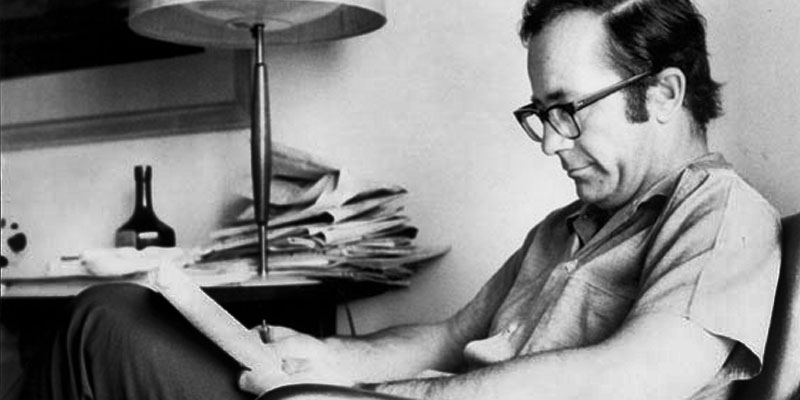
The 1956 shooting caused the rejection of many social sectors. The journalist Rodolfo Walsh led an investigation About the facts he published in his book Massacre operation of 1957, taken to the cinema in 1972. In this book the execution of five civilians in José León Suárez, province of Buenos Aires, was disclosed. When Aramburu was kidnapped and murdered by the Peronist armed organization Montoneros in 1970, one of the causes listed to justify their execution was their responsibility in these shootings.
The 1958 elections
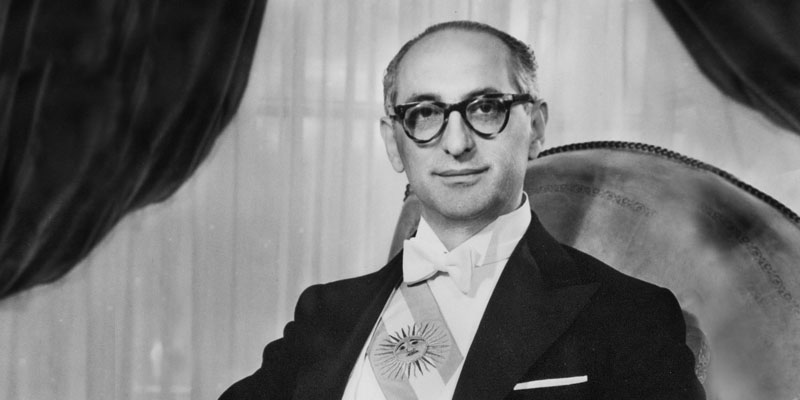
Political persecution and state censorship during the years of the Peronist government motivated the support of some political parties such as the UCR (Radical Civic Union) and the Socialist Party (PS) to the Liberating Revolution. However, during the Aramburu government these parties suffered internal divisions because some factions were closer to the dictatorship and others were more prone to approach Peronism.
With proscribed Peronism, radicalism was the majority political group. However, In 1957 the UCR was divided into two games:
- The UCRP (Radical Civic Union of the People) headed by Ricardo Balbín and close to the dictatorship.
- UCRI (uncompromising radical civic union) headed by Arturo Frondizi and very critical of the dictatorship.
After the restoration of the Constitution of 1853, Aramburu summoned national elections, which were held on February 23, 1958 . In addition to the two radical parties, other political forces were presented.
Frondizi represented progressive and developmental ideas and attracted the attention of intellectual and youth sectors. Besides, Perón from exile summoned the Peronist voters to vote for the UCRI, due to their position contrary to the dictatorship . Some historians suggest that there was a secret pact between Frondizi and Perón to get the Peronist vote, but others claim that there is no concrete evidence to support this idea.
The UCRI defeated in the 1958 elections with 49 % of the votes compared to 32 % of the UCRP. Thus, Frondizi was elected constitutional president. Assumed on May 1, 1958 day that marked the end of the government de facto of the liberating revolution.
References
- Calvert, Par & Halperin Donghi, T. (2023). History of Argentina. Britannica Encyclopedia. https://www.britannica.com/
- Larraquy, M. (2017). Argentina. A century of political violence. South American.
- Luna, F. (1993). Brief history of Argentines. Planet.
- Potash, R. (1986). The army and politics in Argentina II. 1945-1962: From Perón to Frondizi. Hyspamerica.
- Rouquié, A. (1981). Military power and political society in Argentina. I emecé.