We explain what ludism was, its main ideas and consequences. In addition, what are its characteristics and why it is so important.
What was Ludism?
Ludism was a protest movement of the British workers of the early nineteenth century, which violently opposed the transformations initiated in the context of the industrial revolution.
The luditas mainly rejected the use of machinery in looms and industries since these advances meant a lower need for artisanal qualified labor, an increase in unemployment and, therefore, a decrease in their salaries.
This movement receives its name by Ned Ludd, an English county worker LeicalShire. Ludd became known for destroying some factories in 1769. It is not known with certainty if Ned Ludd was a real person or part of a popular legend.
However, the figure inspired Textile workers in Nottingham. In 1811, various letters and proclamations signed with the name “Captain Ludd” or “General Ludd” appeared that called the violent revolt against industrialization.
Ludism was a phenomenon that lasted a few years . By 1816, the repression of the luditas led to the dissolution of the movement and the discontent workers of the factories turned to other forms of protest and workers’ organization, such as the brotherhoods or the brotherhoods
Origins of Ludism
The first manufacturing workers were directed against industrialization and loss of jobs generated by the introduction of machinery in factories. Towards the end of the 18th century, workers from different places in England They claimed that the mechanization of tasks through machines was harmful to society .
In 1786, the textile workers of the city of Leeds published a joint letter denouncing that the machines had left thousands of workers out of work. These complaints were common and their objective was to convince public opinion and the authorities to put a limit to the use of machinery in the new industries.
However, at the beginning of the 19th century, unemployment increased and the quality of life worsened, and the claims of the workers began to take violent forms. In 1811 anonymous proclamations signed under the name “Captain Ludd”, “General Ludd” or “Nedd Ludd” that threatened with the destruction of the machines and facilities of the factories began to circulate.
Historical context of ludism

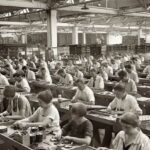
The industrial revolution, which began at the end of the 18th century and deepened during the 19th century, had a deep impact on society and the quality of life of the European lower classes. The factories were huge spaces with few windows and almost without ventilation. The workers spent all day in front of the machines that operated forced to stay in their job.
The working days reached 16 hours a day and were reduced to 10 hours in the best cases. They could only be interrupted by a short pause for lunch. In addition, children were incorporated as children as labor in the factories, who were paid with a minor salary.
The increase in mechanization generated unemployment and, therefore, descended wages. In turn, the living conditions of the workers also worse. The homes of the workers’ families had one or two rooms, which they used to sleep and to eat, and the buildings integrated homes from many families.
Main ideas of ludism
The luditas argued that the introduction of machinery in the factories generated greater unemployment among the qualified workers. With the use of machines, unqualified workers could perform the tasks of qualified workers and in much less time.
The luditas understood that the machines were not the guilty of unemployment and the worsening of their quality of life, but the owners of the factories that introduced these innovations to improve productivity. In this sense, the Luditas believed that the work community and the values of qualified work should be defended. Besides, They argued that the authorities had to impose limits on industrialization so that the national economy would guarantee the well -being of all groups of society.
Protests of Ludism
Between 1811 and 1816, ludism expanded especially among workers with three -headed textile industry: the Yorkshire laneros, Lancashire manual weavers and Nottinghamshire lace weavers.
Among the most violent protests is that of 1811, when Nottinghamshire’s weavers made a great revolt and destroyed sixty knitting machines . In 1812, one hundred and fifty armed laneros attacked William Cartwright’s mill in Yorkshire and, in 1813, there was another great wave of violence in Lancashire.
All these demonstrations were repressed by police forces and authorities. In 1813, Eighteen Luditas were arrested, prosecuted and convicted of death for their actions. This gave a strong blow to the movement that began to organize more and more in hiding. Police repression and the appearance of other forms of workers’ protest led to the decline of the Ludite movement and its disappearance around 1816.
Consequences of ludism

The ludite movement did not generate the changes that were proposed nor stop the incorporation of machines in the industry. However, it was one of the first forms of labor organization that sought to defend the interests and quality of life of workers in the face of the imposition of every time working conditions.
While the luditas were repressed, other forms of labor organization appeared at the same time. The old trade organizations of brotherhoods or brotherhoods began grouping the workers who associated to provide mutual help. With the voluntary contribution of the members, they gathered money to support themselves in cases of dismissal, illness or death.
On the other hand, Industrial entrepreneurs began to alarm before the organization of workers and began to form their own associations. The former were intended to share information about workers and their activities. If a worker was problematic for an entrepreneur, the rest of the members promised to say goodbye no longer to hire him again.
In addition, industrial entrepreneurs began to press the government to take protection measures. In 1800, the English Parliament had approved the so -called Combinations Acts (“Association Laws”) that prohibited the collective claims of workers.
In the following decades, The workers’ organizations were repressed their public meetings and the leaders of the labor associations were persecuted were prohibited.
Unions and cartism

During the first decades of the nineteenth century, The first modern trade union associations appeared, called Trade Unions (which in English means “ex officio unions”). Its objective was to represent affiliated workers and present the claims to entrepreneurs and authorities.
The Trade Unions They were voluntary associations but, unlike the brotherhoods, their goal was not mutual help, but The improvement of working conditions through the recognition of the basic rights of workers .
As Combination Acts prohibited collective claims, the first Trade Unions They were illegal. Its main claims were the reduction of the working day, the regulation of children’s work, salary improvements and the recognition of the right of workers’ association.
In 1824, the Trade Unions They achieved the repeal of the Combination Acts And, therefore, workers’ associations began to be legal. In a short time a confederation was created, called the General Trade Unionswhich nucleated the different union associations.
In the following decade, a sector of union associations began to promote the idea that workers had to start being part of the government to see their interests represented. In 1839, a movement presented a document called the “Charter del Pueblo” to Parliament that was signed by 1,200,000 workers. Since then, this political movement was called “cartismo.”
The town letter presented to Parliament contained six claims:
- Voting right for every man over 21, sane and without criminal record.
- Voting by electoral ballot, to protect the voter in the vote exercise.
- Elimination of the requirements of possessing properties to be a member of Parliament.
- Remuneration to members of Parliament so that they can devote themselves to their legislative functions, regardless of their personal economic condition.
- Leveling of electoral districts so that there is an equal representation about the number of voters.
- Annual renewal of Parliament, for more effective control of representatives.
Although the claims were rejected on successive occasions, cartism was the first experience of political participation of unions and workers’ associations.
Continue with:
References
- Britannica, The Editors of Encyclopaedia. (2023). Luddite. Britannica Encyclopedia https://www.britannica.com/
- Stearns, P. (1994). Luddism. Encyclopedia of Social History. Garland Publishing.
- Wilczynski, J. (1981). Luddtes An encyclopedic dictionary of marxism, socialism and commune. Macmillan Reference Books.