
We explain what Eisenhower doctrine was during the Cold War. In addition, the historical context and who was John Foster Dulles.
What was the Eisenhower doctrine?
The Eisenhower doctrine, also known as the doctrine of mass reprisals, was An American strategic doctrine implemented during the presidency of Dwight D. Eisenhower in the context of the Cold War . The term “mass retaliation” was first used by Secretary of State John Foster Dulles in a speech delivered in January 1954.
The Eisenhower doctrine It raised the possibility of responding with the use of nuclear weapons to any aggression (nuclear or conventional) of the Soviet Union (USSR) or of communist China anywhere in the world . The intention was to deter communist regimes to support or promote insurrections in other countries to the perspective of receiving an American nuclear attack on their own territories.
The doctrine was elaborated in a context in which the Soviet Union had developed the atomic bomb (in 1949) and President Eisenhower had proposed to increase development in nuclear technology after the uncertain result of the Korean war (1950-1953).
The Eisenhower doctrine received some criticisms in the United States, especially from members of the Democratic Party. In practice, the United States external policy during Eisenhower's presidency was a reinforced version of the “containment” policy previously implemented by President Harry S. Truman.
Key points
- The Eisenhower or mass retaliation doctrine was an American strategic doctrine adopted during the presidency of Dwight D. Eisenhower (1953-1961) in the context of the Cold War.
- The Eisenhower doctrine consisted of responding to the aggression of the Soviet Union or communist China anywhere in the world, with a mass nuclear retaliation that could be directed against the territory of the communist powers.
- The Eisenhower doctrine was formulated by Eisenhower Secretary of State, John Foster Dulles. In practice, the American foreign policy of these years was only a reinforced version of the previous containment policy.
The historical context
When World War II (1939-1945) ended, United States and Soviet Union They became the two greatest world powers . Since they had conflicting interests based on political, economic and ideological differences, from now on they were confrontated countries that competed for hegemony in different parts of the world in what was called a cold war.
During the presidency of Democrat Harry S. Truman (1945-1953), the United States adopted a doctrine of “containment” (known as Truman doctrine) that sought to contain the advance of Soviet communism. This doctrine consisted of economic or militarily support the governments that faced communist insurrections or the pressures of the Soviet Union.
After arriving at the Government of Republican Dwight D. Eisenhower in 1953, the United States adopted foreign policy guidelines inspired by The new Secretary of State, John Foster Dulles. In a speech in January 1954, Dulles used the term “mass retaliation” which went on to name this new doctrine, also called Eisenhower doctrine.
The principles of Eisenhower doctrine
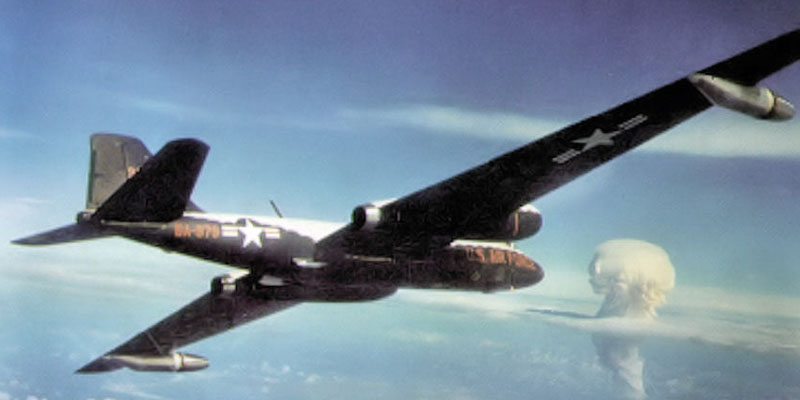
The Eisenhower doctrine started from two obvious military realities: American superiority in the field of nuclear technology and the key role of American superbarderos grouped in him Strategic Air Command (Strategic Air Command), capable of launching atomic bombs on enemy territory.
John Foster Dulles said that, from now on, the United States would respond to any aggression with the media and in the places he chose.
The Eisenhower doctrine was based on three very simple principles:
- In case of a Soviet or Chinese attack, the United States would not hesitate to launch mass retaliation through the use of nuclear weapons.
- The immediate response of the United States would not necessarily have to occur in the place where the aggression had occurred.
- The existence of “sanctuaries” free of attack would not be recognized. Any place in the communist bloc, including the Soviet Union, could be attacked.
This policy It was also known as BRINKMANSHIP or “policy of the edge of the abyss.”
This new policy was complemented by two actions:
- The concretion of different treaties such as Seato (Organization of the Asian Southeast Treaty) or the Baghdad Pact, which linked to the United States with almost fifty countries. There was talk of the “pactomania” of Dulles.
- Strengthening secret services and information devices : The FBI (Federal Bureau of Research) and, above all, the CIA (Central Intelligence Agency).
At the military level, the new doctrine had an immediate consequence in the United States: the accelerated development of the Air Force to the detriment of the Navy and the Army. However, In practice it was a more moderate doctrine than it seemed so some historians considered it a reinforced “containment” policy.
The growing nuclear development in the Soviet Union soon led to the lack of credibility of the doctrine whose application would have brought to mutual destruction insured. The Secretary of Defense of John Fitzgerald Kennedy, who happened to Eisenhower in the presidency of the United States between 1961 and 1963, promoted the replacement of the doctrine of mass reprisals for a flexible response strategy with the intention of preventing the possibility of a world catastrophe.
Who was John Foster Dulles?
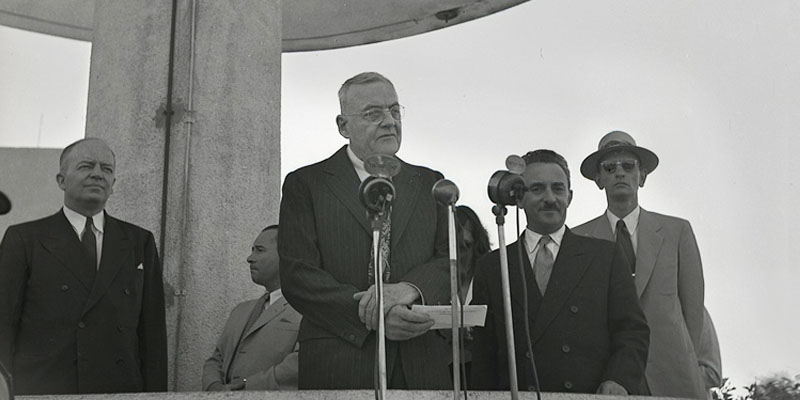
John Foster Dulles was An American politician and diplomat belonging to the Republican Party . He held various positions under the administrations of Harry Truman and, above all, of Dwight Eisenhower. With the first he participated in the Dumbarton Oaks conference in 1944 and directed the delegation signed by the San Francisco Treaty with Japan in 1951.
He was appointed Secretary of State for Eisenhower in 1953 since he performed until his resignation for health reasons in 1959. It was contrary to the policy of “containment” of communism applied by the administration of Truman and, from his position, launched a new strategic policy against the Soviet Union (call New look) which was based on American technological superiority and the adoption of nuclear massive reprisals in case of a communist aggression. This new policy placed the foundations of Eisenhower doctrine.
In practice, the new US government policy looked a lot like the traditional policy of “containment”, as demonstrated by the lack of reaction to the labor uprising in East Berlin in 1953 or before the Soviet invasion of Hungary in 1956. Its hostility before the movement of non -aligned countries led to the United States to face important third world countries such as India or Egypt .
Although he financially supported France in the Indochina War, Dulles refused to involve US troops in Vietnam and resigned himself to the partition of the country agreed in the 1954 Geneva agreements.
Promoted the creation of a network of global alliances against the communist bloc whose main examples were the Seato (Organization of the Treaty of Southeast Asia), the Baghdad and the Cento Pact (Organization of the Central Treaty). He had to resign his position in April 1959 for health reasons and died on May 24, 1959.
Continue with:
References
- Freedman, LD (2023). Strategy Nuclear. Britannica Encyclopedia. https://www.britannica.com/
- Powaski, Re (2000). The Cold War: the United States and the Soviet Union, 1917-1991. Criticism.
- United States Department of State (SF). 1953-1960: Betry of a Bi-Polar Foreign Policy. Office of the Historyn. https://history.state.gov/
- Weintal, E. (2023). John Foster Dulles. Britannica Encyclopedia. https://www.britannica.com/


