
We explain to you what were the blocks of the Cold War, its origin and history. In addition, its characteristics and alliances.
What were the Blocks of the Cold War?
The Blocks of the Cold War were Two alignments of countries that defined the international relations of the second half of the 20th century . Each block was headed by a world power with its own economic, political and ideological characteristics:
- The western or capitalist bloc (under the hegemony of the United States)
- The eastern or communist block (under the hegemony of the Soviet Union)
The two blocks were formed after World War II, when The allies, who had defeated the Nazis, agreed to distribute the government of Germany . The disagreements between the United States, the United Kingdom and France – which dominated the western sector – and the Soviet Union (USSR) – which dominated the eastern sector – caused the division of Germany and the rest of Europe between Western capitalist nations and the eastern communist countries.
During the cold war, The two rival powers did not face each other militarily but they competed for the supremacy in the political, ideological, diplomatic, economic, cultural and scientific fields. Anyway, They directly or indirectly supported military episodes in various parts of the world (such as Southeast Asia, Africa, Latin America and the Middle East). The Cold War concluded with the fall of the Soviet Union in 1991.
Frequent questions
What was the cold war?
The Cold War was a political, ideological, economic, social and warlike conflict that began after ending World War II.
What blocks faced each other in the Cold War?
The blocks that faced were: the western or capitalist bloc, led by the United States, and the eastern or communist block (led by the Soviet Union).
What countries faced each other indirectly in the Cold War?
The countries that were involved were:
- The members of NATO, led by the United States (with Belgium, Canada, Denmark, France, Iceland, Italy, Luxembourg, Norway, Netherlands, Portugal and the United Kingdom).
- The members of the Eastern Block, through the Warsaw Pact, led by the Soviet Union (with Eastern European countries, such as Albania, Bulgaria, Czechoslovakia, Hungary, Poland, German Democratic Republic and Romania).

The historical context

The allied triumph in World War II (1939-1945) was largely due to the intervention of the United States and the Soviet Union. The leaders of both powers gathered before the end of the war at the Yalta Conference (1945), together with the British Prime Minister, to agree on the terms of Germany’s surrender and define their areas of influence in Europe.
Once the war in Europe was completed, another conference was held in Potsdam and Germany was divided into four areas of occupation, distributed between the United States, the United Kingdom, France and the Soviet Union. Berlin was also divided into four sectors, and in it the Allied Control Council for the Joint Government of Germany was installed, but the differences between Western nations and the Soviet government caused the Council to stop working.
The British and American occupation areas were unified economically in 1947, and the Soviet Union, which controlled East of Germany, blocked Berlin between 1948 and 1949, which prevented the western sector of the city from supplies. The blockade was built in 1949, but The opposition between the capitalist and the east communist was consolidated with the Foundation of the Federal Republic of Germany (or Western Germany) and the German Democratic Republic (or Eastern Germany) . Also with the NATO Foundation (Military Alliance of the capitalist bloc) and the installation of governments under Soviet control in Eastern Europe (communist bloc).
The dividing line between both blocks He was called “Steel curtain” and the alignment with one or another block extended to other parts of the world and characterized the cold war until the fall of the Berlin wall (1989) and the dissolution of the Soviet Union (1991). A series of leaders from decolonized countries (such as Indonesia, India and Egypt) promoted a movement of non -aligned countries, with the aim of maintaining neutrality in the confrontation between the two blocks.
The western block
Transatlantic ties
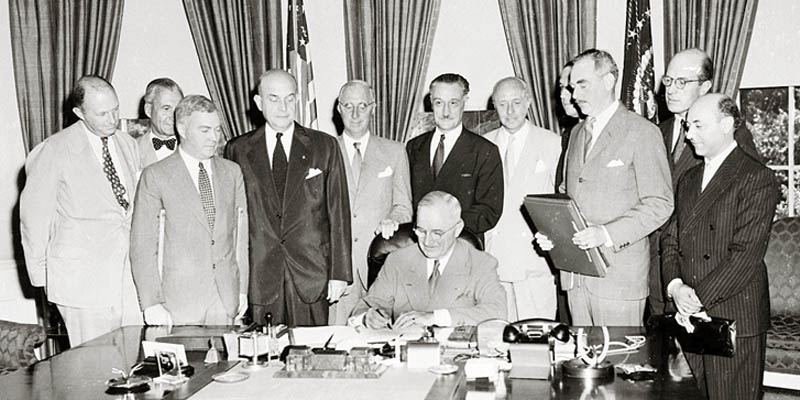
The Western Block during the Cold War was made up of countries of capitalist economy with democratic political systems. The lifting of the obstacles to world trade, sponsored and managed by international instances such as the International Monetary Fund (IMF) or the General Agreement on Customs and Commerce Tariffs (GATT), led to commercial and monetary exchanges, which avoided isolationist tendencies (that is, the preference for economic isolation or the rejection of international alliances).
One of the reasons that led to the United States to promote the constitution of a block constituted around alliances, despite the fact that this contradicted its historical traditions, was reinforce Western Europe, which had been weakened by World War II and it was necessary not to lose the cold war.
The Truman doctrine (who had to support the populations that faced the communist advance) military and economically And, above all, the Marshall Plan (A program of financial aid to the countries of Western Europe), constituted the first two steps of the new American position. The reconstruction of European economies and the achievement of a certain social stability They were key elements of the “containment” of communism in Western Europe .
He European Recovery Program, Better known as Plan Marshall, led to the United States to raise the need for European economic coordination. Thus, in 1948, the European Economic Coordination Organization (OECE) was born, embryo of the future Organization for Economic Cooperation and Development (OECD). The conclusion of this process of conformation of the western block took place in 1949 with the signing of the North Atlantic Treaty and the Constitution, the following year, of NATO (Organization of the North Atlantic Treaty) the Great Western Military Alliance.
The beginnings of the “European construction”
The United States played an essential role in the postwar period, by promoting Western European countries towards the construction of European unit. The “European idea” (that is, The notion of a European identity and the promotion of a unit of Western European countries ) It was not new. During the interwar period, figures such as Coudenhove-Kalergi politician or statesman Aristide Briand defended an integrative project that failed after the depression of 1929 and the rise of fascism.
After World War II, Various initiatives prepared the way to integration:
- In May 1948, more than 750 European figures, including important political leaders, met at the Congress of The Hague, and in 1949 the Council of Europe was born.
- In the 1950s and 1951, when in Korea the first “hot conflict” began (that is, armed) of the cold war, the main steps were taken in the integration process: the Schuman statement and its immediate consequence, the creation of the European Coal and Steel Community (CECA).
- Western Europe had started a unit road in which Economic integration had an essential role . The signing of the Treaties of Rome in 1957 and the birth of the European Economic Community (CEE) were the following and decisive steps, until the creation of the European Union in 1993.
A worldwide network of alliances
The historical experience of the interwar period and the Cold War led the United States to take a historical turn in its traditional isolationism. Beyond the transatlantic ties with Western Europe, the US Secretary of State launched a series of international alliances with the aim of consolidating the western block and stopping the advance of communism :
- OAS . At the time of President Harry S. Truman, the Rio Treaty with twenty Latin American countries was signed in 1947. This initiative was consolidated in 1948 with the foundation of the Organization of American States (OAS). This institution has always been based on an imbalance of forces between US power and the rest of the countries of the continent. In any case, the existence of the OAS could not avoid the alignment of the Cuban government (emerged after the 1959 revolution) with the Soviet Union, nor the emergence of Marxist inspiration movements that led guerrilla wars in several Latin American countries during the 1960s and 1970s.
- ANZUS AND TREATY OF SAN FRANCISCO . The Korean War (1950-1953) led in 1951 to the constitution of a military alliance in the Pacific: the Anzus (Australia, New Zealand, United States), and the signing of the San Francisco Treaty with Japan, former enemy of the United States, with which he endorsed peace. In any case, the intention to stop the communist influence in the Pacific motivated US intervention in the Vietnam War (1964-1975) in support of South Vietnam, in which Vietnam winner of the North (which received the support of the Soviet Union and the communist China) was supported.
- Seato . President Dwight Eisenhower and his Secretary of State, John Foster Dulles, completed and systematized the Western Alliances Network: in 1954 the Seato was born (acronym in English for the organization of the Treaty of Southeast Asia), with Great Britain, France, Australia, New Zealand, Philippines, Thailand and Pakistan.
- Cento . In 1955 the Baghdad Pact was signed, Security Alliance in the next East between Great Britain, Türkiye, Iraq, Pakistan and Iran. When withdrawing from the Iraq alliance in 1959, this covenant became CENTO (acronym in English for the organization of the Center Treaty).
The eastern block
“Popular democracies”
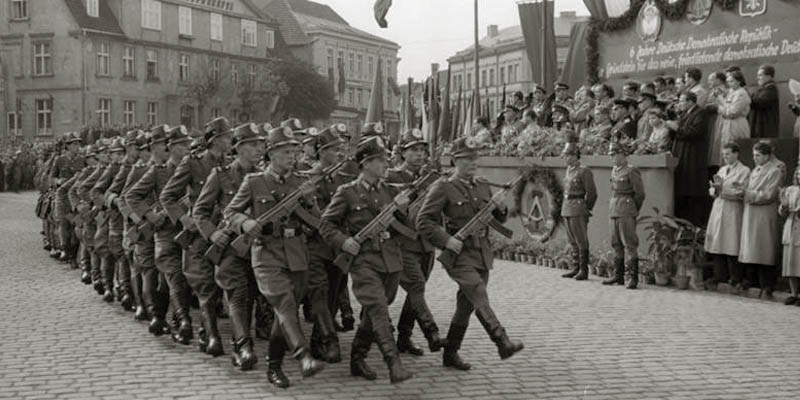
During the thirties, the Soviet Union was consolidated as a totalitarian state founded on the control of the population and the repression of the dissent. Anyway, the Stalin regime achieved rapid industrialization that allowed him to position himself as a world power and be one of the winning countries in World War II.
When the cold war against Western democracies broke out, In the areas of Europe occupied by the Red Army, new “satellite” states of the Soviet Union (which adopted the name of “popular democracies”) were organized)) .
With the exception of Albania and Yugoslavia, where the native communist guerrillas triumphed over the forces of the axis at the end of World War II and led the communists directly to power, The establishment of “popular democracies” In Eastern Germany, Romania, Bulgaria, Hungary and Poland, by intervention of the Soviet Union, It was carried out during a process that culminated in 1948 with the Prague blow (When the communist model was also imposed in Czechoslovakia).
The process was similar in all affected countries:
- First it was given “denazification” that is, the purge (the departure of the public positions and the imprisonment, the execution or other punishment) of those who had been collaborators of the axis, which often also entails the repression of an important part of the most accommodated classes, would have sympathized with Nazism or not.
- In second place, “national fronts” were formed in which the country’s Communist Party collaborated with various democratic forces, but the key positions in the Government were reserved (such as the Ministries of Interior, Defense, Economy or Justice).
- Third, it was promoted The elimination of non -communist forces and the complete “satellization” of the new regime. The repression against any dissent was accompanied by the complete dependence on Moscow.
In the economic field, the Soviet nationalized land and factories and even They disassembled and transferred to the Soviet Union complete factories as well as staff and resources. In general, in the “popular democracies” he tended to organize economic activities according to Moscow’s guidelines and interests. Bilateral agreements between the Soviet Union and the various countries of the Eastern Block regulated mutual economic relations.
The Yugoslav Schism in 1948 was the first fissure in the block that was being formed around the Soviet Union, when Marshal Tito broke relations with the Soviet regime without therefore abandoning socialism. In the 1960s, the regimes of Albania and Romania stopped participating in the organisms of the eastern block, while Cuba, on the contrary, joined the block after the 1959 revolution.
The organization of the communist bloc
The dissemination of Jdanov doctrine (which stated that the world was divided between an imperialist block, led by the United States, and a democratic block, led by the Soviet Union), and the creation of the Kominform in 1947 were the first reactions of the Soviet Union after the rupture with the Western powers. The Kominform was a coordination body of the countries of the communist bloc and played an important role in ideological mobilization and propaganda in these countries. After the Yugoslav Schism, the Kominform became focusing on the fight against Tito, given Stalin’s fear to a “contagion” in the rest of the “popular democracies.”
Another key element of the Kominform work was the Organization of the Peace Movement, which focused its criticism in the North American nuclear armament and launched great campaigns for the collection of signatures that requested the prohibition of atomic weapons. These campaigns, which simultaneously presented to Soviet power as a defender of La Paz, achieved the support of a large number of intellectuals worldwide.
In parallel, in the “satellites” states, A new wave of purges (1948-1952) He marked the last years of the Stalin dictatorship. Any attempt to initiate a “national route” to socialism that did not follow the letter the Soviet model was accused of “deviationist”, and its supporters indicated as “Trotskyists” “or” Titoists. “
The reality was that approximately a quarter of the members of the communist militancy (often the most veteran and more experienced militants) were judged, imprisoned or executed. Repression became a characteristic feature of “popular democracies.”
The ComeCon and the Warsaw Pact
In 1949, ComeCon was born (Economic Mutual Aid Council), a multinational institution that grouped the USSR and the East countries (with the exception of Yugoslavia). The ComeCon sought promotion and the planning of commercial exchanges between the countries of the block. Only from 1960 this organism could function fully.
The Soviet Union was creating a network of alliances to give coherence to its block. However, this network was much less dense than that of the western block, and it took longer to consolidate. The government of Moscow was signing bilateral agreements with the “popular democracies” and with the communist China of Mao.
Two years after Stalin’s death, already root of the entrance of the Federal Republic of Germany at NATO, he was born in 1955 The Warsaw Pact, a military alliance that joined the Soviet Union with all the European countries of the communist bloc, with the exception of Yugoslavia .
It is estimated that the military forces of the pact amounted to 6 million soldiers, with a highly approved armament. The unified command of these troops was in the hands of a Soviet general. In July 1991, a few months before the dissolution of the Soviet Union, the Warsaw Pact was ended. A few days before, ComeCon had stopped working.
Continue with:
References
- Britannica, Encyclopaedia (2022). Cold War. Britannica Encyclopedia. https://www.britannica.com/
- Powaski, Re (2000). The Cold War: the United States and the Soviet Union, 1917-1991. Criticism.
- Veiga, F., Da Cal, E. & Duarte, A. (2006). Simulated peace. A story of the Cold War. Alliance.


