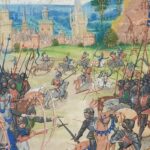
We explain what the Middle Ages is, what was the origin and stages of this period. In addition, its main characteristics and how was its end.
What is the Middle Ages?
The Middle Ages is the period of history between the fall of the Roman Empire of the West, in 476 d. C., and the arrival of the Spaniards to America, in 1492. This historical period is between the old age and the Modern Age .
This periodization corresponds to studies on the history of the West, focused on the development of European Western culture. Traditionally, it was considered that the Middle Ages was a time of religious oppression and restriction of culture, science and knowledge. However, different current academic studies clarify this vision and propose a deeper and more complex explanation about the period.
During the Middle Ages, The power of European states was weakened in favor of feudal lords great landowners who dealt with the safety of their lands. The political, economic and social organization revolved around the feuds, in which the peasants worked in exchange for the protection and protection of their feudal lord.
Besides, During this period the Muslim religion arose and expanded For the Arabian Peninsula, the Middle East, North Africa and Southern Europe. In contrast, the Christian Church developed as a fundamental force in Europe, which gave cultural identity to the different political units in the continent.

Characteristics of the Middle Ages

Among the main characteristics of the Middle Ages, we can define:
- It started in 476 d. C., with the fall of the Roman Empire of the West and ended in 1492 d. C., with the arrival of European colonizers to America.
- It belongs to a traditional periodization and focuses especially on studies on the history of European societies and the next East.
- During its more than ten centuries, different states emerged and fell; In Europe, political fragmentation and the establishment of a political, economic and social system called feudalism prevailed.
- The Christian religion dominated the European scene as a political force and generated a cultural identity that faced Muslim expansion.
The Middle Ages in History

The first scholars who started using the term “Middle Ages” were Philosophers, artists and poets of the 16th and 17th centuries . Giorgio Vasari, an art historian, published in 1550 his book The lives of the most excellent architects, painters and Italian sculptors from Cimabue to this time. In this work, he highlighted two historical periods for the splendor of art and culture: the ancient age, of which Greek and Roman sculpture and architecture exalted, and the modern age, its own time, in full boom of the Italian rebirth.
While there were between both periods, Vasari called him Middle Ages and saw him as a dark period, without cultural advances . I saw the Middle Ages as a lower stage, between two upper stages, antiquity and modernity. This vision remained in other branches of the studies on the past, and was shared by the historians of the nineteenth century.
At the moment, Historians no longer consider the Middle Ages as a dark era . The development of historical studies and different historiographic schools highlight the importance of the time. In this period there were very important changes and political, economic and cultural movements of great relevance.
Stages of the Middle Ages

Historians divide the Middle Ages into three stages:
- Early Middle Ages (476-843 d. C.) . After the fall of the Roman Empire of the West, three great power centers were formed: the Roman-Germanic kingdoms, the Byzantine Empire and the Muslim caliphates. From this stage dates the Franco of Charlemagne, Justinian’s reign in Byzantium and the great expansion of Muslim faith.
- High Middle Ages (843-1100 AD) . During this period the feudal system took shape, based on personal fidelity, agricultural production and economic self -sufficiency. The incessant wars and the loss of large political units led to the depopulation of cities and the preponderance of rural life. The power of Pope Christian over the West was consolidated, in direct confrontation with the Byzantine Empire, which founded the Orthodox Church.
- Low Middle Ages (1100-1492 AD) . In this period the cities resurfaced and a new social group appeared: the bourgeoisie. From this period they date the Christian cross wars to recover territories in the East, the crisis of the fourteenth century, the black plague of 1348, the strengthening of the monarchies (England, France and Spain) and the great schism of the Christian Church. It ends with the arrival of Columbus to America in 1492 d. C.
Political power in the Middle Ages

Since the fall of the Roman Empire of the West, the political, cultural and administrative unity that existed around the Mediterranean Sea was dissolved. The European continent, North Africa and the Near East Asian became areas of dispute between various cultural peoples and identities.
- Roman-Germanic kingdoms. During the 5th century d. C., different peoples of German origin were established in the domains of the Roman Empire. With the fall of the Empire, these peoples became independent kingdoms. Although some disappeared rapidly, others prospered for several centuries. The main Roman-Germanic kingdoms were those of the Visigoths, suevos, francs, bourgeois, ostrogods, vandals and Anglo-Saxons.
- Byzantine empire. The Roman Empire of the East survived the attacks of the Germanic peoples and remained as a political unit during almost the entire Middle Ages. During the following millennium, different cultural and political influences combined and transformed the identity of the Eastern Empire, which was characterized by the legacy of the Greek culture, the sacred exaltation of the emperor and the Orthodox Christian church, autonomous of the papal influence of the West. Throughout the period, the Byzantine Empire was constituted as a barrier against the advance of the Arab Califatos.
- Islamic Arab caliphates. The expansion of Muslim faith in the Arabian Peninsula became the unifying element of the different local tribes. At the death of the Prophet Muhamom, his successors founded the first dynasties of Caliphs And they dealt with the military expansion of Islam to North Africa, the next and the Middle East and the Iberian Peninsula in Europe. The caliphates were organized around the creation of a network of cities (Damascus, Baghdad, Samarcanda, Fez, Córdoba, Granada), linked through trade and common Islamic culture.
- Carolingian Empire. During the VIII and IX centuries d. C., under the dynasty of the Carolingians, the Franco kingdom managed to consolidate its political and territorial authority through an alliance with the Christian papacy. During the reign of Pipino El Brief and Charlemagne, the Empire was consolidated by establishing personal loyalty ties with the warrior aristocracy, in exchange for real lands and privileges. At the death of Charlemagne in 814 d. C., disputes exploded by the succession of the Empire, which finally ended up dividing into different kingdoms.
- Feudalism . With the second wave of invasions (Normans, Magiares, Saracenos and Eslavos), the heirs of the Carolingian empire had to resort to the warrior aristocracy to defend the territories, and their power weakened. In the European continent a political, economic and social system called feudalism was imposed, in which the feudal lords (of war or religious origin) administered justice, protected and controlled their territories.
- Strengthening of the monarchies . The fourteenth century crisis decreased the power of feudal lords and allowed the strengthening of the authority of the Kings. England, France and the Christian kingdoms of the Iberian Peninsula allied with local bourgeoisies and promoted policies to control the nobles.
- Papal states . In addition to being the religion prevailing in Europe, the Christian Church was constituted as a territorial political power, whose main territories were in the Italian Peninsula. In political terms, the Pope attributed the function of representing God on earth and claimed to be above any earthly authority. In the economic field, the Church owned extensive properties and accumulated wealth that it obtained through alms, tithing, donations and inheritances of feudal kings and lords. Since the eleventh century, the Christian Pope convened the Christian kings and lords to reconquer Jerusalem, who was under the power of Muslim caliphates. Between 1096 and 1291 d. C., the Cross wars That, although they had some temporary victories, they were finally defeated by Muslims.
Feudalism In the Middle Ages

Since the eleventh century, the feudal system or feudalism was the prevailing model during the Middle Ages, and consisted of the Political-territorial organization of Europe in small political units called feudos .
The fiefs were lands that the kings had granted noble warriors for their service. The fiefs included a castle, forests and lands that surrounded it . The feudal lords possessed the usufruct of the land and had the right to exploit the work of the peasants who lived in the fief.
The delivery of feudos was carried out through a ceremony in which the feudal lord pay tribute to the king, swore fidelity and promised to assist him in case of war. Thus, the Lord was linked to the monarch through a double bond: that of the benefit, for which he recognized that the property was the king, and that of the vassalage, for which he compromised his loyalty.
As the power of the kings weakened, The feudal lords began to have more autonomy and acquire more rights over their land . For example, Ban’s power made them judges of everything that happened in their lands: they could set taxes, establish obligations to peasants and punish disobediences.
Over time, the most important lords (Condes, Dukes and Marquises) granted, in turn, parts of their fiefs to other less powerful lords (barons and gentlemen), also through a vassalage ceremony.
Social organization in the Middle Ages

From the imposition of feudalism, Society was crossed by legal inequality since they imposed legal differences between those who had privileges (the king and the feudal lords) and those who did not have them (the peasants and artisans). Belonging to one or another group was defined from birth and could not be legally modified. According to the Christian Church, this social order had been established by God.
The different groups that made up the feudal social order were:
- Peasants and artisans . The majority of the peasantry was constituted by servants, who were peasants subject to the land in which they lived and that they had to work for the feudal lord. The servants had to work their own lands and those of the Lord. In addition, there were some peasants who were free and owners of the lands that worked, called allodies. However, the free peasants were less and less. The artisans dedicated much of the time to their trade, but also cultivated their lands for their own subsistence.
- Feudal lords . The lords made up the privileged group of feudal society and were noble. They should not pay taxes or work the land. The lords could be lay or religious. The religious lords were members of the hierarchy of the Church and the lay lords were noble who were dedicated to war.
With the resurgence of cities since the eleventh century, a new social group appeared: the bourgeoisie. The bourgeois were the inhabitants of the Burgos : The new urban nuclei that were formed in crossings of roads, near the castles or the old Roman cities. They were dedicated to artisanal production (hardware, ceramics, fabric, furniture, etc.) for exchange with agricultural products from the peasantry.
Over time, Some of them began to become merchants that traveled from city to city for the purchase and sale of products. The merchants who managed to gather great fortunes began to settle in the cities, build better homes and invest in more profitable commercial companies. They became a wealthy social class although it did not have the political privileges of the nobility and the clergy.
Economic organization in the Middle Ages
Between the VIII and XI centuries, the danger of invading peoples and the fragmentation of political power limited trade and the exchange of goods, The cities were depopulated and rural life predominated .
In the feudal system, within each fief there were all the necessary assets for the subsistence of the feudal lords and the peasants; From food and clothing, to weapons and work tools. For this reason, it is argued that The feudal economy was a closed and self -sufficient economy .
However, the development of the agrarian economy during the feudal period generated significant population growth and stimulated the medium and long distance trade. From the eleventh century, cities resurfaced as population and economic centers thanks to the growth of commercial activity and the presence of universities, religious centers or administrative venues of political power.
The inhabitants of the cities were dedicated to trade and artisanal production and they were called bourgeois. They formed unions in order to defend their economic interests and regulate their activities. In addition, with commercial exchange it resurfaced the use of the currency and, with it, people devoted especially to exchange, loan and financing of commercial companies appeared.
Towards the end of the Middle Ages, the 14th century crisis . This economic crisis was caused by the great demand for food generated by the demographic increase and the depletion of the fertility of agricultural lands. Given the shortage of food, there began to have famines and diseases that generated, in turn, peasant uprisings against the feudal lords. In addition, there were urban rebellions against the high bourgeoisie that controlled cities.
In 1348 the so -called “black plague” extended throughout Europe, a bubonic plague epidemic that is estimated to killed a third of the European population.
One of the main consequences of the crisis was the shortage of labor, the greatest availability of land for agricultural work, the weakening of the ties of feudal servitude and the strengthening of the bourgeoisie and the monarchies, to the detriment of the power of the feudal lords.
Art and architecture in the Middle Ages

During the Middle Ages, Art and architecture were related to the expression of political and religious power . They fulfilled the function of expressing and legitimizing the power of kings, emperors and the high clergy of the Church.
Throughout medieval history, different movements and styles emerged, especially linked to their culture of origin; For example, Byzantine, Islamic, Romanesque and Gothic.
One of the main artistic movements of the Middle Ages was Romanesque art . This movement was developed in Western Europe during the XI, XII and XIII centuries. Architecture was its main expression, followed by sculpture and painting.
Romanesque art was an essentially religious art which resulted in the construction of cathedrals, churches, cloisters, monasteries, bells and other architectural works for sacred use. However, the Romanesque style can also be seen in the construction of castles, walls and palaces.
Among the main Romanesque works, the Cathedral of Sigüenza, the collegiate of Santillana del Mar, the walls of Ávila and the Castonne Castle can be highlighted.
Culture in the Middle Ages

While traditionally it was considered the Middle Ages as a Dark and oppressive times for the development of knowledge, ideas and culture currently this vision is strongly discussed.
During the urban resurgence of the XI and XII centuries, the commercial expansion and the greatest wealth of the monarchies and the Church marked the need to have prepared and efficient people to perform different types of professional work. Given this, universities emerged: educational institutions, which began to attend, above all, the children of the bourgeois.
Universities began to be founded in the eleventh century in the absence of professional workers such as doctors, lawyers, jurists, teachers and other areas of knowledge. Originally, universities were study centers that arose in the field of monasteries and cathedrals. They had their own organization, established an association between teachers and students, with a rector, assistants and study courts.
Some of the oldest and famous universities were: the University of Salerno (specialized in medicine, incorporated Jewish and Muslims professors), that of Bologna (stood out in law and legal studies), that of Paris (illustrious in the theological studies), the English universities of Oxford and Cambridge, the French of Toulouse and Montpellier, and the Spanish of Salamanca.
Continue with:
References
- Romero, JL (2013). The Middle Ages. Economic Culture Fund.
- Pirene, H., Van Werveke, H., Echevarría, S., & Soler-Vinyes, M. (1939). Economic and social history of the Middle Ages. Economic Culture Fund.
- De Libera, A., & Lanceros, P. (2000). “Introduction” in Think about the Middle Ages. Editorial Anthropos.