We explain what Morse code is, how it works and where it is used today. In addition, we tell you how its invention and its history were.

What is morse code?
Morse code, morse key or morse alphabet is an international system of representing characters through a series of signals emitted intermittently . These signals can be short or long and are transcribed through periods (.) and hyphens (-) respectively, separated from each other by white spaces. The characters they represent are, essentially, letters and numbers.
Since its invention in the 19th century, Morse code became a useful tool for telecommunications, especially in the era of the telegraph, when a way to transmit information in real time was needed, in the absence of the powerful technologies available today. Its name pays tribute to its inventor, the American Samuel FB Morse (1791-1872).
There are two variants of the Morse code: the traditional variant, adapted to the English language and created by Samuel Morse in the 1830s, and the international variant, created from this first code in 1851, to adapt it to the various characters of the Western European languages. Beyond some changes made in 1938, this second version is still used in different areas.
The Morse alphabet can be used for communications through sound, light and other impulses as long as the distinction between long and short signals, and the pauses between them, can be replicated. For this reason, it is a very versatile technological tool, whose use is not completely ruled out despite the years.
Invention and history of Morse code

The invention of the Morse code took place hand in hand with the expansion and popularization of the telegraph during the first half of the 19th century. Telegraph communications made it possible to connect distant cities via power lines, but they lacked a practical system to convert electrical impulses into information. The first telegraphs used measuring needles and very primitive systems that limited what could be communicated.
Thus, in 1837, the Americans Samuel FB Morse, Joseph Henry and Alfred Vail created a system to represent the 28 letters of the Anglo-Saxon alphabet and the numbers 1 to 9 through those same electrical impulses.
Initially, Morse had thought of designing a numerical system that would count the number of pulses to create a figure that had to be looked up in a code book, and thus find the associated word. But in 1840 Vail expanded the code to include letters and special characters giving it a more practical and international use.
Morse and Henry then designed a receiver for the code, which consisted of a mechanical clock that moved a paper tape, and onto which a pencil fell each time the electrical pulse was received. Thus, physical marks of short (dots) and long (lines) types could be registered, to form what was called the “Fixed Line Morse Code”, “American Morse Code” or “Railroad Morse”.
However, later, the telegraph operators themselves realized that they could only hear the clicks of the receiving device and know if it was a point or a line, and write them down manually. Thus, the entire treadmill framework was unnecessary; They simply had to learn the alphabet like any other language.
The original morse code It was improved and modified by the German Friedrich Clemens Gerke in 1848 . Thus he created the “Hamburg alphabet”, a simpler version that served as the basis for the creation, years later, of the international Morse code.
From then until the abandonment of telegraphy in the 20th century, Morse code was the basic system for representing writing through electrical, sound and light pulses. It was used in the navy, aviation, railways and numerous fields of the nascent contemporary industrial world.
How does morse code work?

The Morse code operates based on a chain of pulses, that is, of long and short signals, which are received in an orderly manner and in batches, so that whoever receives them can decipher them and recompose a message in natural language. Thus, a short signal (dot) and a long signal (line, equivalent to three dots) are combined with the pause, with the purpose of generating a recognizable syntax, as long as the international Morse alphabet is known and the same language is used. natural.
Thus, each letter, number or special character corresponds to an established and universal sequence of pulses, which is simpler or more complex depending on how used the letter is in spoken language. For example, the letter A corresponds to dot and line (.‒), the letter C corresponds to line, dot, line, dot (‒.‒.) and the letter S corresponds to dot, dot, dot (. .). Therefore, to transmit the word “home”, the following lines of pulses would have to be communicated, separated by pauses:
‒.‒. (C)
.- (TO)
…(S)
.- (TO)
There are, however, certain mnemonic rules that allow very long words and complicated meanings to be abbreviated, in order to make decoding more agile and simpler. There are also combinations that convey to the receiver that there was an error in the transmission and that the message will be rectified next. All of this is taught to those who learn Morse code.
Where is morse code used today?
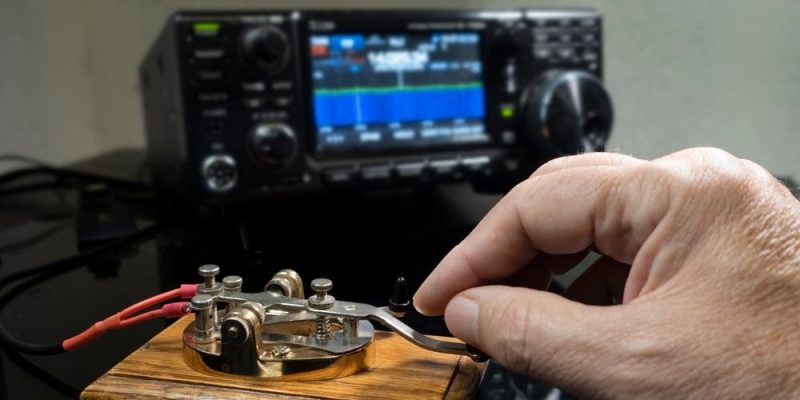
The last standard Morse code transmission in the United States took place in 1999 and that event is considered the symbol of the end of the telegraphic era and the usefulness of Morse code. However, the latter It continues to be used in very specific areas such as the radio amateur and scouting clubs, and the aviation club, as a mechanism to confirm the correct tuning between the plane and those who communicate with it via radio from the mainland.
Online Morse Code Translators
There is nowadays online software to translate the natural message into Morse code and vice versa. Some examples are:
- Rodamedia Morse Translator.
- Morse Decoder.
- Text Converter Morse Translator.
References
- “Morse code” on Wikipedia.
- “The incredible story of Morse code” in Mundo GEO.
- “Dots and dashes: how the invention of Morse Code changed the world” in Infobae (Argentina).
- “Morse Code (communications)” in The Encyclopaedia Britannica.