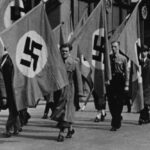
We explain what National Socialism is, the origin of this political doctrine and its characteristics. Also, who was Adolf Hitler?
National socialism is A political, totalitarian and racist doctrine that was imposed by Adolf Hitler in Germany and that protected the absolute power of the State. Hitler ruled from 1933 to 1945 under a totalitarian regime, known as third Reich, in which individual rights and freedoms were suppressed and was persecuted for any opposition.
To the doctrine of national socialism It is also known as Nazism which is the abbreviation of the German National Socialist Party of the Workers, created in 1920 and led by Hitler from 1921. Nazism was an ideology of the extreme right, anti -communist, anti -Semitic and anti -parliamentist that considered the Aryan race as a “upper race” with respect to the populations of the other countries of Europe.
National Socialism took control of the German State and suppressed the unions and many private entities . As in the Italian fascism of Benito Mussolini, the existence of other political parties was not allowed. Through the control of the media, the State tried to position Hitler, called Führer, as an omnipotent leader who was going to rescue Germany.
Who was Adolf Hitler?
Adolf Hitler was A German military and politician who led the National Socialist Party or Nazi party, from 1921 until his death in 1945. Hitler was part of the German army during World War I and began his political life under the flag of the rejection of the Weimar Republic and the provisions of the Versailles Treaty of 1919.
After several years as leader of the National Socialist Party, Hitler assumed the power of German chancellor in 1933 and he gained executive and legislative powers that led him to form a type of antidemocratic and totalitarian government called Third Reich.
During his 12 years in German power, Hitler He sought to unite the Germanic peoples which meant chasing and exterminating all citizens who did not belong to the ARIA race. Imperialist ideas made Germany begin, in 1939, to World War II with the idea of annexing territories.
The persecution of all opposition extended during the Hitler government and went beyond the German borders. During the years that World War II lasted Torture fields were created to enslave and exterminate the races that the Nazis considered inferior.

Origin of National Socialism
In 1919, after the end of World War I was devastated, his people suffered poverty and humiliation produced by the clauses of the Versailles Treaty. The Weimar Republic was the political system that governed Germany since 1918 which consisted of a democratic government that presented great political, economic and social instability.
Hitler’s figure in the political sphere arrived in 1919 when he joined the German Workers Party (DAP) and little by little he began to stand out for his speech capacity, his promises of a great future for Germany and his racist and populist ideas. In 1920 the DAP was renamed as German National Socialist Party (NSDAP), also called the Nazi Party, and Hitler began to be its leader.
In 1923 the army tried a coup d’etat and Hitler was arrested and imprisoned. In those months of captivity he wrote “My struggle”, a book in which he revealed his anti -Semitic and anti -communist ideas and his plans for Germany. After leaving jail, Hitler was silenced, so he could not make speeches but he dedicated himself to structuring the Nazi party creating organizations within it.
Over the years Hitler was winning allies among the ranks of the Army and between a large number of German citizens hit by the war and the economic crisis of 1929. After successive elections, The Nazi party was gaining power in Parliament and by 1932 it already had a majority . In 1933 Adolf Hitler was appointed chancellor by President Paul Von Hindenburg and, after his death, Hitler assumed all the powers of the State and self -proclaimed Germany leader.
In February 1933 there was a fire in the Reichstag and the Nazis blamed the communists. Faced with this situation, an emergency decree was drafted that granted special powers to Hitler and promulgated the enabling law that gave him all the powers of Parliament.
From there they began to limit and eliminate many of the freedoms and rights of the German population, The Communist Party was prohibited and regional governments were in the hands of Nazism . In the “Night of Long Knives”, in June 1934, a massacre of political opponents was carried out that became one of the milestones that marked the development of the Nazi dictatorship.
Using as a flag the resentment for the clauses of the Versailles Treaty, the fight against communism and against the great economic depression, Hitler ruled the third Reich until 1945.
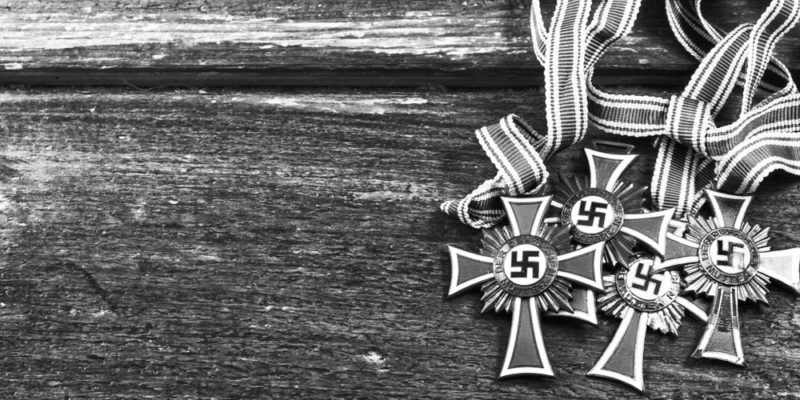
Some of the main characteristics of German nationalism were:
- Leader . Much of the German people were attracted to a charismatic leader, with a speech in which he promised the recovery of German splendor. Hitler was known as “Führer” and was shown as a leader with the mission of guiding and unite the people.
- Nationalism . National Socialism was characterized by exacerbating and exalting the figure of Germany. His followers believed in the superiority of the German people over the communities and peoples of the rest of the nations.
- Totalitarianism . During the third Reich all political power was in the hands of a single leader, Hitler, who ruled on all areas of society. German National Socialism abolished individuals and individual rights and private entities, political parties and unions remained in the hands of the State or were suppressed.
- Anticomunism . National Socialism fought against communism and persecuted all the people who professed that ideology.
- Anti -capitalism . National Socialism was consolidated as a third -position ideology (having no ideas or communists) that claimed the figure of the State as a guide.
- Unipartidism . During the Government of the German socialism all political parties that were not Nazism were prohibited. Citizens with another political ideology were persecuted and repressed.
- Use of propaganda . Propaganda was used, through the media and speeches, to exalt Hitler’s figure as a leader and impose Nazist ideas on citizens.
- Censorship . In the years in which Nazism was in power, all forms of expression and manifestation were prohibited and all those who had ideas that would not commune with national socialism were persecuted.
- Aria race. Nazism took ancient Nordic legends the idea that the Aryan race (which came from the Greeks, Romans and Germans) was stronger, pure and superior. This theory considered that the main mission of the State was to unify the Aryan peoples (which were scattered by Europe and mixed with other cultures) with the aim of recovering the origins of purity of the race and consolidating a new superior race exterminating the rest.
- Imperialism . National Socialism sought to group all German peoples in a single territory. Thus, he invaded other nations and pursued all those who were not considered of the Aryan race.
- Racism . The idea of a superior German breed served as a basis and justification to suppress all those races that were not considered pure. In this way the Nazi regime justified mass killings and persecutions, especially towards Jews, communists and gypsies.
- Use of force . Military forces were used to intimidate the population and suppress and persecute every citizen who would not align the ideas of national socialism.
- State education . The different organizations within Nazism were used to transmit the ideas of National Socialism to all groups of the German population.
National Socialism in World War II

After the First World War it remained between the population and the spheres of German power A great resentment for the provisions of the Versailles Treaty treaty that ended World War and that made Germany responsible for the war with clauses that included payment of debts and removal of territories.
The economic hardship derived from the conditions of the Versailles treaty, added to the economic depression of 1929, generated great discomfort among the German people. Faced with this situation and the weakening of the Weimar Republic, National Socialism directed by Hitler emerged, with promises to recover territories and return splendor to Germany. Imperialism was one of the main engines that promoted German expansionism with the excuse of unifying “the German peoples.”
In 1935, without taking into account the clauses of the Versailles Treaty, Germany began to rearm militarily to attach territories and on September 1, 1939 invaded Poland. This invasion began World War II and marked the beginning of the German expansion, which then continued in countries such as Denmark, Norway and France.
After six years of successive battles, United States, Britain and the Soviet Union faced German expansionism and German troops began to surrender between April and May 1945 . National Socialism began its fall after Hitler’s suicide, on April 30, 1945, and the subsequent surrender of German troops between May 7 and 9, 1945.
References
- “Brief history and presentation about Nazi ideology” in Chile’s National Archive
- “The creation of a leader” in holocaust encyclopedia
- “National Socialism” in Deutschland
- “This is how Hitler amounted to power in Germany” in Channel Historia
- “Adolf Hitler” in Britannica
- “Rise of the Nazis” in Discovery