We explain who Ceausescu was and how he became dictator of Romania. Also, his political rise within the Communist Party.
Who was Nicolae Ceausescu?
Nicolae Ceausescu (1918-1989) He was a communist politician who ruled Romania between 1967 and 1989. He was a member of the Romanian Communist Party (PCR) and had the political support of Gheorghiu-Dej, his predecessor in the country's government.
During his government of Romania, he concentrated the different functions of the State and imposed himself on the different powers and political forces. Controlled political dissent through prohibition, censorship and repression . He established centralized state planning of the economy, fostered the industrialization of his country, and supported access to public health and education.
Romania was part of the Eastern Communist Bloc during the Cold War, but Ceausescu managed to maintain some autonomy from the influence of the Soviet Union in his country. His dictatorial government was overthrown by the Romanian Revolution. 1989, in which the armed forces joined the popular uprisings. Ceausescu and his wife were sentenced to death and executed by firing squad.
The private life of Nicolae Ceausescu
Nicolae Ceausescu was born on January 26, 1918 in Scorniceşti, Romania. Son of Andruta and Alenxandra Ceausescuhad a humble childhood in a rural environment . His family had little income, so at the age of eleven Nicolae had to start working. He went to live in Bucharest, where there were more job opportunities, and got a job in a factory as a worker.
There he came into contact with union organizations and in 1931 he joined the Communist Party of Romania (PCR). At that time, Romania was going through a serious crisis (linked to the Great Depression unleashed in 1929) and the government repressed the protests and banned the party.
The agitation and strikes led to riots in the streets and in 1933 Ceausescu was arrested. Although he was soon released, in the following years He was arrested by the police on several occasions for his partisan activity. He spent almost the entire Second World War imprisoned, until he was released in 1944. In prison he met Gheorghiu-Dej who, a few years later, facilitated his promotion within the political structure of the party.
In 1946 he married Elena Petrescu, another political activist whom he had met in prison. They spent the rest of their lives together and Elena had a great influence on Nicolae's actions and, therefore, on the political future of the country.
The political life of Nicolae Ceausescu
The political rise
During the final years of World War II, the imminent defeat of the Axis side (to which Romania belonged) led to an internal coup d'état and the establishment of a new government coalition between the various forces that had remained underground.
In 1944, the new government changed war alliances and facilitated the Soviet advance and the entry of Russian troops into Romanian territory . In this context, communism not only grew among the population, but the party began to have more power and influence.
In 1944, the Romanian Communist Party appointed Ceausescu secretary of the Union of Communist Youth. In 1947, fraudulent elections were held and the RCP took over the government under the leadership of Gheorghiu-Dej. From there, the monarchy was abolished and the “people's republic” was proclaimed. In addition, all opposition parties were suppressed.
At that time, Ceausescu was already among the main leaders of the party and was appointed Minister of Agriculture. In the following years, he held various positions such as vice minister of the Armed Forces, vice minister of Defense and head of the Higher Political Directorate of the Army.
In 1954, thanks to Gheorghiu-Dej, Ceausescu became a full member of the Politburo (the highest leading body of the Communist Party of the Soviet Union). In 1965, Gheorghiu-Dej died of health problems. Ceausescu became General Secretary of the Party and thus took over the government of Romania.
The Romanian dictatorship
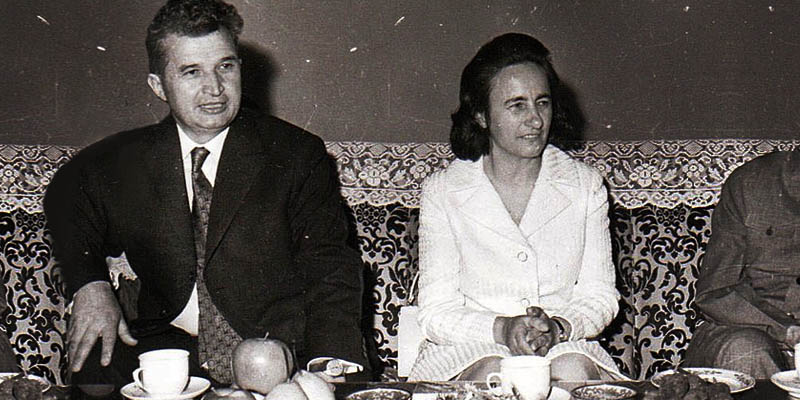
During his government, Ceausescu concentrated power in the presidency and managed to dominate all the powers of the State . On the other hand, he sought to maintain Romania's autonomy from the USSR, an international policy orientation that he took from his predecessor Gheorghiu-Dej. On different occasions he maintained a different position from that established by the Soviet Union. When the Warsaw Pact countries carried out the Prague Spring invasion of Czechoslovakia in 1968, Ceausescu declared himself against and repudiated Soviet policy in a public speech.
In the economic sphere, he also maintained the orientation of Gheorghiu-Dej. He deepened the intensive industrialization program. During the 1960s and 1970s, salaries and living conditions of the Romanian population improved . The State nationalized service companies and the population obtained free health and education at all levels.
However, the concentration of power was accompanied by extreme control over dissent, prohibition of any opposition and censorship of freedom of expression . In the style of other communist dictators, Ceausescu also promoted the cult of his person.
In the 1980s, the limitations of the economic model began to be seen. The government determined the export of rural production in order to pay the foreign debt it had contracted for its industrialization program. The economy deteriorated, wages deteriorated and inflation broke out . Towards the end of the decade, like the rest of the Eastern Communist Bloc countries, Romania entered into crisis.
In 1989, the Romanian Revolution broke out. Popular demonstrations against Ceasescu's communist government spread throughout the country and were harshly repressed by the police. Demonstrations began in Timisoara, where police fired on civilians. Consequently, the riots multiplied and when they reached Bucharest, the armed forces sided with the protesters and rebelled against the government .
Ceausescu and his wife Elena had to escape the city by helicopter and, because the armed forces controlled the airspace, they continued to escape on foot. A police check found them and handed them over to the authorities. December 25 Ceausescu and his wife were sentenced to death and shot by a military platoon . Romanian television showed images of the trial and the execution of the sentence.
References
- Almond, M. (1992). The rise and fall of Nicolae and Elena Ceauşescu. Chapmans.
- Britannica, The Editors of Encyclopaedia (2023). “Nicolae Ceaușescu.” Encyclopedia Britannica.
https://www.britannica.com/ - Palmowski, J. (2000). “Nicolae Ceaușescu.” A dictionary of twentieth-century world history. Oxford University Press.