We explain what a paradox is, what are considered “paradoxes of life” and examples of famous paradoxes, such as time travel.

What is a paradox?
a paradox is an idea, fact, or proposition that contradicts logic or violates common sense . the word paradox comes from latin paradoxwhich literally means “contrary to common opinion.” It is also called antilogy. It should not be confused with sophistry, which is reasoning valid only in appearance.
They are common ground for philosophical or logical debate, since the paradoxes They often lead to dead ends of logic. . They are often formulated as a way of transmitting some conceptual complexity in a specific field of knowledge, the resolution of which escapes the traditional mode of thought.
We can talk about the following types of paradox:
- True paradoxes. Those that are verifiable, but that have an air of absurdity or contradiction to the terms themselves.
- Antinomies. Paradoxes whose result contradicts the premises from which it comes, despite the fact that their deductive methods are perfectly valid.
- Definition antinomies. Mostly used in literature, they are based on ambiguous definitions, or illustrative methods of thinking regarding a key meaning.
- Conditional paradoxes. Propositions that acquire a paradoxical character as we try to resolve them, either because there is a lack of information for their resolution or because it is simply impossible.
It is also common to categorize paradoxes by the area of knowledge to which they relate: mathematical paradoxes, paradoxes in physics, etc.
What is paradoxical?
By extension, all of them are called paradoxical. situations, facts or propositions that contain within them an unsolvable situation ironic, contrary to logic or challenging common sense.
We can say that a situation is paradoxical, for example, when we find ourselves immersed in conflicts whose resolution makes them worse, or when the pursuit of our desires makes them, precisely, unattainable.
Paradoxes of life
We often talk about the “paradoxes of life”, to refer to the fact that People often find themselves in paradoxical situations. ironic or without apparent solution. In them, doing the obvious further complicates what it is supposed to solve.
There is no “official” or definitive corpus of these paradoxes of life, but rather These are popular formulations said by people. They are used as ways of thinking about life and its arbitrariness, in the “logic” of life, that is, as a form of teaching regarding what, paradoxically, one cannot learn to foresee.
In the following points we will see some famous paradoxes from different areas.
Fermi paradox

This title is known as the apparent contradiction that exists between the high probability that intelligent civilizations exist on other planets and solar systems (given the dimensions of the Universe) and the total absence of evidence about that we human beings have to this day.
The first person to formulate this paradox was the Italian physicist Enrico Fermi, in 1950. in the middle of an informal conversation, while working in the United States.
Perhaps due to the pessimism that existed at that time of Cold War and possible nuclear conflict, Fermi answered his own question that, along with the technological development that would make space travel effective, civilizations were also developing the technological potential to annihilate themselves. . Thus, he predicted an unpromising future for humanity.
Epicurus Paradox
Also known as the Problem of Evil, this philosophical or religious paradox contains the difficulty that exists for reconcile the existence of evil suffering and injustice in the world, with the supposed existence of an omniscient and all-powerful deity which is also benevolent, as classical theism suggests.
This paradoxical approach is based on four basic questions:
- Is it that God wants to prevent evil, but cannot? So he is not omnipotent.
- Is it that God is able to do it, but does not want to? So it is not benevolent.
- Is it that God is able to do it and also desires it? Why does evil exist then?
- Is it that God is not able to do it nor does He want it? Why call him God then?
According to the Latin writer and Christian apologist Lactantius, The Greek philosopher Epicurus of Samos was the first to formulate this paradox which is why she is often mentioned by name.
twin paradox
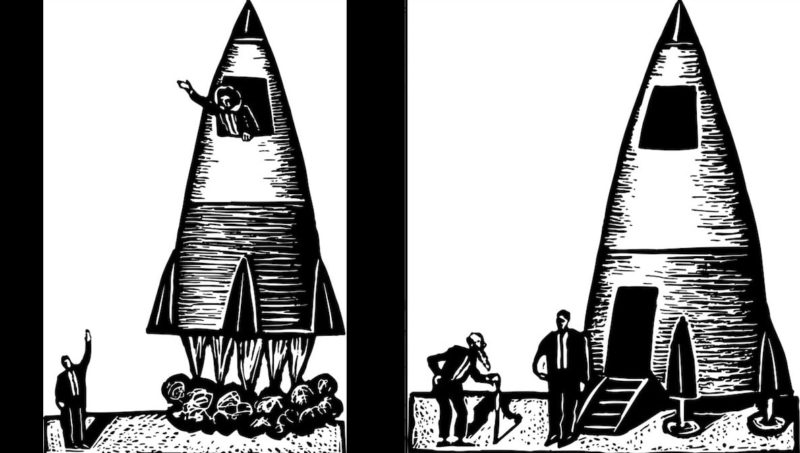
Also called the Clock Paradox, it is a mental experiment that attempts to understand the difference in the perception of time in two observers in different states of motion. It was proposed by Albert Einstein .
It is part of what we know today as the Theory of Special Relativity, where the genius physicist explains how, far from being absolute dimensions, time and space depend on the positioning of the observer .
The most common formulation of this paradox is due, however, to the French physicist Paul Langevin, and takes as protagonists two twins: one of them remains on Earth while the other undertakes a long journey towards a distant star, in a ship. spacecraft capable of reaching speeds similar to those of light.
Eventually, the traveling twin returns and realizes that he is younger than his brother on Earth, since time dilation would have made his time pass more slowly than his brother's own time.
The paradox, however, arises when the observation is made that, seen from the perspective of the traveling twin, it is the Earth that is moving away at speeds very close to light, and therefore it is his brother who would have to age more. slowly.
Time travel paradox
Also known as the Grandfather Paradox, it is a very popular paradox. It was probably formulated by the science fiction writer René Barjael in his novel The reckless traveler 1943, although other authors such as Mark Twain had previously explored it.
The paradox stems from the fact that A man travels through time, returning to the past and being able to murder his mother's father. that is, to his grandfather, before he meets his grandmother and conceives his mother.
In this way, his mother would never be born and he himself, therefore, neither, so he could not go back in time and murder his grandfather, allowing him to meet his grandmother and conceive his mother, who would then conceive him. to him, thus allowing him to travel back in time and murder his grandfather, and so on.
References
- “Paradox” on Wikipedia.
- “Paradox, ha” in Dictionary of the Royal Spanish Academy.
- “Paradoxes” in Soviet Dictionary of Philosophy.
- “What is PARADOX?” (video) in Audiopedia.
- “Fermi Paradox” on Wikipedia.
- “Problem of evil” on Wikipedia.
- “Twin Paradox” on Wikipedia.
- “Time travel paradox” on Wikipedia.