We explain everything about penguins, where they live, what they eat and other characteristics. Also, how long they live and how they reproduce.
What are penguins?
We call penguins the different species of birds belonging to the family Spheniscidae, only birds on the planet that instead of flying, use their wings to dive in the sea and capture their food. They are species almost exclusive to the southern hemisphere of the planet.
This name comes from Welsh pen (“head”) and gwyn (“white”), a term that in Great Britain was given to similar but biologically distant species. However, the first Europeans to observe a penguin were not British, but the crew of the first expedition of the Portuguese navigator Vasco da Gama (ca. 1460-1542), who nicknamed them “child birds” or “silly birds” due to their peculiar way of walking.
Currently There are around 18 living species of penguins known, grouped into six different genera all descendants of gigantic prehistoric seabirds (plolotperids) that more than 60 million years ago adapted their bodies to capturing submerged food on the coasts of New Zealand. This is an adaptation that distinguishes penguins from any other species of seabird that exists.
The penguins are social animals that live in numerous colonies, and whose greatest danger to life is represented by the human hand . In fact, climate change and the melting of the poles is one of the main risks that the species must face, along with maritime pollution from chemicals and plastics. Several of the current species of penguins are at some risk of extinction.
Characteristics of penguins
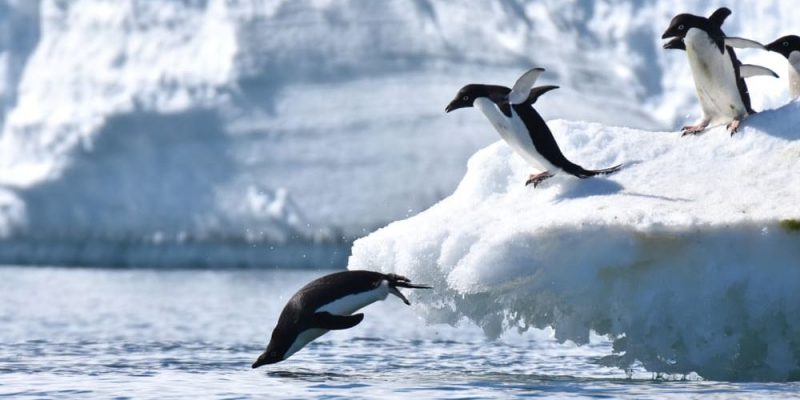
Penguins are broadly characterized by the following:
- Like all birds, are bipedal, but lack flight . Their wings, adapted for swimming, have compressed and solid bones, with rigid joints, and their legs are located further back than usual, to allow them to stand in the dry, and also act as rudders underwater. The general shape of their body is hydrodynamic, although they vary greatly in size.
- The penguins are excellent swimmers, capable of reaching speeds of up to 60 kmph and holding your breath for up to 18 minutes, in some species. They spend most of their time submerged, but they emerge to reproduce and lay their eggs.
- Penguin plumage consists of three different layers black and white in color and other variable features depending on the species, but they also have a thick layer of fat under the skin to insulate body heat from the frozen water and air of Antarctica.
- communicate by squawking with a level of specificity such that they can recognize each other in the middle of noisy and crowded colonies.
- They are sociable animals, forming extensive colonies and famous for their monogamy . In various cultures they occupy a place of sympathy, considered in the West as exotic animals.
Where do penguins live?
The penguins are almost exclusive inhabitants of the southern hemisphere of the planet except for species adapted to equatorial life in the Galapagos Islands (Ecuador).
The species located on the Antarctic continent they represent 80% of the region's biomass although during mating seasons they can migrate to much warmer latitudes. Currently there are penguin colonies on the coasts of New Zealand, Antarctica, Argentina, Chile, Peru, South Africa, the southern region of Australia and the subantarctic islands.
What do penguins eat?
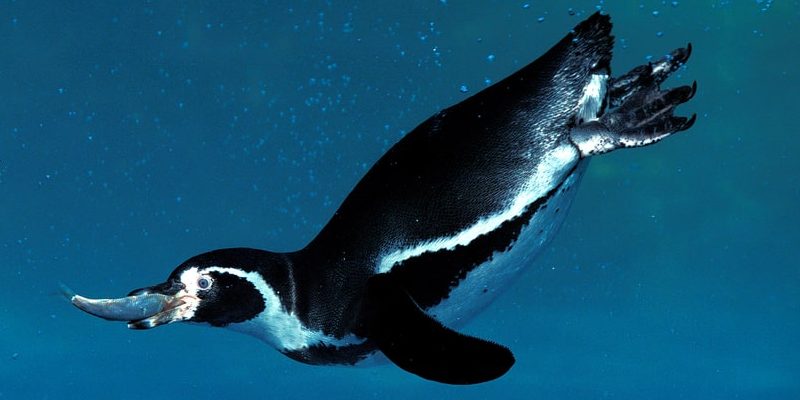
The diet of penguins consists mainly of fish and cephalopods that hunt during their dives, except for some species adapted to eating zooplankton and tiny crustaceans. Penguins have a specialized gland, shared with most marine species, that allows them to eliminate excess salt from ingesting seawater, so do not need to drink fresh water .
How do penguins reproduce?
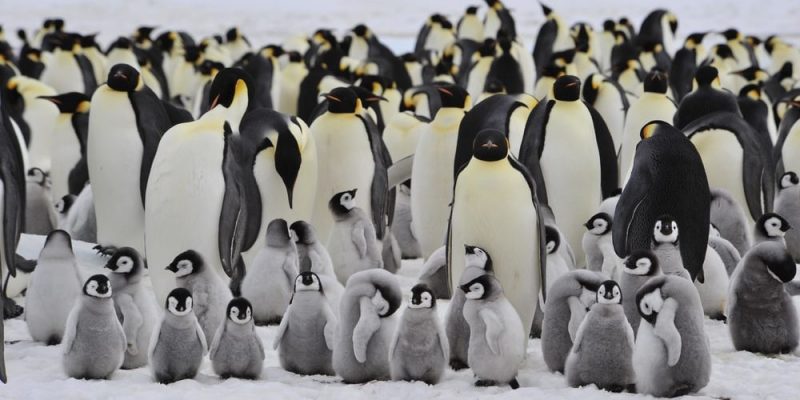
Penguins, like all birds, reproduce sexually and through oviparous mechanisms, that is, laying previously fertilized eggs inside the female. Although most species do not present marked sexual dimorphism (difference between males and females), they do present complex dynamics of courtship and nest construction, whether in underground galleries or above-ground locations.
The emperor penguin, for example, does not create nests, but rather holds the egg against its body for the time necessary for it to incubate, a period that, depending on the species, can take between 32 and 62 days.
Generally, Each pair of penguins lays a single egg at a time, from which a single chick emerges . The chicks grow quickly, and after two or three weeks after the first molt, they become completely independent.
How long do penguins live?
The average lifespan of a penguin varies depending on the species, but In general, it is between 10 and 20 years old and can last a little longer in ideal conditions of captivity.
References
- “Spheniscidae” in Wikipedia.
- “Penguins” in National Geographic.
- “Curiosities about penguins” in VERY Interesting.
- “Penguins: natural history and conservation” at CONICET (Argentina).
- “Penguin (bird order)” in The Encyclopaedia Britannica.