We explain what the post -classic period, its historical context and its characteristics is. In addition, what are the main civilizations and more.

What is the post -classic period?
The post -classic period corresponds to The last stage of the history of pre -Columbian America between 900 d. C. and 1521 d. C.
This stage He stood out for the military emphasis of Mesoamerican cultures and for the development of the centralized state in the Andean region. Among the main cultures of the post -classic period were the Mayan, Inca and Azteca empires.
Pre -Columbian American Chronology

The postclassic period was preceded by the classical period (200-900 d. C.) and is divided into two stages:
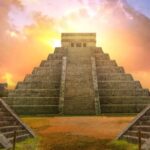
- Early postclassic (900-1200 d. C.) . In this phase the Mixteca and Tolteca cultures developed in the Mesoamerican region, and the Mayan city of Chichén Itzá consolidated its predominance in the Yucatan Peninsula.
- Late postclassic (1200-1521 AD) . This stage was characterized by the development of the Aztec Empire in the Valley of Mexico and the Inca Empire in the Central Andes. In addition, Mayapán’s Mayan city-state consolidated its power to the detriment of Chichen Itzá.
Postclassic period characteristics
The post -classic period was characterized by:
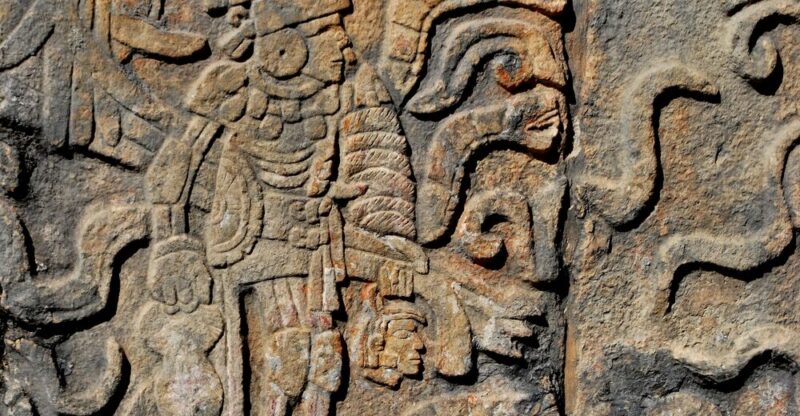
- Mesoamerican political instability . In Mesoamerica, the constant wars for the control of territories and political hegemony marked the rise and fall of numerous cultures.
- Imperial development . Over time, the hegemony of the militaristic victorious states, such as the Aztec Empire, prevailed. This implied the development of a state apparatus capable of controlling and administering the submitted companies, which imposed the payment of taxes and services.
- Defensive architecture . In this warmame context of Mesoamerica, a defensive architecture was developed in urban centers. Several cities built walls around them, as well as ditches and goods storage spaces to survive in crisis situations.
- Consolidation of warriors . The increase in military activity led to leading groups directly linked to the war. The sacred feature of the rulers began to relate to their ability to impose military victory over the other peoples.
- Prosperity of merchant groups . The consolidation of commercial routes and the deepening of class differences within Mesoamerican societies generated that merchant groups be relocated to the social scale. The possibility of bringing exotic and luxury goods from distant lands, that the leading classes used as a symbol of distinction, allowed merchants to enrich and consolidate their political power as part of the ruling classes.
- War pantheon . In the religious sphere, the cult of warrior gods such as Quetzalcoátl (the feathered snake), and the gods linked to the rains and fertility were relegated to a second place began to predominate.
- Ceremonial with sacrifices . New forms of religious worship linked to war and political sovereignty appeared. The role of human sacrifice in religious ceremonies was consolidated as an act of veneration to the gods and as a symbol of political superiority.
- Population growth . The improvement of agricultural techniques led to an improvement in food production. This, in turn, allowed the constant growth of the population. The Aztec capital Tenochtitlán came to house more than 300,000 inhabitants and Cusco, the Inca capital, more than 200,000.
Main civilizations of the post -classic

Among the main civilizations of the post -classic period were:
- Maya . They inhabited the Yucatan peninsula between 2000 a. C. and 1527 d. C. Throughout their history, they organized different independent cities-states with theocratic governments. During the post -classic period, the cities of Chichén Itzá and Mayapán consolidated their power in the Mayan horizon.
- Aztecs . They occupied the Valley of Mexico between 1325 and 1521 d. C. From the alliance of the Tenochtitlán, Texcoco and Tlacopan cities, they created a centralized and theocratic empire, governed by a Tlatoani. His society was stratified among the Pipiltin (noble), the Macehualtin (common people) and slaves. They developed an economy based on the imposition of taxes, agricultural technology and trade.
- Mixtecs . They populated the south of the Mesoamerican region since the preclassic period, and created various independent kingdoms, governed by real couples. The Mixtec culture reached its maximum splendor between 950 and 1521 d. C. and stood out for the development of war technology and the participation of women in the high spheres of political power.
- Toltecs . They settled in northern Mesoamerica, and their culture predominated in the region between 900 and 1100 d. C. founded the city of Tollan-Mexicocotitlan (today called Tula), a multiethnic city-state of militaristic ideology. It is believed that its main language was Nahuatl and exerted great influence on other cultures in the region.
- Incas . In South America, they formed the most extensive empire of the pre -Columbian era. They inhabited the Andean region, between the twelfth and sixteenth centuries d. C. and organized a theocratic empire, led by a sacred monarch called SAPA INCA. His society was structured in communal kinship groups, called ayllusthrough which production and work in agricultural land was organized. Its main gods were Viracocha and Inti, whom they adored as patrons of humanity and their civilization.
End of post -classic period
The end of the post -classic period occurred with the conquest of the Spaniards . Between 1511 and 1521, the Maya resisted the attempts to conquer. In 1521, Hernán Cortés managed to dominate the Tenochtitlán, capital of the Aztec empire.
From there, he sent various armies to the Yucatan Peninsula. European invaders took advantage of disputes between Mayan cities and, around 1546, they imposed on almost the entire peninsula. At the same time, Francisco Pizarro led the Andean campaign and managed to conquer the Inca Empire in 1533.
})
References
- López Austin, Alfredo; and López Luján, Leonardo (2001): The indigenous past. Mexico City: The College of Mexico.
- Boehm of Lameiras, B. (1991). The State in Mesoamerica. Study on its origin and evolution. Spanish Journal of American Anthropology, 2111.
- Carmack, Robert et. to the. (1996): The Legacy of Mesoamerica: History and Culture of A Native American Civilization. Prentice Hall. New Jersey.
- Duverger, Christian (1999): Mesoamerica, Art and Anthropology. Conaculta-Londucci editors. Paris.
- “The Mayan Post-Classic was” in History on the net.
- “Maya” in History.
- “Postclassic Period” in Mesoamerican Research Center.
- “Late postclassic” in UNAM Magazine.
- “Early postclassic” in Mexican Archeology.