We explain what the primitive man, its characteristics and its evolution is. In addition, the first hominids, discoveries and more.

What is the primitive man?
The term “primitive man” refers to Prehistoric human beings which belonged to evolutionary phases before the modern man.
The expression “primitive man” is used to refer to human evolution during prehistory. Traditionally, this term was used to refer to All human groups that existed until the invention of writing . This covers millions of years, from the appearance of Homo habilis (2.5 million years ago) until the development of the first written records (3300 BC).
Nowadays The term is falling into disuse in favor of other more specific concepts such as “paleolithic man” or “archaic man” and is no longer used in academic fields to refer to the men of the Neolithic period (AC. 8000-3000 a. C.).
In its traditional conception, the primitive man It belongs to the Biological Family of Hominids which is made up of primates, such as chimpanzee, gorilla and also the human being. While primates can be identified as a common ancestor among all hominids, through the hominization process, the human species differentiated.
Gender Homo It covers all the species that were part of the evolutionary process of man. There were various types of hominids that coexisted and inhabited the world in different spaces and moments in history. He Homo sapiens sapiens It is the human species that adapted to the changes in the environment and survived the extinction of the other species.
First hominids

According to the archaeological evidence that allowed to rebuild prehistory, among the first hominids are:
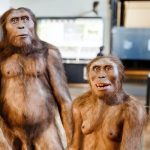
- Australopithecus . It is a species that shares more similarities with apes than with Homos. He evolved in Eastern Africa about four million years ago and was extinguished about two million years ago.
- Homo habilis . It is a species that lived between 2.6 and 1.5 million years ago. He coexisted and had common features to Australopithecus, although he had a greater development of cranial capacity and skill with his hands.
- Homo erectus . It is a species after Homo habilisdating a million and a half years ago. He differentiated himself from the previous hominids due to his most slender body contexture and his greatest stature. In addition, it had more cranial capacity.
- Homo sapiens . It is a species that evolved from Homo erectusand its oldest remains in their archaic form date from 500,000 years ago. He differentiated himself by reaching greater height and cranial capacity. The Homo sapiens They made more elaborate tools, gave more complex use to language and buried their dead.
- Homo Neanderthalensis . It is a species that has lived for 23,000 years to 30,000 years ago. Today is considered a subspecies of Homo sapienstogether with the Homo sapiens sapienswith whom he coexisted for thousands of years. The Neanderthals were hunters and lived in large groups.
- Homo sapiens sapiens . It is the species to which the current human being belongs. The oldest archaeological remains date from 100,000 years ago. For 30,000 years it is the only surviving species of the genus Homo.
Evolution of primitive man
Among the biological characteristics that differentiated the primitive man from the rest of the species we can find:
- The walking in a biped way that is, on two of its lower extremities.
- The development of the skeleton with longer limbs and a shorter and more robust pelvis.
- The upright posture although at first, the back was something hunched.
- The increase in brain mass In proportion to body mass, an evolutionary process called “corticalization.”
- Mental development both conscious and unconscious, as a result of brain activity (evolutionary process called cerebration).
- Hand development together with brain capacity to control the fine motor skills of movements.
- The most space development of the cranial cavity and smaller jaws.
Geographical location of the primitive man
The evolution of the primitive man involved small variations in genetic material that is, in DNA (deoxyribonucleic acid) that contains the instructions for the development and functioning of the organism. The accumulation of genetic information during the passage of the different generations caused the different evolutionary changes.
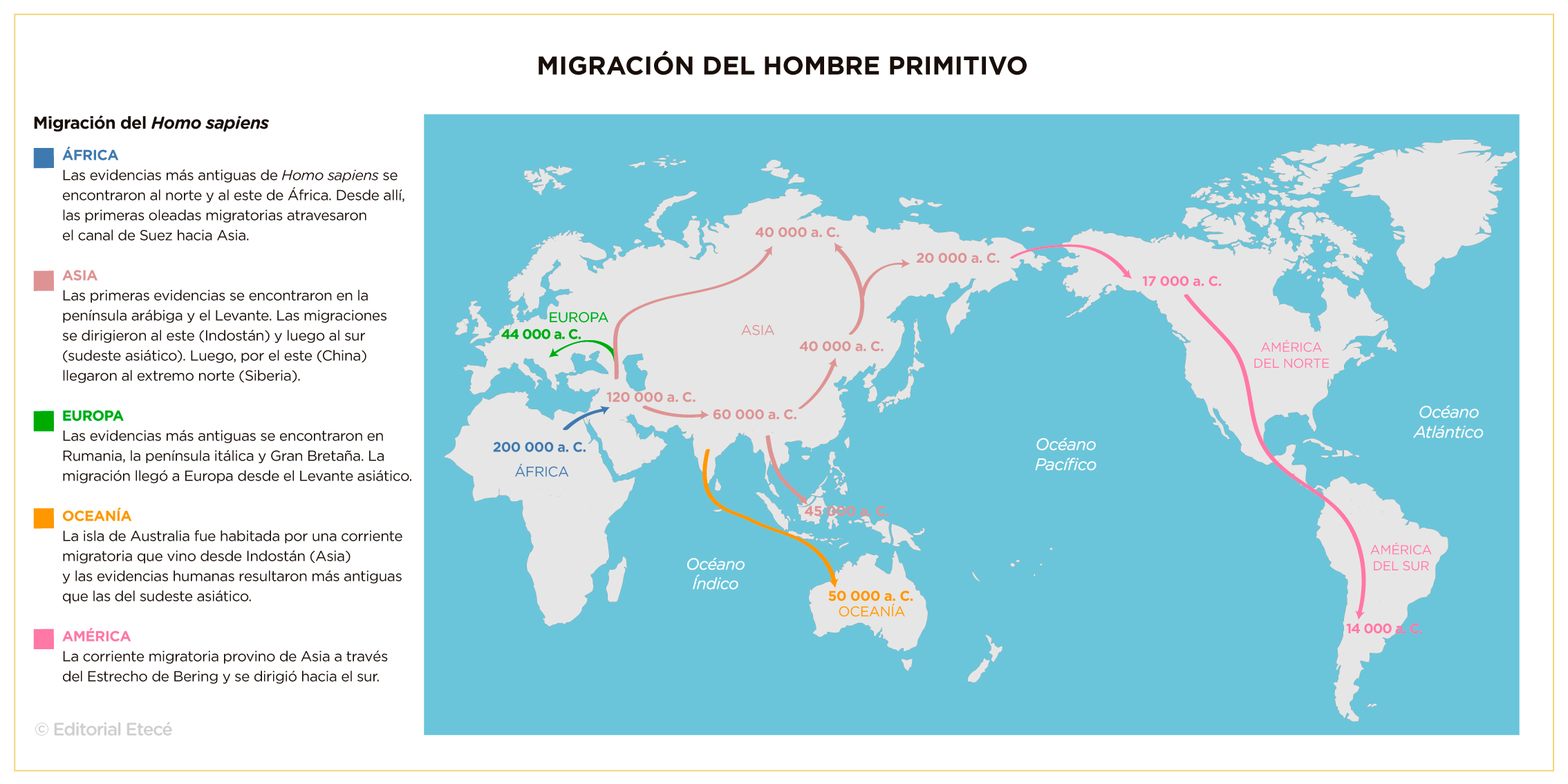
According to the most accepted theory by scientists, it is estimated that about 90,000 years ago he Homo sapiens began to migrate from the African continent to various territories in Europe and Asia . Then, about 60,000 years ago, it extended by Oceania.
More than 13,000 years ago, during the last glacial period of the ice age, a land bridge was generated that united the continental masses of Asia and North America. It is estimated that the primitive man could migrate to the American continent through that path.
In each case, migratory movements had various reasons that forced individuals to mobilize to survive such as the lack of food and the need to go in search of new sources, the hard climatic conditions or natural catastrophes.
Discoveries of primitive man

The primitive man, that is, the ancestors of the genre Homo And the predecessors, made key advances that changed the course of their offspring.
Among the main discoveries of prehistory are:
- Utensils carving . The primitive man made small tools and utensils carved in bone and stone that allowed him to crumble the animals that hunted and collect vegetables and fruits.
- The work of the stone . The primitive man did stone work with increasingly sophisticated techniques, such as the polished stone that allowed him to manufacture stronger tools, even to work the earth.
- Fire control . It was one of the most important discoveries for the development of primitive man. In the beginning, he allowed him to warm up in the caves during the frost nights, scare wild animals, illuminate and cook food.
Primitive man culture
The main cultural features of primitive man were the following:
- Nomadism . Human groups did not live in a fixed place, but moved following animals and seasonal cycles.
- Subsistence economy . Primitive men fed from elements that existed in nature. In principle, through the collection of fruits and vegetables and the consumption of meat from dead animals due to natural causes or abandoned by other predators. Then, they became hunters, first of small animals, and then, through the manufacture of group hunting tools and techniques, they began to capture larger animals.
- Bands . The nomadic way of life and the subsistence economy favored that human groups organize in small groups (called “bands” by historians) of between 20 and 30 people. These groups were united by kinship relations and controlled the territories by which they moved to obtain their resources.
- Equal societies . Primitive men had no leaders or formal bosses. Sometimes an individual could stand out for his skills and was specially respected. The elders were heard from their experience and had greater authority to resolve conflicts. However, they were equal societies in which there was no hierarchy of power.
The end of primitive man
During the Neolithic (8000-3000 BC), human groups were developing certain knowledge and experiences that changed human organization deeply and gave rise to modern man:
- Livestock . The observation of nature by long periods allowed the primitive man to domesticate plants and animals. From the selection and care, the men went from controlled hunting (in which animals of reproductive age were preserved) to the capture of animals for their breeding and control.
- Agriculture . From the observation of growth and plant cycles, the primitive man selected seeds and planted them to wait for their growth. He developed different irrigation and agricultural care techniques to produce food.
- The creation of villages . From the development of a productive economy (livestock and agriculture), the first large towns emerged. Men built more complex buildings, with more durable materials. They developed housing spaces, but also for the storage of resources and the manufacture of tools and other material objects.
})
References
- López Serrano, A. (1996). Hominization and material culture process. The contribution of historical anthropology.
- Harris, M. (1981). Introduction to General Anthropology. Alliance.
- Leakey, R., & Lewin, R. (1994). Our origins. RBA Editors.
- “Homo Sapiens and Early Human Migration” in Khan Academy
- “Human Evolution” in Britannica
- “Ancient Humans: What We Know and Still Don’t Know” in New Scientist
- “Prehistory in 6 minutes” (Video) in Play Academy
- “The history of human evolution” in NMAS1
- “The basic concepts of human evolution” in National Geographic
- “Main hominids and its evolution: the origin of the Homo sapiens”In Khan Academy