
We explain what World War I, the causes and consequences of this conflict was. In addition, what were its main characteristics.
What was World War I?
The First World War, also known as the Great War, was a large -scale armed conflict that happened between 1914 and 1918, and in which the main powers of the time faced. It was the first war conflict that developed as a war of positions with a technology that included repetition weapons, bombings and air attacks on trenches networks.
The combatant countries aligned in Two great alliances:
- The triple alliance led by Germany, Italy and the Austrohungal Empire.
- The triple entente made up of France, Great Britain and Russia.
The war was a consequence of the political, economic and territorial competence of the European colonialist empires. Without good it was a conflict that happened mainly in Europe, the world economy ended deeply.
The Great War reached levels of mortality and destruction existent until then . The advance of arms technology, the transformation of the conflict into a war of positions and the incorporation of soldiers into a mass war, led to the death of more than 10 million soldiers and more than 5 million civilians.
At the end of the conflict, European economies were deeply affected and the United States consolidated their power in the new world order. The European map changed dramatically : Central empires disappeared as great political units and new countries emerged. Tensions produced by destruction, poverty and political instability transformed Western societies.

Frequent questions
Why was World War I produced?
World War I was caused by rivalry between European colonial empires, which competed for territories, resources and power.
Who won the First World War?
The side that won the First World War was made up of the United Kingdom, France, Italy, the United States and Japan (and other countries that supported it). Russia belonged to this side at the beginning of the war, but withdrew from the conflict a few months before the end.
How was World War I?
World War I was a mass war, for the number of people involved, and was the first “total war”, since all the resources of the countries involved were dedicated to war. In addition, it was the first war of positions: the armies settled in trenches to maintain the occupation of territories.
What were the most important battles of World War I?
Among the most important battles of World War I find the two battles of Marne (1914 and 1918), the Battle of Galipoli (1916), The Battle of Verdún (1916) and the battle of the Somme (1916).
What were the consequences of World War I?
The main consequences of World War I were the death of almost fifteen million people, the transformation of the European map (the German, Austrohungal and Ottoman empires disintegrated into different states), the creation of the Nations Society, the postwar economic crisis and the consolidation of the hegemony of the United States in international politics.
- See also: Phases of World War I
Characteristics of World War I

Among the main characteristics of the First World War are:
- Temporary extension Although all the countries that initiated the war believed that it was going to be a short and quick war conflict, the Great War lasted four and a half years, from July 28, 1914 until November 11, 1918.
- Mass war. For the first time in history, the war conflict reached a mass scale. During the Great War, the population as a whole was mobilized for an extremely prolonged period (more than 4 years). For the first time, the life of man was considered as “war material” available based on military objectives in a massive way.
- War of positions. Instead of War of movementsthe great war triggered in a War of positions. In this combat modality, the soldiers were perpetrated in trenches to defend the positions obtained. Verdun and Somme battles are the most cruel example of this new war system; They lasted several months and took more than two million lives of soldiers. Given the new repetition weapons, the belligerent countries built trenches networks on war fronts.
- War service industry. In this context, the true war potential was in the industrial force of each state. The innovations of the metallurgical, mechanical and chemical industries developed new armaments (machine guns, gases, flamethrowers, tanks and submarines, among others).
Trigger events of World War I
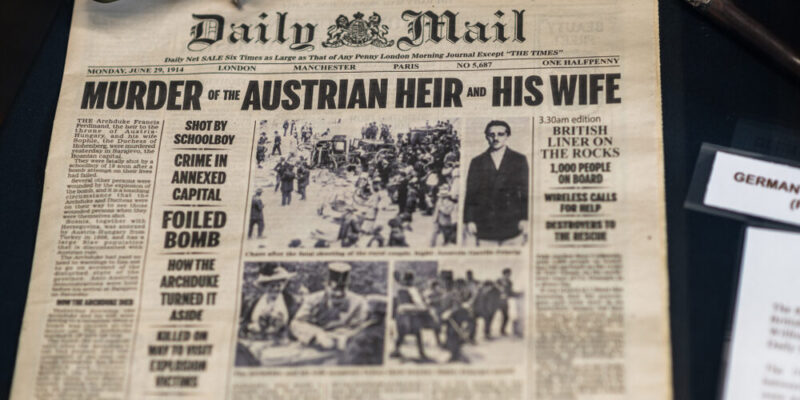
The Great War took place from 1914 to 1918. Its starting point is considered The murder of Archduke Francisco Fernando de Austria (Heir to the throne of the Austro-Hungarian Empire) by a young Serbian nationalist in Sarajevo.
This event triggered a diplomatic conflict that became an armed conflict. Consequently, the Austro-Hungarian Empire declared war to Serbia. Russia came out in support of Serbia, Germany declared war on Russia and invaded Belgium and, then, Great Britain entered the conflict against Russia.

- See also: Chronology of World War I
World War I alliances
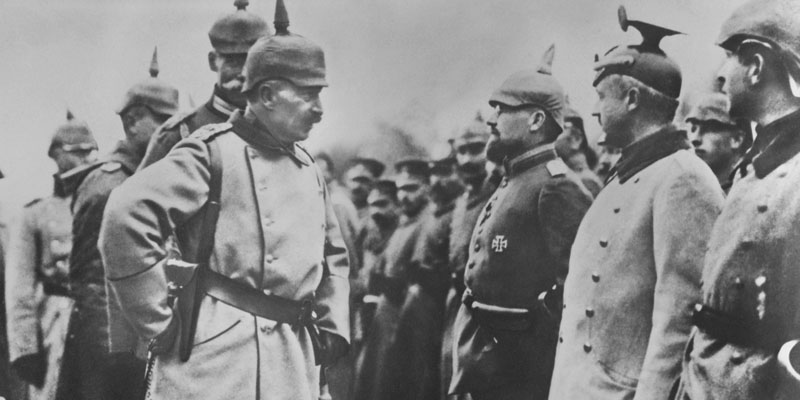
The powers were grouped into two sides that were integrated as follows:
- Triple Alliance. It was made up of the so -called “central empires”: the German empire, the Austrohungal Empire and the kingdom of Italy. The latter, however, changed sides to the first year of the conflict, and fought instead the Ottoman Empire and Bulgaria. Other nations would be added to the alliance based on their relations with the central powers.
- Triple entente. It was made up of the United Kingdom, France and the Russian Empire. Italy joined in 1915 and then also did Japan, Romania and the United States. As the conflict grew, other nations joined the alliance against the central empires.
- Can serve you: World War I alliances
Background of World War I
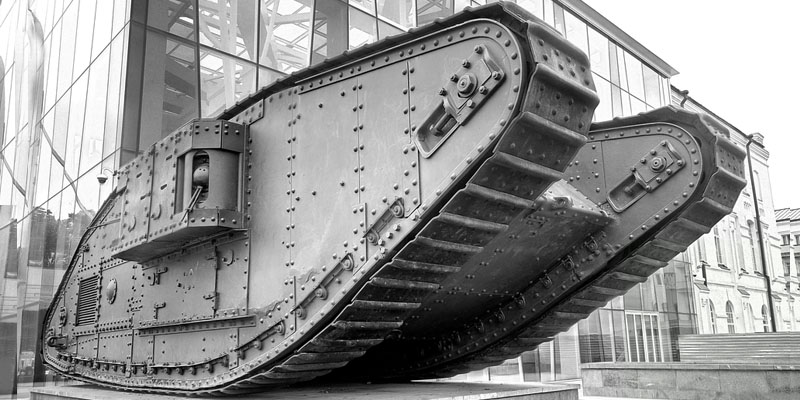
Since the end of the 19th century, a period known as “Armed Peace” was lived in Europe. The European imperial powers competed for their economic and territorial power, which continuously growing tensions between the states. In that context of latent conflict, The powers began to invest more and more resources in the production of armament and in the expansion of their armies.
Given this situation, the different powers were weaving a system of alliances between states. In 1882 the Triple Alliance was formed, an agreement that committed Germany, Italy and the Austro-Hungarian Empire to rely militarily among them. In 1907, Russia, Great Britain and France signed their own coalition with the same purposes: the triple entente.
In this context, there were some decisive factors that led to the growth of conflicts between the powers:
- Economic competition. With the development of industrial capitalism, the power of states began to be measured by their material and productive resources. Its possibility of imposing on the other powers depended largely on its economic, industrial and financial capacity.
- Territorial imperialism. In the last decades of the nineteenth century, European powers sought to extend their political and economic influence in those regions where the states were weaker. Through military occupation, European powers were imposed on the African continent and in many areas of Oceania. Populations, governments and local economies underwent the control of European states, which imposed measures to satisfy their own interests.
- Nationalism. Since the previous century a new type of collective identity had been consolidated in Europe: national identity. According to nationalist ideas, there should be a direct correspondence between territory, political unity and cultural identity. From the representations of the past and the present, the idea that countries should be composed of homogeneous cultural units was created. This new ideology entered into direct conflict with the reality of European populations, in which states were often made up of ethnic entities with various origins and customs.
- Opposed interests. In the political map of Europe, the different powers and countries had political interests that faced them with each other. There were powers (such as the Austro-Hungarian Empire and Great Britain) that sought to preserve their power against the growth of other states; Others wanted to improve their future (such as Italy and Serbia); Instead, there were states that had suffered great defeats in the recent past and wanted to restore their power (such as France, Türkiye or Russia).
- See more in: Causes of World War I
Fronts of World War I
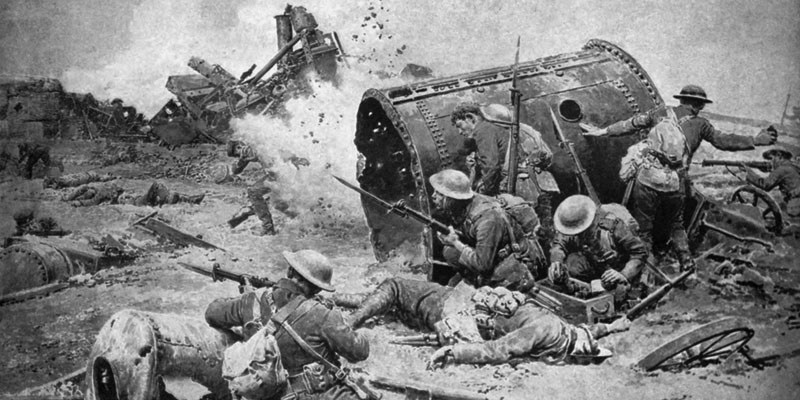
The great war occurred simultaneously on several fronts:
- Western front It is the border on which France and Great Britain against Germany faced, after the latter invaded Belgium and Luxembourg. Then, trench lines were established that stagnated the positions of both sides. The main battles of this forehead were the battle of Marne, the battle of Verdún and the battle of the somme.
- Eastern front. It is the territory in which Germany and the Austrohungal Empire fight against the troops of the Russian Empire. In addition to the border areas between these countries, the front covered the Kingdom of Poland (invaded by Germany), the area of the Russian Carpates and Armenia (with the incorporation of the Ottoman Empire into the conflict). Among the most important battles of this front are the battle of Tannenberg and the battle of Lodz.
- Balkan front. It is the region where they fought the Austrohungal Empire, the Ottoman Empire and Bulgaria, against Serbia, Montenegro and Greece.
- Middle East Front . It consisted of the confrontation of troops more than anything British in its attempt to penetrate the Ottoman Empire and create a corridor to Russia. To this front was added Palestine in 1916. The most prominent battle was the battle of Gallipoli.
- African front. The British and French forces in Africa attacked the German colonies, and this created a climate that took advantage of South Africa to join the conflict and also take over Africa of the Southwest in 1915.
End of World War I
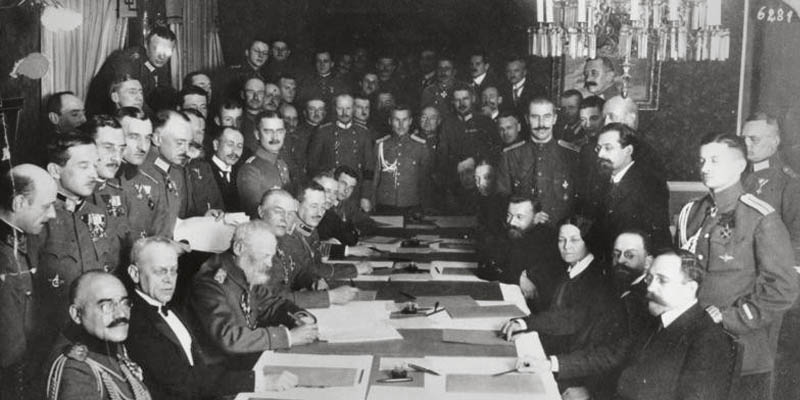
In 1917 two events happened that changed the development of war decisive. The Russian Empire crossed the Russian revolution that expelled the Tsar and installed a new regime, governed by the Bolsheviks. The new government sought the departure of the war with the central empires and signed in 1918 the Brest-Litovsk treaty, according to which Russia had to yield the territories of Poland, Lithuania, Estonia, Ukraine and Finland.
On the other hand, The United States entered the conflict directly and sent weapons, ammunition and food to its allies France and Great Britain.
In front of this imbalance, Germany carried out four followed offensives with which he managed to position himself on France and reach 60 kilometers from Paris. However, The unified counteroffensive of the allies imposed on the German army .
Before exhaustion and continuous defeats, German troops began to go back and discouragement was generalized . The internal pressures and movements in the German population forced Emperor Guillermo II to abdicate. On November 11, a Council of the provisional German government signed the armistice with France and Great Britain and, finally, the war was put an end.
- It can serve you: End of World War I
Consequences of World War I

Among the main consequences of World War I can stand out:
- The rearrangement of the European map. In post -war treaties, the distribution of territories and the creation of new states, which delimited a new European political map were established. Poland appeared as a new state that would work as a “plug state” between Germany and Russia. The central empires were dismantled: Austria, Yugoslavia, Czechoslovakia and Hungary appeared as autonomous states. Turkish possessions in the Middle East passed to British hands. The German colonies were distributed among the winning states.
- The creation of the Nations Society. An international organization was created for the first time with the aim of avoiding large -scale armed conflicts in the future. Although the scope of the Nations Society was limited and failed to fulfill its objective, it was a clear antecedent for the creation of the United Nations Organization after World War II.
- The social consequences of war. The war caused the death of 10 million soldiers and 5 million civilians. On the other hand, the social space obtained by women during the war began to be recognized, which with their work sustained industrial production. In the United States, Belgium, Germany, Holland, Sweden, Austria and Hungary approved women’s suffrage.
- The economic consequences of war. The European economic scenario was materially exhausted. In addition to the very high levels of destruction of industries, fields and cities, the defeated countries had to endure very hard peace conditions, which led them to have to rethink their economy and face terrible social tensions. The winning countries, on the other hand, regained their old levels of production and strengthened their role as industrial suppliers.
- The hegemony of the United States. The US government used credits and investments as a tool to sustain European economies, which allowed it to increase its influence in Latin American countries (buyers of European industrial goods).
- See also: consequences of World War I
Treaty of Versailles
At the end of the Great War, the powers made several agreements. The most important of these was the treaty of Versailles, in which different points were agreed:
- Culpability. The responsibility of Germany and the consequent destruction of war was officially established. Germany had to recognize that it was his aggression that triggered the conflict.
- Territorial clauses. The new ordering of the European political map was established (although many of these clauses relied on other treaties signed after the end of the war). As a defeated power, Germany lost 13 % of its European territory (where 6.5 million people lived) and all its colonies, which were distributed among the winning powers.
- Military clauses. It was drastically limited to the German Navy and Army and Rhinet (the German region on the border with France).
- War repairs. The payment of war compensation to Germany was imposed (the quantity and destination of the payments were established the following year at the spa and London conferences).
- Nations Society. The creation of an international organization oriented to mediate among countries to avoid future clashes was agreed. Germany was prohibited from incorporating.
The hardness of these conditions and the humiliation felt by the Germans were fundamental elements for the deepening of nationalist feelings in Germany and the growth of the Nazi Nationalize in the later decade.
Continue with:
- World War I peace treaties
- Assets of World War I
- Dead of World War I
- PERIOD OF DELIVERY
- Second World War
References
- Hobsbawn, eg (1998). 20th century history. Criticism
- Tato, Mi, Bubello, JP, Castello, AM and Campos, E. (2011). History of the second half of the twentieth century. Estrada
- Gilbert, M., & Devoto, A. (2005). World War I. Sphere of books.


