We explain what thunderstorms are, how they form and the types that exist. Also, its characteristics and consequences.
What are thunderstorms?
Thunderstorms are a meteorological phenomenon characterized by atmospheric instability (manifested in heavy rain, strong winds and sometimes hail), as well as the generation of lightning and thunder.
Thunderstorms are produced by the encounter of masses of warm, humid air with masses of cold air. . This causes the formation of high, dark and very unstable clouds, called “cumulonimbus”, which are what will cause storms.
In general, thunderstorms produce intense precipitation in a very short time, which can cause flooding and property damage.
How do thunderstorms form?

Thunderstorms form from a combination of atmospheric factors including heat, humidity and vertical air movements . These movements lift warm, moist air into the upper atmosphere, where it meets colder air.
When warm, moist air rises and cools, it condenses and forms clouds. As clouds continue to grow in size and moisture load, water and ice particles become electrically charged due to friction and collision within the clouds.
This is how clouds form cumulonimbus, of great vertical development (they can exceed 10 thousand meters in height), which are characterized by their high humidity and electrical activity charge.
Negative electrical charge builds up at the bottom of storm clouds, while positive charge builds up at the top. As the electrical charge intensifies, A discharge can occur within the cloud, or between the cloud and the surface, called “lightning.” ”.
At the same time, the energy released by lightning heats the surrounding air to very high temperatures and produces a sound known as “thunder.”
Types of thunderstorm
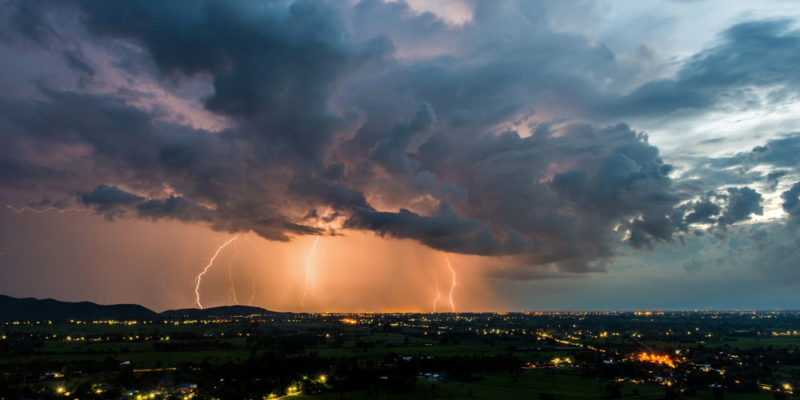
According to their nature, thunderstorms can be classified into:
- Single cell storms . They are isolated storms that form from a single storm cell. They produce lightning, thunder, hail and heavy rain.
- Multicellular storms . They have two or more cells that are organized into a larger storm. They can cause significant property damage and cause flooding, brief tornadoes, and hail.
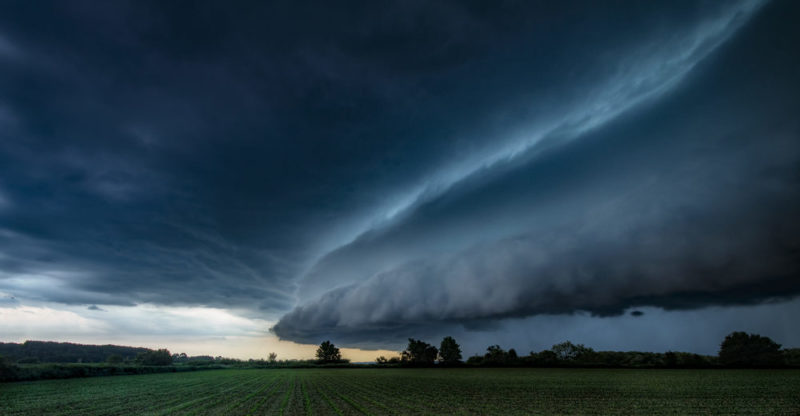
- Squall lines . They are active storm lines with hurricane-force winds, intense rains and a common storm front that can reach several hundred kilometers in length.
- Supercell storms . Through a circuit of ascending wind currents, these storms are fueled by a large charge of energy and, due to their hurricane-force winds, can be particularly destructive. They are characterized by remaining active for many hours and traveling long distances.
- Arched Echo Storms . They are so called because they appear arc-shaped on radars. They are characterized by producing very strong winds and gusts of rain and their “arc” can be hundreds of kilometers long.
- Mesoscale convective systems . They are sets of large-scale thunderstorms, which can affect several states or even entire countries. They can last for many hours and produce strong winds, heavy rain, flooding and hail.
Consequences of thunderstorms
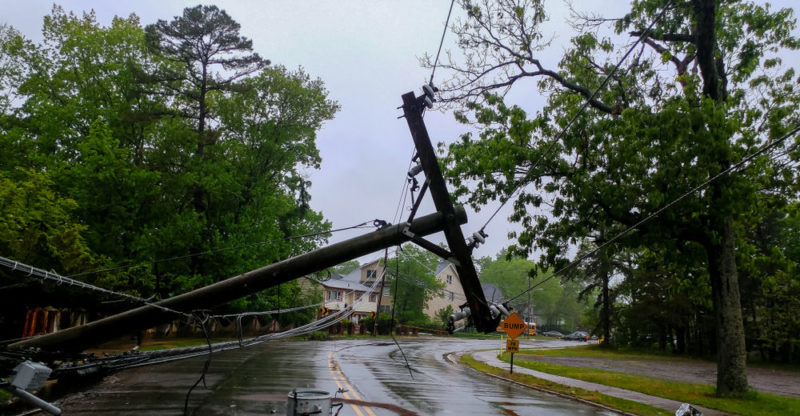
The main consequence of a thunderstorm is lightning that can strike objects and people and cause serious injuries and even death. Additionally, lightning can cause fires and damage electrical and electronic devices.
Strong winds can damage buildings, vehicles and structures, and can be very dangerous for people who are not sheltered from the storm.
In addition, the intense rains produced by thunderstorms can cause flooding, since they usually occur torrentially in a short period of time.
Finally, thunderstorms Sometimes they are also accompanied by hail, which can damage crops, vehicles and structures.
Phases of a thunderstorm
Electrical storms have three phases:
- Development . During this stage the warm air rises and produces the cumulonimbus. This beginning of the storm can be observed from the formation of dark, vertical clouds that grow in height rapidly.
- Maturity . The vertical growth of the storm reaches a maximum and the clouds acquire their particular tower shape. The lower part of the storm is dark gray, while the highest sector, due to the ice crystals, appears lighter in color. It is the time when the heaviest rainfall develops, the strongest winds, lightning and thunder multiply and there may be hail. If the thunderstorm happens during the day, dark clouds obstruct sunlight and the sky darkens as if it were nightfall.
- Dissipation . It is the moment in which the storm loses strength and intensity. The rain becomes lighter, the winds lose speed, and lightning and thunder occur less frequently.
How does thunder originate?
During an electrical storm, lightning appears as very large “sparks.” When that happens, the air around the beam heats up and expands at high speed. This expansion produces sound waves, which are the thunder we hear during storms.
Since the speed of light is greater than the speed of sound, first we see lightning and seconds later we hear thunder.
Why do lightning strikes occur?
Lightning occurs due to the buildup of electrical charges during a storm or similar phenomena, such as volcanic eruptions.
When the accumulated electrical charge is large enough, a sudden lightning discharge occurs. This discharge can occur within the storm cloud, between two clouds, or between the cloud and the ground.
What attracts lightning the most? Lightning from a storm usually hits high points, closer to the storm, such as trees or tall buildings. On the other hand, metallic elements, electrical or electronic devices and water, due to their good electrical conductivity, also function as an attraction for lightning.
How far away is a thunderstorm?
There is a method to calculate the distance of a storm, which is based on the differences in the speed of movement between sound and light.
That is why you can perceive the difference between when the light of lightning is produced and the sound of thunder is heard. This happens because light travels at approximately 300,000 km/s and sound travels at 332 m/s.
Therefore, to determine the distance in kilometers of a storm, you must count the seconds that pass from when you see the lightning until you hear the thunder, and then divide that number by 5. For example, if 15 seconds between lightning and thunder means that the storm is approximately 5 kilometers away.
Why are thunderstorms dangerous?
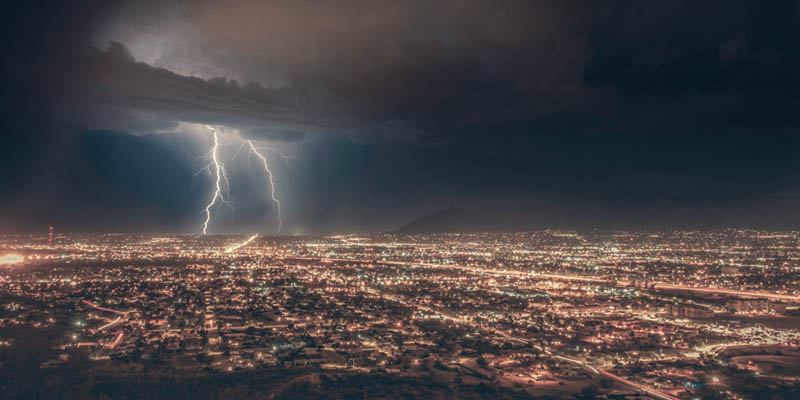
The greatest danger of these storms lies in the presence of lightning. Lightning is particularly dangerous because it is capable of very quickly releasing great energy that can reach several hundred megawatts.
Such electrical power is capable of causing electromagnetic damage to digital or electronic equipment and seriously injuring a person or animal upon direct or indirect contact.
Security measures
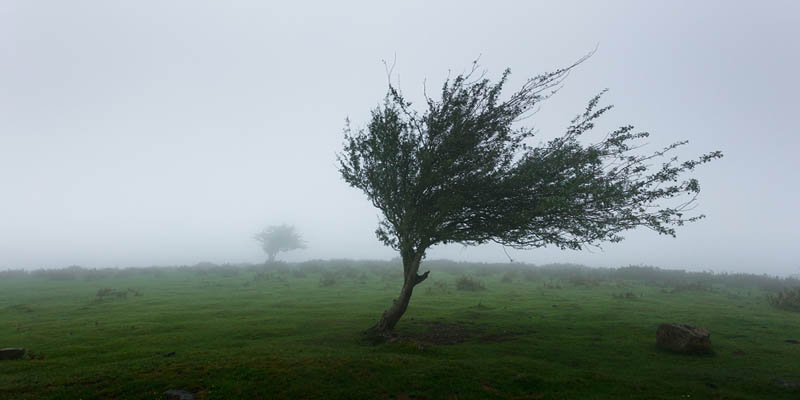
Some safety measures that can be taken in the event of a thunderstorm are the following:
- Seek shelter from the wind and rain.
- Avoid open places.
- Avoid standing near tall objects such as trees, light poles or any metal object that can attract lightning, such as bicycles or umbrellas.
- Stay away from water sources such as pools, lakes or the sea.
- Do not use electronic devices such as cell phones, computers or televisions.
References
- Biopedia (sf). thunderstorm. https://www.biopedia.com/
- Ecoexploratory (sf). ¿What are thunderstorms? https://ecoexploratorio.org/
- Geoencyclopedia (2023). thunderstorm. https://www.geoenciclopedia.com/
- National Geographic (2023). Meteorology: how lightning is formed. https://www.nationalgeographic.com.es/