
We explain what the tropical climate is and what its characteristics are. In addition, types of climate and examples of flora and fauna of their environments.

What is tropical climate?
The tropical climate is a type of climate that is characterized by warm temperatures above 18 °C throughout the year. It is typical of the regions near the equator, between the tropics of Cancer and Capricorn.
A distinctive feature of the tropical climate is that does not present seasonal variability : Due to its high temperatures all year round, only summer exists, and climatic conditions similar to those of spring, autumn, much less winter do not occur at any time.
Another characteristic of the tropical climate is related to its abundant rainfall, with values between 800 and more than 2500 millimeters per year . Due to the combination of high levels of heat and rain, the tropical climate is conducive to the growth of abundant vegetation and extensive areas of humid forests and jungles . In them you can find a great biodiversity of animal species and different types of plants, shrubs and trees.
Features of the tropical climate
Some characteristics of the tropical climate are:
- It has temperatures above 18 °C all year round.
- Its average rainfall is very abundant, between 800 and 2500 millimeters per year. In some places the maximum rainfall can reach 5000 or 6000 millimeters
- The only season that exists is summer: there is no spring, autumn or winter.
- It is located in areas near the equator, between the tropics of Cancer and Capricorn. Due to the curvature of the planet, in these areas the sun's rays hit more perpendicularly than in other latitudes, and for that reason they have higher temperatures.
- Hurricanes and major tropical storms can occur in some areas. These phenomena are more frequent in summer, when the temperature of the oceans is higher.
- The Caribbean and some areas of Brazil in America, Gabon and the Democratic Republic of Congo in Africa and Malaysia, Indonesia and the Philippines in Asia are some countries that have a tropical climate.
Types of tropical climates
According to the Köppen climate classification, there are three subtypes of tropical climate:
- Equatorial tropical climate . It has high temperatures throughout the year. Seasonal variations are minimal and temperatures are usually between 24 and 34 °C all year round. Precipitation is abundant and constant and there is no dry season. Every month it rains at least 60 mm of precipitation. The annual accumulations can exceed 3000 mm. The combination of high temperatures and frequent rainfall favors the development of lush vegetation. The predominant biome is the tropical jungle, with a great diversity of plant and animal species.
- Tropical monsoon climate . It has high temperatures all year round, but rainfall is less than in the equatorial tropical climate, and has a marked annual seasonality. During the summer months, rainfall is very abundant, with values that exceed 100 mm per month, but in the winter months it decreases considerably, and can even present values of 0 mm. The predominant biome is the jungle, a product of the high temperatures and abundant rains during the summer.
- Tropical savanna climate . The tropical savannah climate has high temperatures all year round and a marked seasonality in its rainfall. The difference with the tropical monsoon climate is that the rainy season is much shorter, and much of the year the rainfall is very low and entire months can even go by without rain. The typical biome for this climate is the savannah, which is characterized by the presence of scattered grasslands and trees, and flora and fauna adapted to the alternation of rainy months and extensive dry periods.
The Köppen climate classification is one of the most used to differentiate the types of climate that exist. According to this criterion, there are five major types of climates: tropical climate, arid or dry climate, temperate climate, continental climate and polar climate.
Tropical climate location

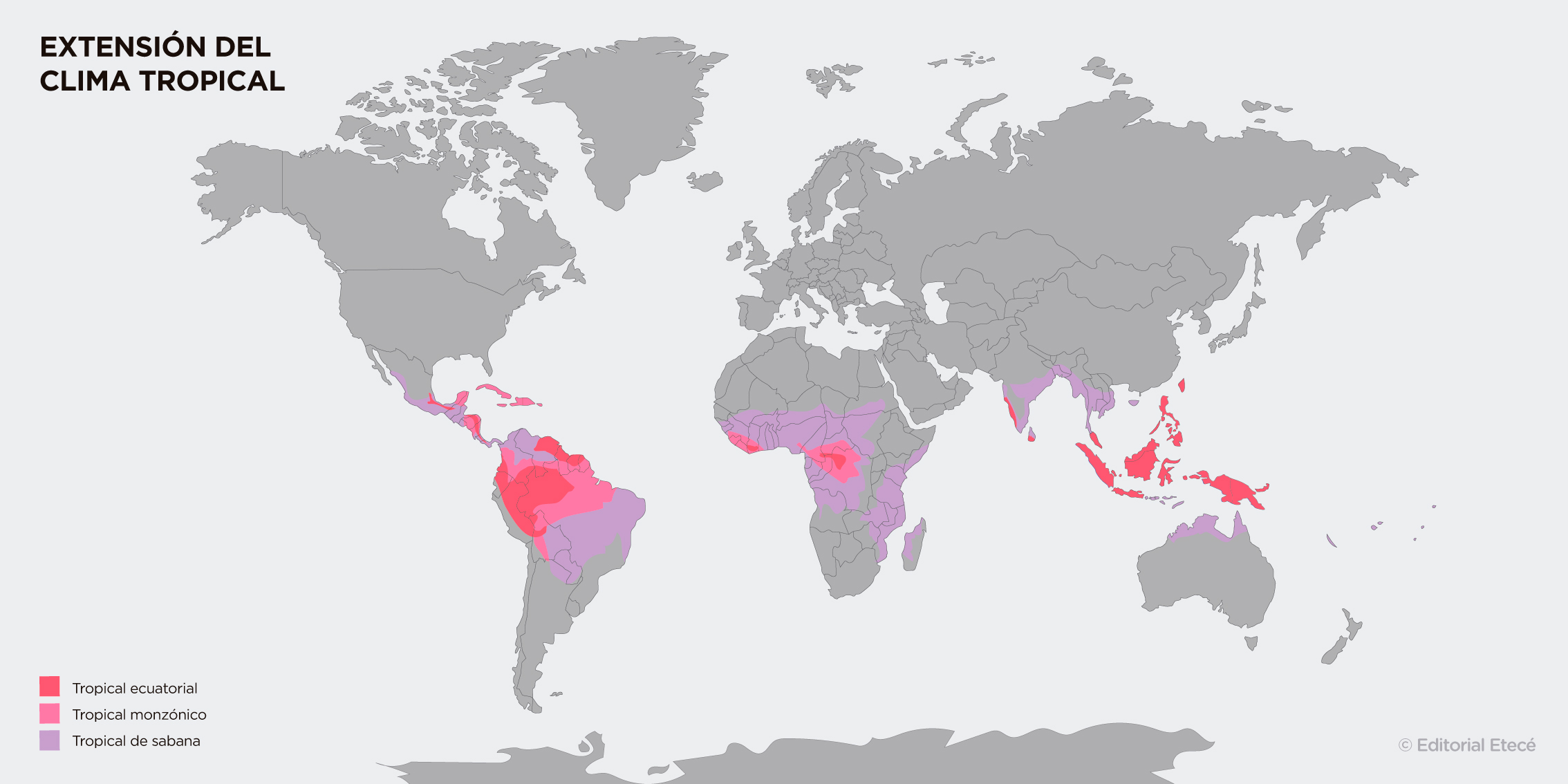
The tropical climate is distributed on the planet as follows:
- equatorial tropical . It is found in areas close to the equator. It covers part of Brazil, Ecuador, Colombia, Venezuela and part of the Caribbean Sea in America; sectors of the Democratic Republic of Congo, Congo, Liberia, Uganda and Gabon in Africa; and parts of Indonesia, Malaysia, Thailand, the Philippines and Fiji in Asia.
- Tropical monsoon . It is found in areas close to the equatorial tropical climate. In addition to the countries near the equator, it covers sectors of Central America, the Gulf of Mexico, India, Bangladesh, Vietnam, Laos, Cambodia and northern Australia.
- Savannah Tropical . It is found in large regions of Brazil, Venezuela, Colombia and Central America. In addition, it is a very widespread climate subtype in Africa, and includes partially or totally the surface of the Democratic Republic of Congo, Congo, Angola, Zambia, Tanzania, Kenya, Uganda, Sudan, South Sudan, Nigeria, Benin, Togo, Ghana, Ivory Coast and Guinea. In Asia it is found in some regions of India, Myanmar and Thailand, and in Oceania in northern Australia and Papua New Guinea.
Flora and fauna of the tropical climate
Although there are variations between the three subtypes of tropical climate (equatorial, monsoon and savannah), they share some common characteristics in relation to flora and fauna.
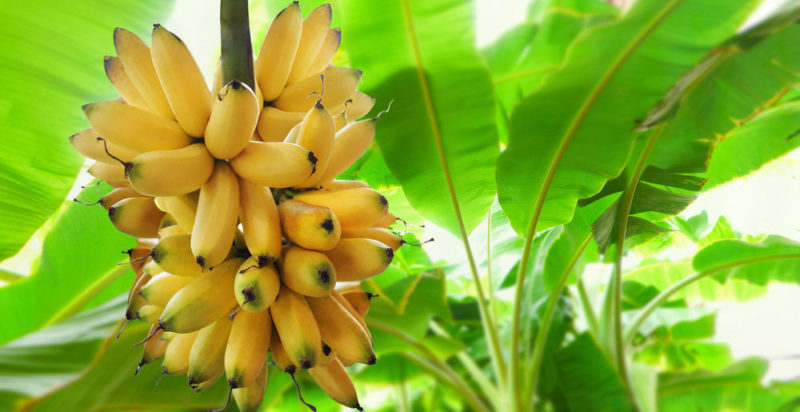
In the equatorial tropical climate the vegetation is in the form of dense tropical forests with great biodiversity. Some emblematic tree species of tropical forests are the rubber tree, banana, cocoa tree, teak tree and a wide variety of palms.
As for fauna, in these forests there are species such as the orangutan and other primates that are characterized by having adaptations to move in the trees, such as long and agile limbs. In addition, there is a wide variety of reptiles and amphibians.
In the tropical monsoon climate vegetation is also abundant, but tends to be more dispersed and less dense than in the equatorial. The vegetation adapts to the wet and dry seasons, with trees that can lose their leaves during the dry season and bloom again when the rains begin. Examples of species include the mango tree, bamboo and cedar.
Regarding fauna, you can find species such as the Bengal tiger, the Indian rhinoceros, the Asian elephant, the langur and several types of birds. Many animals have adaptations to withstand dry seasons, or produce seasonal migrations in search of water.
In the tropical savannah climate the vegetation is characterized by extensive grasslands with scattered trees. The flora adapts to seasonal conditions with a long dry season. Drought-resistant grasslands and trees predominate here, such as baobab, acacia and tamarind. These species have deep roots and tough leaves to conserve moisture.
The fauna characteristic of this type of climate includes the lion, zebra, African elephant, hippopotamus and giraffe.
})
References
- Arriols, E. (2018). What is the tropical climate and its characteristics. https://www.ecologiaverde.com/
- Sans, I (2022). Tropical climate: characteristics, temperature and plants. https://www.clima.com/
- Terrasa, D. (2018). Köppen climate classification. https://geografia.laguia2000.com/


