We explain what the secondary sector is, what its subsectors are and how it differs from the primary and tertiary sectors.

What is the secondary sector?
The secondary sector of the economy, also known as the industrial sector, is that dedicated to the transformation of raw materials into goods or products of consumption which will go directly to the consumer, or in semi-finished goods or equipment that in turn feed other industries.
This is the second step in the productive or economic chain, which occurs after the primary sector has extracted the raw material from nature. For example: once the mining industries obtain copper from the subsoil, the secondary sector proceeds to make coaxial cables with it, which will then go to stores and companies that provide television and internet services.
To achieve this transformation of raw material into product, The secondary sector uses different industrial procedures for which work, energy, machinery and raw materials are normally required. Sometimes, it also uses other industrial inputs, such as different chemical compounds.
The secondary sector is one of the most important in the development of an economy, since the procedures applied to the transformation of raw materials give added value to the product, which generates a profit greater than the cost of the raw materials. For example, cable made from copper has more value than pure copper extracted from mines.
Subsectors of the secondary sector
The industrial sector normally comprises four subsectors:
Craft
The artisanal subsector is dedicated to manufacturing consumer goods in workshops or domestic spaces usually family and local belonging.
It was the basic industrial sector in Europe until the Industrial Revolution and the invention of mass production, since its production is slow and cannot meet the demands of the entire market.
Industry
Industry is a key subsector for the support of capitalism, since allows large quantities of goods to be produced in a short time through the use of large, more or less automated machinery to carry out continuous and fast work. Only in this way can a growing market of demand for goods and services be satisfied.
Construction
Construction is a subsector that is dedicated to the construction of houses, skyscrapers and public works such as squares, roads, schools, bridges or tunnels. It is a fundamental industrial sector for urban expansion and population growth.
Energy obtaining
Energy is a subsector that is dedicated to the generation of electricity through different means and mechanisms, some safer, cleaner and more reliable than others.
It is an essential activity to sustain today's way of life and economic production.
Examples from the secondary sector
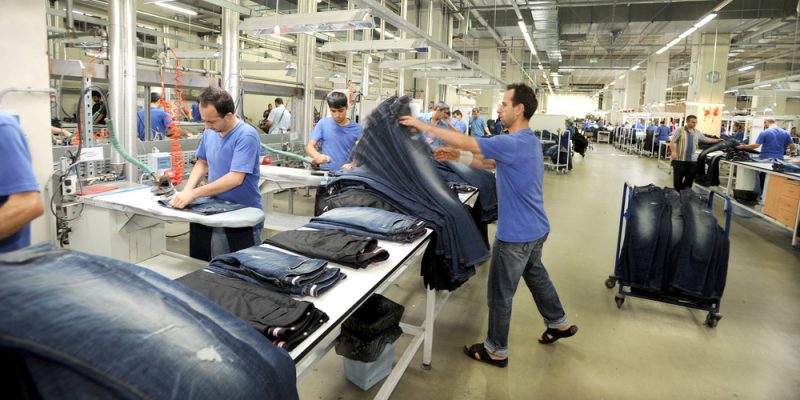
Some examples of secondary sector industries are:
- Textile factories shoes, clothing and other items for personal use, which they produce en masse thanks to large mechanized facilities. To do this, they consume raw materials such as fabrics, leather and plastics.
- Bottling and packaging machines which use raw materials from the chemical industry to produce food and beverage containers.
- Chemical and petrochemical industries which from natural substances, such as oil or different minerals, obtain a wide range of inputs that are used, in turn, in other industries, either as raw materials or as preservatives, disinfectants, fuels, etc.
- power plants dedicated to the generation of electricity from various mechanisms to mobilize generating turbines. In some cases, natural waterfalls are used, in others fossil fuels are burned or more complex chemical processes are used, such as the fission of uranium. The objective of these industries is to supply electrical energy to direct consumers and economic sectors of different types.
Difference between the primary and secondary sector

Unlike the secondary sector, which is responsible for transforming raw materials, The primary sector is the one that extracts the natural resources necessary to start the productive chain and takes them directly from the environment through different mechanisms.
This is why the first sector represents the first stage of production: without raw materials nothing can be manufactured. This does not mean that the primary sector does not require subsequent sectors: to extract raw materials, for example, machinery and tools are needed that are the work of the secondary sector.
Some examples of the primary sector are: the mining industry, the agricultural industry, the fishing industry and oil extraction.
What is the tertiary sector?
The tertiary sector, also called the service sector, is distinguished from the primary and secondary sectors in that it neither extracts nor transforms raw materials, but rather provides support, through specific services, both to the first two sectors and directly to the consumer .
The services are intended to satisfy transportation, logistics, marketing, finance, entertainment and many other needs. Thus, although the tertiary sector does not produce goods, it is a fundamental sector for economic development, since it not only satisfies the needs of the population, but also allows the production processes of other sectors to be refined, improved or enhanced.
Continue with :
References
- Gayathri, R. (2016). “Role and Importance of the Secondary Sector”. ABHYUDAYA. Newsletter of UGC-UPE. (vol. 4, n. 1), p. 1. University of Mysore. https://uni-mysore.ac.in/
- Ministry of Industry and Energy of Spain. (2002). Industrial economy. General Technical Secretariat of Mining.
- Tauler Romero, M. (1983). Practical encyclopedia of economics: economic sectors (VII). Orbis.