
We explain what the interwar period was, its historical context and how were the years 1919 to 1924. In addition, the treaties that were signed and alliances that were formed.
What was the interwar period?
The interwar period It was the stage between the end of World War I (1914-1918) and the beginning of World War II (1939-1945) . The initial phase of the interwar period, between 1919 and 1924, was characterized by the economic needs of reconstruction in Europe and for the signing of peace treaties Among the winning nations (headed by the United Kingdom and France) and the defeated nations (Germany, Austria, Hungary, Bulgaria and Türkiye).
The treaties signed after the 1919 Paris Conference were: the Treaty of Versailles (with Germany), the Treaty of Saint Germain (with Austria), the Trianon Treaty (with Hungary), the Neuilly Treaty (with Bulgaria) and the Treaty of Sèvres, then replaced by the Treaty of Lausana (with Türkiye).
The peace treaties and the creation of the Nations Society (designed by the US government, which finally did not integrated it) did not serve to create an international framework of international stability . In a context of serious economic difficulties, the world political situation was characterized by the existence of multiple pending conflicts, the difficulty in the application of treaties and the appearance of important international tensions.

Key points
- In the early years of the interwar period (1919-1924) peace treaties were signed with the overdue nations in World War I, such as the Versailles Treaty (1919), which imposed onerous war repairs to Germany.
- At the beginning of the interwar period, the Society of Nations was born, an international organism that had the mission of ensuring cooperation between nations and the peaceful resolution of conflicts. In practice, he did not achieve his main objectives and was replaced by the UN (United Nations) in 1945.
- In the early years of the interwar period, economic difficulties and territorial conflicts occurred in Europe, the Bolshevik government was consolidated in Russia (which gave birth to the Soviet Union) and the fascist leader Benito Mussolini arrived in the government of Italy.
The birth of the Nations Society
The Nations Society, which had been devised by the president of the United States, Woodrow Wilson, was born at the Paris Conference of 1919. For the first time in history an international organization was created To discuss big problems and peacefully solve conflicts between countries .
Through the signing of the Pact of the Society of Nations, the Member States promised to respect the territorial and political integrity of the other members and to adopt measures to safeguard peace in the face of possible external aggressions.
However, the dream of international concord fate very soon. The Nations Society took the appearance of a winner society: The entrance to Germany was denied and the Bolshevik Russia, and the United States finally resigned to participate due to the opposition of the American Senate.
While the United Kingdom and France remained in the body, the absence of other powers (mainly the United States) and the lack of military and economic means to apply their resolutions determined the low incidence of Nations Society in the international relations of the interwar period.
The Treaty of Versailles with Germany
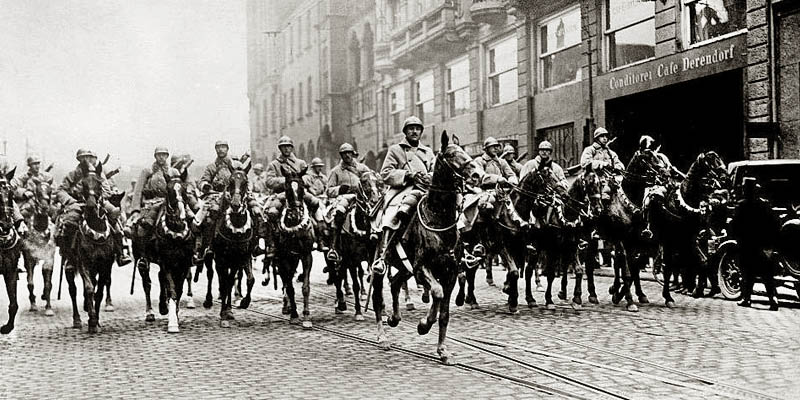
The Versailles treaty was agreed and signed by the winning countries (with the exception of the United States) and He was imposed on the German Government (the Weimar Republic), who signed it on June 28, 1919. The Treaty He was very severe with Germany well He was responsible for war and imposed considerable war repairs (which had to pay the winning states), the obligation to disarm and numerous territorial losses.
The British government considered that only a peaceful and prosperous Germany could face the payment of war repairs, which implied a conciliatory position against the German difficulties to pay. However, The French government considered that the central was to prevent Germany from becoming a threat .
Finally, the position that forced Germany to meet the demands of the Versailles Treaty was imposed.
Germany challenged from the beginning the French attempt to enforce Versailles clauses . On April 27, 1921, the Repair Commission announced the total amount that Germany had to pay, and in July 2022, a new moratorium application of the German government caused on January 11, 1923 the French decision to invade the Ruhr basin (A German mining region) and thus charge repairs .
The German government decreed passive resistance and The situation led the German economy to collapse . The new German government, chaired by Gustav Stresemann, called in September 1923 the cessation of passive resistance.
France, which was also exhausted economically and needed US credits (whose government was contrary to the actions that the French government was carrying out)agreed the progressive withdrawal of the Ruhr occupant forces which took place on August 25, 1925.
The United States Mediation led to the creation of a committee responsible for studying the issue of repairs, which began operating in January 1924 and was chaired by an American financial, Charles Dawes. The result was the Dawes Plan, which aimed at the fulfillment of payments through certain criteria that They will guarantee the stability of the German economy .
Little by little, the idea that it was convenient to solve postwar problems through cooperation was extended. Even so, the resentment caused by the Treaty of Versailles and its signature by the Weimar Republic fed nationalist movements (such as Nazism) that acquired prominence during the years of the great depression.
The disintegration of the Austrohungal Empire
The disintegration of the Austrohungal Empire, as a consequence of the defeat of the central empires in World War I was accompanied by strong tensions among the countries that inherited their territory . Some examples are the conflicts over the northern territories of the Adriatic Sea, by the Teschen region and by Hungary.
The italo-yugoslava struggle in the north of the Adriatic
In the Treaty of London (1915) signed during World War I, France and the United Kingdom promised to the Italian government the annexation of some territories among them the Peninsula of Istria, north of the Adriatic Sea, which at that time was in the hands of the Austrohungal Empire.
These claims collided with respect to the principle of nationalities defended by Woodrow Wilson (President of the United States), then Part of the Istria Peninsula was inhabited by Slavic populations.
In 1919, The US president proposed a border line, the “Wilson Line”, which left Southeast of Istria in the hands of the Yugoslava authorities .
This situation aroused outrage in Italy, which left the Paris Conference for two weeks (from April 24 to May 7, 1919). On September 12, the Italian nationalist poet Gabriele D'Anunzio occupied with a group of volunteers the port of Fiume (current city of Rijaka in Croatia).
The conflict was resolved with The signing of the Rapallo Treaty (1920), which set the borders between Italy and the Yugoslavo kingdom . The Italians renounced the Continental Dalmatian region, while the Yugoslava border moved east of the “Wilson Line”. This arrangement did not quit according to either of the two states. On the other hand, D'Annunzio was evicted from the fixume by Italian troops They occupied the city in 1920 and Fiume was declared an independent city.
Nationalist discontent that was developed in Italy after the conflict He was used by fascist leader Benito Mussolini, who challenged the Italian liberal state and reached power with his departure on Rome in 1922. Under the pressure of the fascist government, Yugoslavia recognized Italian sovereignty in Fiume with the signing of an italing-yugoslav treaty in 1924.
The conflict between Poland and Czechoslovakia by Teschen
The rich industrial region of Teschen was disputed by the new states of Poland and Czechoslovakia after World War I. The Poles claimed the territory based on the principle of nationalities (the region was inhabited for 55 % of Poles, 27 % of Czechs and 18 % of Germans), while the Czechoslovak government based its claim on the historical belonging of the territory to Bohemia.
In November 1918, the armies of both countries entered the territory and Provisional division was made which favored Czechoslovakia and that ended up becoming final .
The Hungarian issue
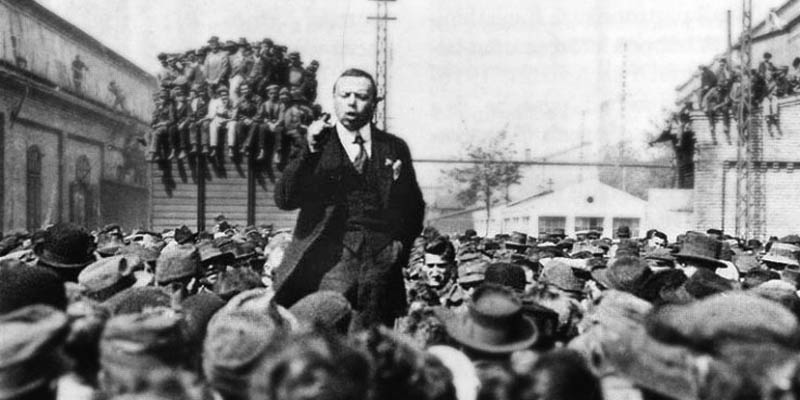
Hungary was one of the great losers of World War I. After the proclamation of the Republic of Hungary on November 16, 1918, Two thirds of the Hungarian territory were occupied by Serbian, Czech and Romanian troops .
The chaos that continued led to the ephemeral communist revolution of Béla Kun in March 1919, which He established a Soviet Republic and won the rejection of much of the population due to their repressive measures.
On August 1, Béla Kun resigned and left Budapest before the arrival of a Romanian army, which occupied the city a few days later. Allied pressures got the Romanians to leave the capital. Finally, a government directed by Admiral Miklós Horthy was instituted, who was forced to sign Trianon's treaty in June 1920: Hungary was reduced to a small state of 92,000 square kilometers and millions of Hungarians were out of their borders (In Czechoslovakia, Romanian Transylvania and Yugoslavia).
The Horthy government tried to get a review of the borders established in the Trianon Treaty, but Czechoslovakia, Yugoslavia and Romania formed the small entente in August and signed a defensive pact against Hungarian aspirations to review the peace treaties. France provided its support to the New Alliance.
The alliances of France and Italy in Central Europe
France sought to establish a network of alliances With the new countries that emerged between Germany and Russia To surround Germany that I longed to review Versailles's treaty and was seen by the French as a threat.
France had already formed the Franco-Russian alliance against German expansionism in 1893, but in the new scenario there were two major differences: on the one hand, none of the new countries had a power comparable to that of Russia, and on the other hand, these new countries were faced with each other by multiple nationalist conflicts.
Despite all the difficulties, France's Foreign Minister signed an alliance treaty with his pair of Poland in 1921. The Franco-Polaca Alliance included a Military Secret Treaty against Germany . In 1924, the French government extended its alliances to Czechoslovakia, which indirectly linked her to the small entente born in 1920. Although she tried to reconcile her two new allies, the Teschen conflict prevented an alliance between Poland and Czechoslovakia.
Meanwhile, Italy had been discontent with the treaties and established a network of agreements Diplomats with the European countries of the Danube region that had been losers in the war and were disagreement with the status of the situation after the Paris Conference: Hungary, Austria, Bulgaria and Albania.
Thus, while the United Kingdom remained outside the alliances in central and eastern Europe (region in which it had no special interest), France sought allies among countries satisfied with the new situation created after the war, with the aim of strengthening security against Germany. On the contrary, Italy tried to establish agreements with unhappy countries.
The disintegration of the Ottoman Empire
The Sèvres Treaty
The distribution of the territories of the Ottoman Empire after the defeat of the central empires was based, in part, on previous secret agreements At the end of World War I.
The governments of the United Kingdom and France had reached an agreement to distribute the Arab possessions of the Ottoman Empire ( Sykes-Picot Agreement, 1916), and also agreed with the Italian government to grant some territories of southern Anatolia (Saint-Jean-De-Maurienne Agreement, 1917). Besides, Once the war was over, France and the United Kingdom approved Greece's aspirations in anatolia areas that had Greek population.
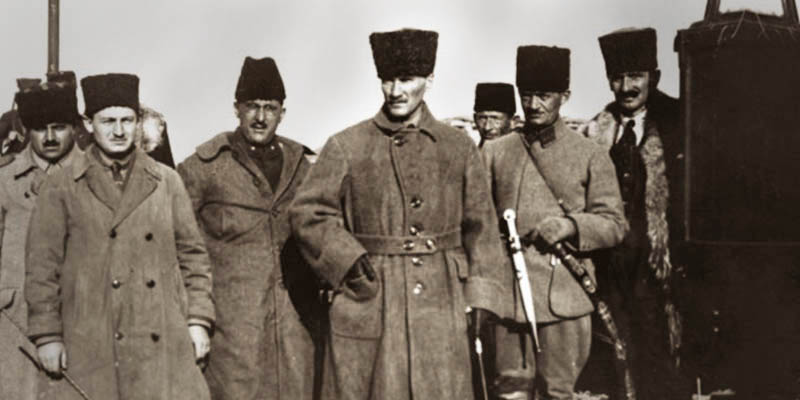
The Treaty of Sèvres, signed in August 1920, was very hard with Türkiye because it implied great territorial losses and, in addition, it did not take into account the triumph of The Mustafa Kemal “Atatürk” revolution In Istanbul in 1919. The new Turkish leader represented the modernizing and nationalist cause against the imperialist aspirations of the victors, and headed the struggle for the independence of Türkiye.
The Greco-Turca war
In May 1919, the Greek Invasion of Anatolia began, which unleashed the Greco-Turca war (1919-1922) and in March 1920, a few months before the signing of the Sèvres Treaty, troops of the Entente They occupied Istanbul.
During the Greco-Turca war there were massacres (more than 20 % of the male population of Anatolia died) and culminated with the victory of Türkiye . More than one million Greeks were deported from Anatolia.
He Lausanian treaty (1923) ended the Turkish disintegration process. Although negative clauses for Türkiye were maintained, it maintained control of Anatolia (in Asia) and Eastern Thrace (in Europe). In addition, the sultanate was abolished and the Republic of Türkiye was proclaimed, whose first president was Mustafa Kemal.
The United Kingdom and France distributed the possessions of the missing Ottoman Empire in the Middle East, following, in broad strokes, what was agreed in the Sykes-Picot agreement.
Who was Mustafa Kemal “Atatürk?
Mustafa Kemal Atatürk (1881-1938) was a Turkish military and statesman, Founder and first president of the Republic of Türkiye (1923-1938) .
After the defeat of the Ottoman Empire in World War I, Atatürk joined the Turkish population against the Greek invasion that tried to impose the Treaty of Sèvres. He defeated the Greeks and expelled the troops from the country's entente. He recovered Turkish national pride and, when he assumed as presidentmade Turkey a modern state .
Atatürk modernized the legal and educational systems of Türkiye and promoted the adoption of Western cultural aspects. An example was the introduction of Latin alphabet to write the Turkish language. His legacy, although he was challenged by Islamist forces, remains a key element of modern Turkey.
The Soviet problem
Western intervention in the Russian Civil War
One of the big problems that followed at the end of World War I was Fixing the borders of the new Soviet state . From the armistice of December 1917 (promoted by the Bolshevik government that had just access to power) and after the treaty of Brest-Litovsk signed between Russia and Germany in March 1918, the powers of the entente actively helped the opponents of the Bolshevism and They intervened militarily in the civil war between the Red Army (Bolshevique) and the White Army (counterrevolutionary) .
The Bolshevik government trusted the extension of the revolution to the heart of Europe, but the failures of the Spartan insurrection in Berlin and the Soviet Republic of Béla Kun in Hungary put an end to this expectation.
However, the successes of the Red Army forced Western powers to withdraw their intervention troops in 1919 and initiate the sanitary cord policy: it was about Create a series of antisovietic states on the western border that would allow to stop the expansion of communism to the west.
The Polish-Soviet war
In the context of the revolution and civil war, Finland, Estonia, Latvia and Lithuania broke ties with Russian power and agreed to independence . In Poland, General Jossef Pilsudski proclaimed the Republic of Poland in November 1918 and sought to establish favorable borders. In its expansion to the east, kyiv (Capital of Ukraine) reached in 1920.
The allies proposed a Russian-Polish border line (the “Curzon line”) that divided beamorruse between the two states.
Meanwhile, a Soviet counterattack took the Red Army to the doors of Warsovia (capital of Poland). The Poles resisted with French support and, in March 1921, the Riga Treaty was signed: The Russian-Polaca border was fixed on a line of 150 to 200 kilometers east of the “Curzon line.” This meant territorial losses for the Bolshevik government, to which the Besarabia region was added (annexed by Romania).
American isolationism
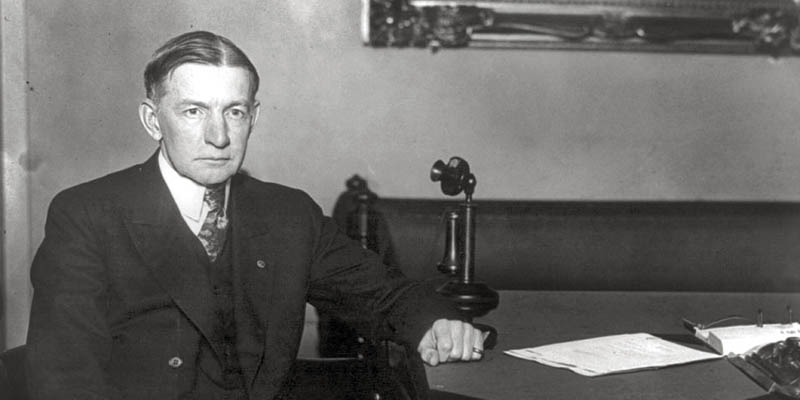
The rejection of the United States Senate to sign the Versailles treaty and the pact of the Nations Society was an example of the traditional American isolationism (that is, the refusal to be involved in permanent alliances).
For the United States to adhere to both treaties, it was necessary for the Senate to ratify them. Although Democratic President Woodrow Wilson had promoted the creation of the Nations Society, the Senate with Republican majority rejected his signature. And when the Republican candidate, Warren G. Harding, won the 1920 presidential elections, the United States definitely rejected the signing of the Versailles Treaty and the entrance to the Nations Society. In August 1921, The Washington Government signed a separate peace treaties with Germany, Austria and Hungary .
However, the US policy of the 1920s was not fully isolationist, because The United States government was actively involved in issues such as armament control and war repairs (with the so -called Dawes plan) .
Japanese expansionism: Washington's treaties
Despite his poor participation in World War I, The Japanese position in Oriental Asia was reinforced after the war . The disintegration of the Russian Empire and the abandonment of German concessions in the region made Japan the only great power to the gates of China and the third naval power of the world.
The restlessness caused by this fact in the United States made the president, Warren G. Harding, with the support of British Prime Minister, David Lloyd George, invited seven powers (United Kingdom, Japan, France, Italy, China, Netherlands and Belgium) to meet in Washington.
The Washington Conference (from November 1921 to February 1922) concluded with the signing of three treaties:
- Treaty of the four powers (United States, the United Kingdom, Japan and France). It implied a mutual commitment to recognize the possessions of each power in the Pacific and the promise to consult in case of controversies or aggressive actions of any country in the area.
- Treaty of the five powers (United States, United Kingdom, Japan, France and Italy). It meant the adoption of measures aimed at naval disarmament. Limits were put on the acorazados fleets: the United States and the United Kingdom would maintain a parity, Japan could reach 60 % of that amount, and France and Italy could reach 35 %.
- Treaty of the nine powers (United States, United Kingdom, Japan, France, Italy, China, Netherlands, Belgium and Portugal). He implied a commitment to respect China's territorial integrity.
These agreements marked the beginning of a close policy of understanding between the United States and the United Kingdom demonstrated the recognition of the maritime superiority of the Anglo -Saxon powers and expressed the acceptance of Japanese naval power in the Pacific.
Continue with:
References
- Britannica, Encyclopaedia (2022). League of Nations. Britannica Encyclopedia. https://www.britannica.com/
- Britannica, Encyclopaedia (2022). Treaty of Versailles. Britannica Encyclopedia. https://www.britannica.com/
- Cabrera, M., Juliá, S. & Martín Aceña, P. (comps.) (1991). Europe in crisis. 1919-1939. Editorial Pablo Iglesias.
- Itzkowitz, N. (2023). Kemal Atatürk. Britannica Encyclopedia. https://www.britannica.com/
- Sevillano Calero, F. (2020). The Europe of award. The disrupted order. Synthesis.


