We explain the history of the radio, its background and its evolution. In addition, what are its characteristics and the first transmissions.
Radio History
The history of the radio includes the various discoveries, findings and inventions that allowed the emergence of broadcasting and of radio devices in their various versions, for which it was key, first, the discovery of the transmission of electromagnetic waves.
The history of the radio, thus, It includes at least a century of scientific and technological innovation in charge of some of the most privileged minds of physics, engineering and applied sciences. It begins at the end of the 19th century and culminates with the digital radio of the late twentieth century.
Radio was an unprecedented invention that revolutionized human communications and that allowed the development of later technologies, such as television, wireless internet and radar.
Electromagnetic wave physics
The propagation of electromagnetic waves was Formulated by James C. Maxwell in 1873 product of their experiences in this regard in the previous decade. Maxwell realized that variable electric fields created variable magnetic fields and vice versa, thanks to which electromagnetic waves could be generated that spread in space.
In 1888 Maxwell’s theories were put into practice by Heinrich R. Hertz that managed to artificially create electromagnetic waves and detect them, through a manufacturing apparatus. Hertz showed that waves had similar characteristics to light and moved at a similar speed.
Consequently, The waves could also be reflected, diverted, polarized, etc. since it was electromagnetic variations of the same spectrum. In tribute to this scientist, electromagnetic waves are called “Hertzian waves.”
The first transmission of Hertzian waves took place on Christmas Eve in 1906 thanks to a high frequency electromagnetic alternator that generated waves modulated in amplitude (AM). The voice of Reginald Aubrey Fessenden was transmitted by singing a carol from Brant Rock Station, Massachusetts, and his voice was captured by the ships on the coast.
Radio history
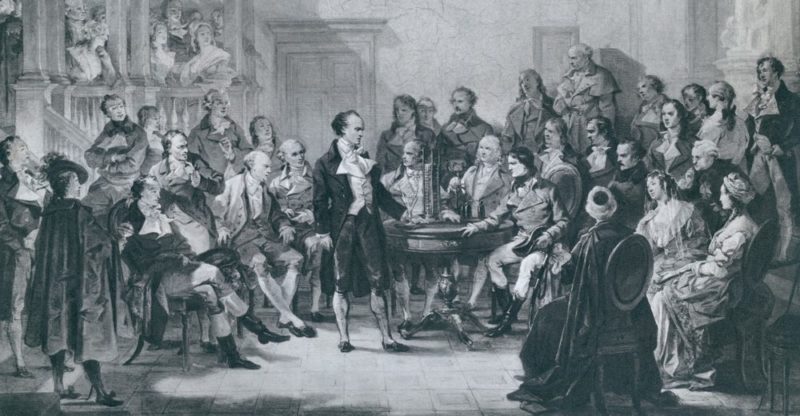
Before the radio was invented, two important inventions emerged at the beginning and mid -nineteenth century:
- The voltaic battery. Created by Alessandro Volta, which was a kind of battery capable of producing electric fields.
- The telegraph. Created by Joseph Henry, and improved by Samuel Morse, which was an artifact capable of sending and receiving electrical signals transmitted along a conductive cable, then translating them into a written message, thanks to a numerical code.
Another important antecedent was The invention of telephony Graham Bell’s work, presented in 1875. Similar to the telegraph, this invention could transmit the sound of the human voice through conductive cables, in the form of electrical impulses.
And finally it is The invention of the Soviet Aleksandr Popov who invented the antenna and made with it the first electromagnetic wave transmissions at a short distance.
Radio origin
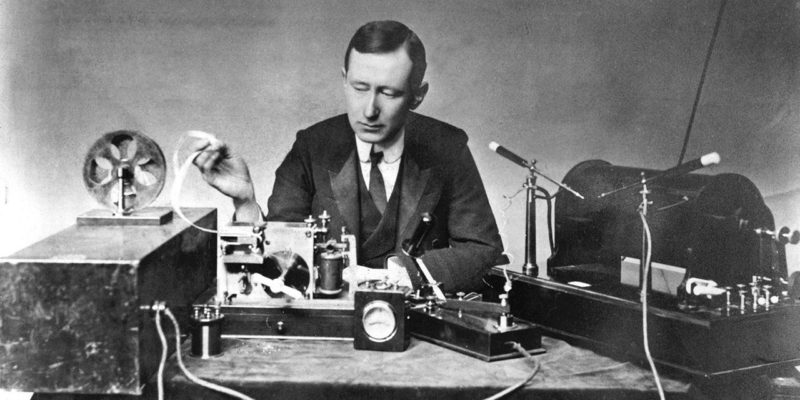
There is a historical controversy with respect to the radio creator. On the one hand, the famous Serbian inventor Nikola Tesla presented the first patent of a Hertzian wave receptor . However, the Italian Guglielmo Marconi produced the first hertzian wave receiving device in 1896.
Marconi proceeded to demonstrate to the Navy and the Army the applications of his invention, and that is why he is remembered as the creator of the radio. Many believe that there is evidence of Marconi’s theft .
The confusion is because The United States Supreme Court in 1943 ruled against Marconi Wireless Tel. Co. a company that demanded the use by the US radio army during World War I, without paying patent rights. However, this failure has nothing to do with who invented the radio.
The first radio device
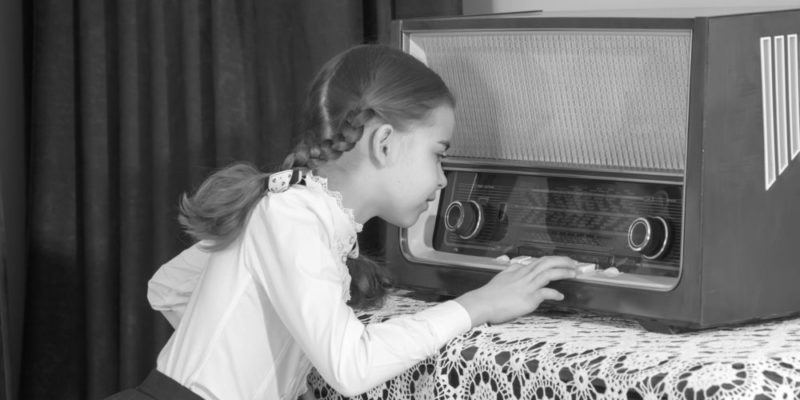
The first radio device in history was Galena Radio, invented in 1910 by Americans Henry Dunwoody and Greenleaf Whittier Picard. It was a “portable” device of about ten kilograms of weight, manufactured from the lead sulfide glass known as Galena. It was impossible to change dial, although the stations continued to be very scarce.
For the first radio device with a broadcaster change spent 7 years until it was invented by French Lucien Lévy, who baptized him as Superheterodine.
First radio transmissions
The first radio transmission along large distances It was carried out by Marconi in 1899 along the La Mancha channel between Dover (England) and Boulogne (France), a distance of about 48 kilometers. Thus was demonstrated the ability of this new invention that people called “the telegraph without threads.”
Then there was the first transmission in North America to which we have referred, on Christmas Eve in 1906. Regular commercial transmissions and for entertainment of the population began in 1920. One of the first took place in Buenos Aires, Argentina. It was opera PARSIFAL by Richard Wagner, transmitted from the roof of the Coliseo Theater.
Five years later there were already a dozen radio stations in the city and many others in the interior of the country. The transmissions took place at short time of sunset until midnight.
Similarly, The world’s first regular station of the world emerged in the United States and it was called 8mk (today is called WWJ). It was inaugurated in Detroit, Michigan, in 1920, and belonged to The Detroit News. In 1922, the British Broadcasting Corporation (BBC) was inaugurated in London, which would result from the most famous in the world.
The golden age of radio
The golden age of radio is considered The years from 1920 to 1930 even, in which there was a true world explosion of radio stations, especially in industrialized countries.
At that time A new mobile coil speaker was invented work by Americans Chester W. Rice and Edward Washburn Kellogg, who solved many problems when listening to the radio. Until then, there were various methods to do so, such as connecting headphones direct to the device box.
The radio in the car
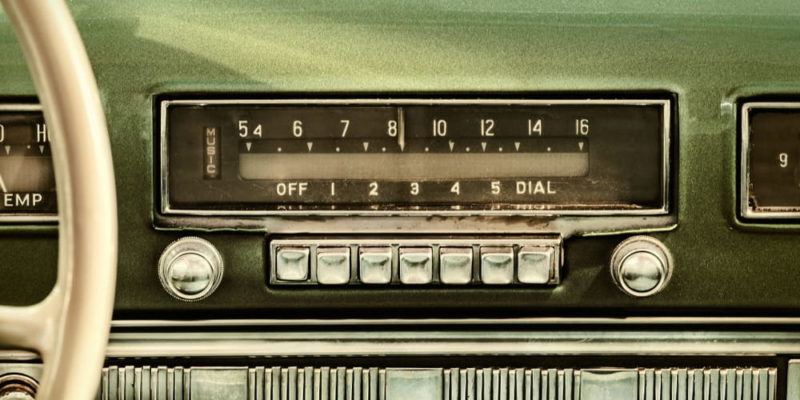
The popularization of radio led to wanting to hear it in various fields, including when driving. That’s why, In 1927 the first automobile radios were produced and promoted especially those of the brand Philco Transitone.
Since then, The association between the radio, the music player and the car He did not stop, using the fact that the view must be occupied during handling, but not the sense of the ear.
Transistor radio
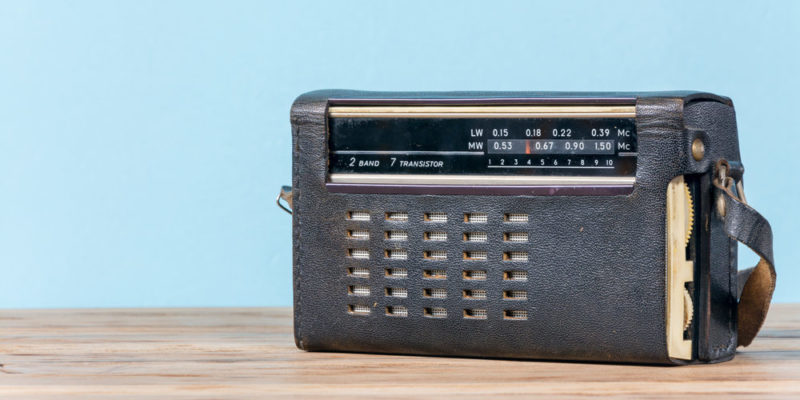
In 1948 the world of electronics was revolutionized with the appearance of transistors, North American Bell’s work : semiconductor artifacts capable of interrupting, mitigating or leaving a flow flow.
Your invention The Nobel Prize in Physics earned them in 1956 To the three engineers John Bardeen, Walter Brattain and William Shockley. This artifact allowed the appearance in 1953 of the first radio of transistors, the work of the German company Intermetall.
These new transistors radios They were more efficient, light, economic and small than the traditional ones. They fired the production of radio devices for millions in the 1960s and 1970s, when they became a popular medium to follow the news during the Cold War. Its useful life lasted until 80, when they were replaced by new more efficient technologies.
Digital Radio

The radio survived to the digital age, despite the notorious decline that during the 80s and 90s suffered, because of the popularization of television. With the Internet and the technological possibilities of the new millennium he won new life and the first digital radios appeared, transmitted online. Podcasts also appeared, which are downloadable radial emissions.
Radio history timeline
- 1873. Maxwell publishes his theory about electromagnetic waves.
- 1888. Hertz creates the first electromagnetic wave detector and transmitter.
- 1895. Marconi invents the first hertzian wave receiver using an electric oscillator created by Hertz.
- 1896. Popov invents the first electromagnetic antenna.
- 1897. Tesla presents the patent for the radio transmitter.
- 1899 Marconi performs the first transmission from one country to another (England to France).
- 1900. The AM radio is invented.
- 1901. Marconi and Fleming transmit the first wireless telegraphic signal along 2,400 km away.
- 1910. The first Radio Galena is invented by Dunwoody and Whittier Picard.
- 1914. The First World War begins and the radio is used to coordinate the location of the troops.
- 1920. The first regular and entertainment radial emissions appear.
- 1933. FM radio is invented.
- 1948. Transistor radio is invented.
- 1963. First satellite radio emission.
- 1993. The first online radio station arises.
References
- Radio History (video) at https://www.youtube.com/
- Radio history: inventor and evolution at https://curosphere-historia.com/
- 10 data on the origin of radio in the world at https://www.radionational.co/
- The background of the radio at http://recursos.cnice.mec.es/
- Radio (Broadcasting) at https://www.britannica.com/