We explain what the Persian Empire, its formation and development was. In addition, what were its characteristics, culture, economy and more.
What was the Persian Empire?
The Persian Empire (also known as the Aquemenida Empire) was A central Asian empire that existed between 550 and 331 a. C . The Persians built the greatest and most powerful empire of the time, conquered the different kingdoms of Asian Mesopotamia, Levante, Syria, the peoples of Anatolia and part of the Greek cities.
This empire is recognized for having linked a huge and heterogeneous territory thanks to the strategic combination of centralization and flexibility. In addition, Persian conquests towards other peoples were characterized by their religious tolerance and incorporation of cultural features of the conquered peoples.
Characteristics of the Persian Empire
Some of the main characteristics of the Persian Empire were:
- It existed between 550 and 330 a. C. and dominated Central Asia, Mesopotamia, Palestine, Egypt, Anatolia and part of Greece.
- His political organization was based on the figure of the emperor and combined a strong central administration with a flexibility and tolerance.
- It was led by the Aquemenida dynasty, represented by: Cyrus II, Cambises II, Darío I, Jerjes, Artajerjes I, Darío III, among others.
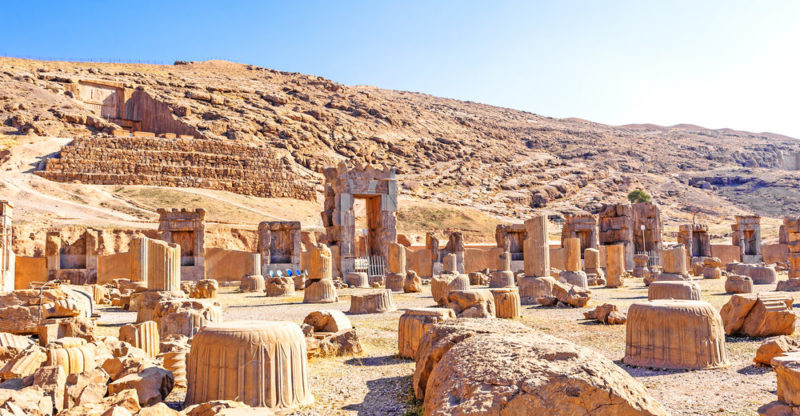
- Its capital was installed in Persepolis, considered one of the maximum emblems of Persian civilization.
- Its territory was divided into satrapia, which allowed an orderly administration of politics and imperial economy.
- It stood out in the trade and in the development of commercial routes that allowed to connect all the territories of the Empire.
- Its culture took features and traditions of the conquered territories and was characterized by the development of architecture and art.
Geographical location of the Persian Empire

Originally, The Persians settled on the Central Asia Plateau in the region that currently belongs to Iran. Through military campaigns, they began to conquer the peoples of the region and build an empire that, at its time of maximum extension, dominated the western territories of Palestine, Syria, Mesopotamia, Egypt, Anatolia, Thrace, Macedonia, Armenia towards the West and the entire central Asia to the Indo River, towards the east.
To its capital, Persepolis, Other important cities that the Persians founded or conquered were added Throughout its history, such as Ecbatana, passing and Susa.
Currently, the Persian Empire would correspond to the territories of Iran, Iraq, part of Egypt, part of Greece, Afghanistan, Pakistan, Armenia, Jordan, Turkmenistan, Oman, Turkey, Syria, Lebanon, Yemen and part of India.
History of the Persian Empire
Towards 1400 a. C., Iran’s plateau began to be inhabited by two nomadic groups of Indo -European language : The Medes, in the north, and the Persians, in the south. These peoples spoke the same language and shared beliefs and customs. However, they were not recognized as a common identity. For centuries, the Assyrian Empire dominated the region and forced Medes and Persians to pay taxes. Towards the eighth century a. C., the Medes became independent and founded a fortress called Ecbatana, which became its capital. In 612 a. C., King Medo defeated the Assyrians and imposed their domain on the Persians.
Towards 550 a. C., the Persian King II organized a rebellion and managed to take the capital of the Medes. Then, a series of military campaigns began to extend their domain and conquered the kingdoms of Lidia, Babylon and other cities of Asian Mesopotamia. The regions of Phenicia and Jerusalem were peacefully dominated.
After the death of Cyrus II, Persian power was in the hands of his son, Cambises II, who was in command of the conquest of Egypt in 525 a. C . The maximum consolidation of the Empire occurred in the reign of Darío I, who was responsible for carrying out many of the works that allowed the interconnection and organization of the territories and the development of cities and palaces.
The fall of the Persian Empire
For 530 a. C., the Persian empire was already extended by Asia and by Egypt, and King Darío I had to face Revueltas that developed in various territories. One of them was the Ionic Revolt, carried out by the Greek territories of the Jonia region with the support of other Greek cities. This revolt was suffocated and ended with the devastation of the city of Miletus.
One of the greatest objectives that Darío I set was the conquest of the rest of the Greek territories. At that time, Greece was organized in cities-states that were gradually growing in importance and power. The Persians invaded by sea, in what is known as the First Medical War, and conquered the Cycled Islands, but were then defeated by the Athenians in the Battle of Marathon (490 BC).
After Darío I’s death, his son, Jerjes I, assumed Persian power who wanted to continue with the idea of annexing the Greek territories. Thus the Second Medical War began in which the Hellenic peoples were victors, in battles such as Salamina (480 BC).
After these successive defeats, Arterjerjes assumed, son of Jerijes and then who was the last king of Persia: Darío III. At this time, Greece had been unified under the power of Macedonian Alexander the Great, which put as a objective the conquest of the Persian Empire.
Alexander the Great invaded the Persian Empire and his conquest was developed throughout three main battles: the battle of the Granic (334 a. C.), The battle of Issos (333 BC) and, finally, the battle of Gaugamela (331 BC), in which the Persian empire was defeated and Alejandro was erected as the new king.
Politics and Society of the Persian Empire
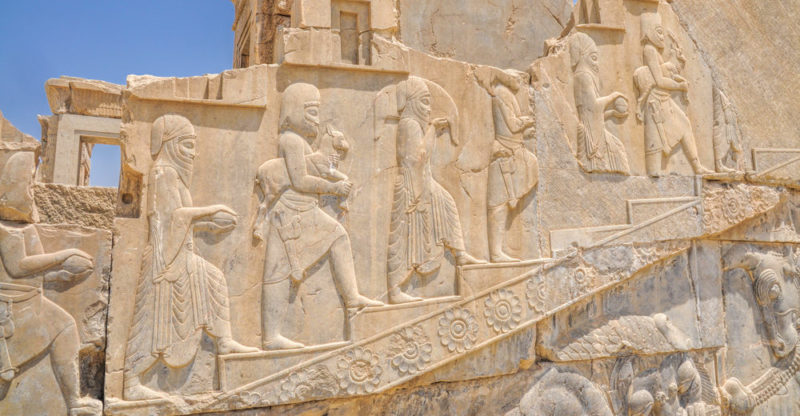
The Persian Empire occupied a huge territory, which integrated heterogeneous regions and cultures. Despite the internal rebellions and the political crises that the different emperors of the Aquemenida dynasty, the empire, remained united thanks to the combination of a centralized, strong and effective organization with a flexible administration, which respected local uses and customs.
In the center of the organization was the emperor. It was a theocratic empire, since the Persians They believed that the power had been granted by the God Ahura Mazda and could not be governed without its protection. They argued that this God had granted Persia the supremacy over the rest of the peoples of the world.
The territories of the empire were divided into twenty satrapia (Provincial organization that was established by King Darío I). Each satrapia was governed by a satrap designated by the emperor. This system allowed to grant political uniformity within a heterogeneous empire. Each satrapia had some autonomy for the management of the territory and had to pay tribute to the central power. The level of control, autonomy and taxes that each satrapia had depended on its relationship with imperial power.
On the other hand, within each satrapia The resource control and administration system was reproduced . The local rural population was assigned economic obligations: in addition to usual taxes and services that affected the amount of work they could dedicate to their own crops, they had to provide food to the court of the satrap.
Persian Empire Economy
The Persian economy was based on the imposition of taxes and the domain of local productive resources by the central power and the different levels of imperial rulers.
With the creation of the Empire, the Persians unified regions of independent economic development, which were previously only linked to each other by commercial, diplomatic or military ties. By incorporating this heterogeneity, the Persian Empire developed certain elements that affected local economies throughout the Near East:
- Fiscal and Tax Unification . All satrapias had to pay taxes to the Empire, but the amount and characteristics of the tribute depended on the relationship with the central power.
- Currency introduction . The silver and gold darico became the official currency of the Empire. Its metal and weight were guaranteed by the real wedge.
- Domain of productive resources by the imperial authorities . The monarch, the royal family, the nobility, the satraps and the Persian courtiers were privileged in the distribution and delivery of land.
- State Strategic Resources Control . The different levels of imperial government sought to control water access and built advanced irrigated systems to improve agricultural development in drier areas.
- Extension of commercial routes . The State developed and improved the network of roads that connected the different regions. In addition, this unification allowed the development of commercial ties with farthest regions and the creation of routes towards the Far East and Europe.
Religion of the Persian Empire
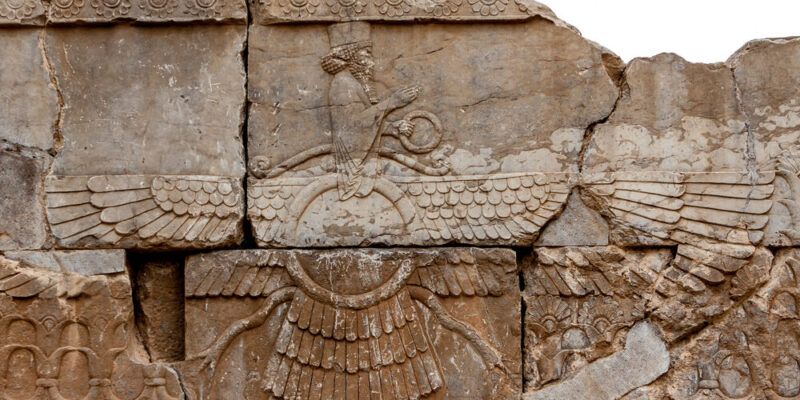
As for religion, the Persians They professed Zoroastrismo Religion that had been revealed by the Iranian prophet Zoroastro and who raised the worship of a supreme god: Ahura Mazda.
The Persians They believed that the world was the place where the forces of good and evil faced . The good was guided by the God Ahura Mazda, creator of the world, the good and the bright, and the evil by Angra Mainyu, creator of the darkness, the negative and the dark. However, for Persians good and evil were not entities that could be represented, but rather incorporeal truths. Ahura Mazda and Angra Mainyu were referents of those forces, but they did not personify them.
For the Persians, Human beings had to combat evil And, in this way, help Ahura Mazda. They believed that if people practiced justice and virtue, they would be judged after their death and rewarded with eternal salvation.
Regarding the religious organization of the Empire, the Persians maintained a great tolerance with the conquered peoples and allowed them to continue their local cults. Therefore, in the imperial territory different types of beliefs and religions lived.
Persian Empire Culture

The Persian Empire It was characterized by respecting the culture and traditions of the dominated regions And, in many cases, he incorporated several of these customs.
- Architecture . The Persians stood out in the construction of Palacios, large walled buildings that used to be the housing of emperors or nobles. The Palacio de Persepolis, located in the east of the country, was one of the most recognized and worked as the capital of the empire. Persian palaces were distributed throughout the different conquered lands and were decorated with frescoes, mosaics and sculptures.
- Art . The upper classes of each region took the Persian artistic style in the production of jewels and luxury goods. They adopted their decorative styles and their clothes to position themselves socially as part of the elite.
- Army . The Persian army was formed by archers, cavalry, infantry and a large shipping fleet. As the empire enlarged, the army incorporated other local techniques.
- Graves . The Persians stood out for their burial ritual. After dying a loved one they did not bury him because they considered that the bodies contaminate the earth. The bodies, then, remained on stone structures located in height. The emperors built elevated tombs on the ground. The decoration of the grave was simple, but inside the funeral trousseau consisted of a golden sarcophagus, luxury clothing and jewelry with precious stones.
Continue with:
References
- Liverani, M. (1995). The Medes and Persian Unification. The Old East. History, society and economy. Critical editions.
- Kuhrt, A. (2000). The Aquemenide Empire. The Middle East in Antiquity (c. 3000-330 BC). Grupo Planeta (GBS).
- “Persian empire, what was your main legacy?” In UNHCr.
- “Persian Empire” in Ifergan Collection.
- “Alejandro against the Persian Empire, the battle of Issos” in National Geographic.
- “Persian Empire: Map of a domination based on flexibility” in UNHCr.
- “Persian Empire” in History.
- “The Achaemenid Persian Empire 550-330 BC” in The Met.