
We explain what analytical geometry is, its history, characteristics and most important formulas. In addition, its various applications.

What is analytical geometry?
Analytical geometry is a branch of mathematics dedicated to the in-depth study of geometric figures and their respective data, such as areas, distances, volumes, intersection points, inclination angles, etc. To do this, it uses basic techniques of mathematical analysis and algebra.
It uses a coordinate system known as the Cartesian Plane which is two-dimensional and is composed of two axes: one of abscissa (x axis) and another of ordered (y axis). There we can study all the geometric figures that are of interest to us, assigning each point of the figure a specific location of coordinates (x, y).
Thus, the analyzes of analytical geometry usually understand the mathematical interpretation of a geometric figure that is, the formulation of equations. Or it can be the opposite: the graphical representation of a mathematical equation. This equivalence is expressed in the formula y = f(x) where f is a function of some type.
Analytical geometry is a fundamental field of mathematics that is usually part of the high school curriculum.
History of analytical geometry
The founder of this field of study is considered the French philosopher René Descartes (1596-1650), with the appendix titled “Geometry” in his famous work Discourse of the method.
However, in the 11th century, the Persian mathematician Omar Khayyam (c.1048-c.1131) used similar ideas, which Descartes could hardly have known. That is to say, both of them probably invented them on their own.
Given the hermetic nature of Descartes' ideas, the Dutch mathematician Franz van Schooten (1615-1660) and his collaborators expanded, developed and disseminated analytical geometry in the West. It used to be called “Cartesian Geometry,” to pay homage to its creator, but that term today prefers to be used to refer only to the appendix written by Descartes.
Applications of analytical geometry

Analytical geometry is one of the most useful conceptual tools of humanity, and today we can see its applications in, to name a few examples:
- The hanging bridges From the ancient wooden suspension bridges to their modern versions with steel cables, the geometric principle of the parabola is applied in each of them.
- Satellite dishes Parabolic antennas to capture satellite information have the shape of a paraboloid, generated by their reflector that rotates on the axis, chasing the signal. Thanks to the reflection property of the parabola, the antenna dish can reflect the satellite signal towards the feeding device.
- Astronomical observation The celestial bodies orbit in a path that describes an ellipse, as deduced by Johannes Kepler (1571-1630), and not a circle, as Copernicus (1473-1543) believed. These calculations were possible only using analytical Geometry.
Analytical geometry formulas
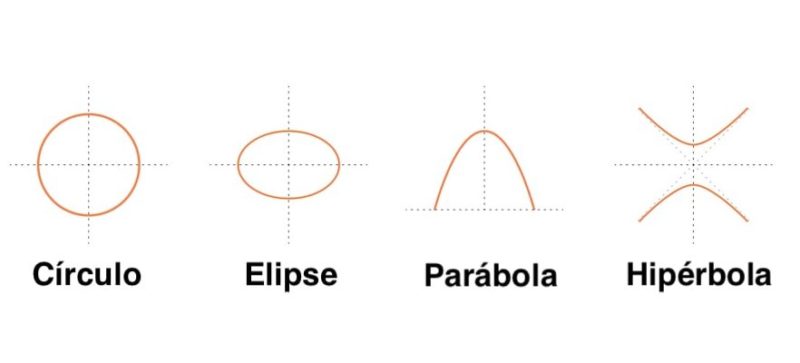
Geometry studies geometric figures and obtains their basic equations, such as:
- The straight They are described by the formula ax + by = c .
- The circles They are described by the formula x2 + and2 = 4 .
- The hyperbolas They are described by the formula xy = 1 .
- The parables They are described by the formula y = ax2 + bx + c .
- The ellipses They are described by the formula (x2/to2) + (and2/b2) = 1 .
References
- “Analytical geometry” on Wikipedia.
- “Brief history of analytical geometry” (video) on math2me.
- “Analytical Geometry” at the National Polytechnic Institute (Mexico).
- “Analytical geometry” at Khan Academy.
- “Analytic geometry” in The Encyclopaedia Britannica.


