
We explain what antimatter is, how it was discovered, its properties, differences with matter and where it is found.
What is antimatter?
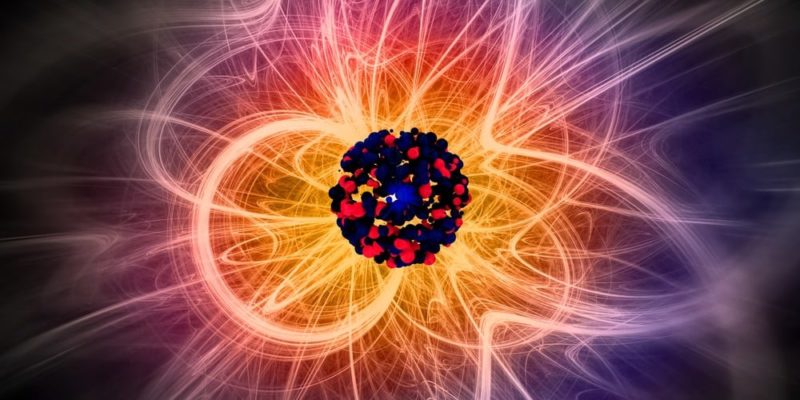
In particle physics, it is known as antimatter. type of matter made up of antiparticles instead of ordinary particles. It is a less common type of matter.
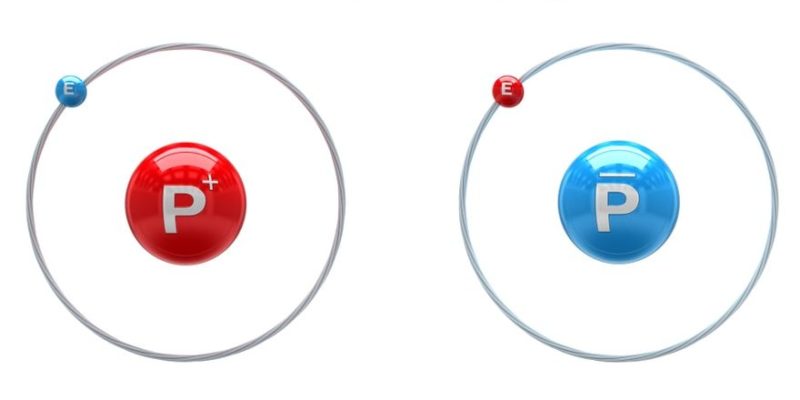
Antimatter is very similar to ordinary matter, the only difference is in the electrical charge of the particles and some quantum numbers. Thus, an antielectron, also called positron, It is the antiparticle of the electron, which has the same properties except the charge, which is positive. Antineutrons, for their part, are neutral (like neutrons) but their magnetic moments are opposite. Finally, antiprotons differ from protons in that they have a negative charge.
When they interact, antimatter and matter annihilate each other after a few moments, releasing enormous amounts of energy in the form of high-energy photons (gamma rays) and other particle-antiparticle pairs of elementary particles.
In physics studies, a distinction is made between particles and antiparticles using a horizontal bar (macron) over the symbols corresponding to the proton (p), electron (e) and neutron (n).
Atoms made up of antiparticles do not exist naturally in nature because they would annihilate with ordinary matter. Only a very small amount has been successfully created in experiments aimed at the formation of anti-atoms.
Discovery of antimatter
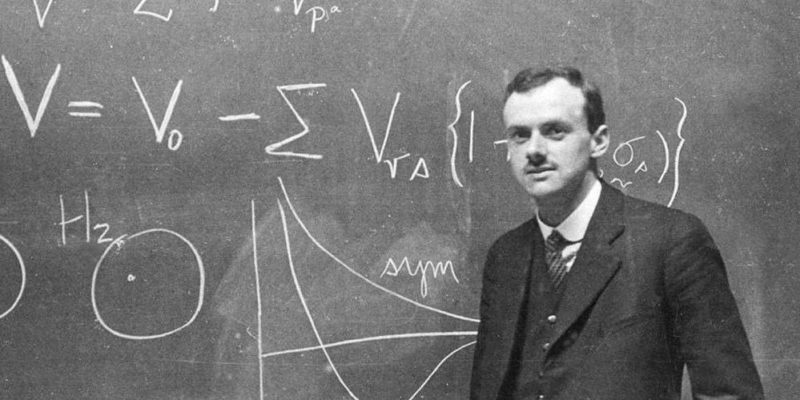
The existence of antimatter It was theorized in 1928 by the English physicist Paul Dirac (1902-1984) when he proposed to formulate a mathematical equation that combined the principles of relativity of Albert Einstein and those of quantum physics of Niels Bohr.
This arduous theoretical work was successfully resolved and from there He concluded that there had to be a particle analogous to the electron but with a positive electrical charge . This first antiparticle was called antielectron and it is known today that its encounter with an ordinary electron leads to mutual annihilation and the generation of photons (gamma rays).
Therefore, it was possible to think about the existence of antiprotons and antineutrons. Dirac's Theory was confirmed in 1932, when positrons were discovered in the interaction between cosmic rays and ordinary matter.
Since then, the mutual annihilation of an electron and an antielectron has been observed. Their meeting constitutes a system known as positronium, half-life never exceeding 10-10 or 10-7 seconds.
Later, at the Berkeley particle accelerator (California, 1955) antiprotons and antineutrons were produced through high-energy atomic collisions, following Einstein's formula of E = mc2 (energy equals mass times the speed of light squared).
In a similar way, In 1995 the first antiatom was obtained thanks to the European Organization for Nuclear Research (CERN). These European physicists managed to create an atom of hydrogen antimatter or antihydrogen, made up of a positron orbiting an antiproton.
Properties of antimatter
Recent research into antimatter suggests that it is a matter as stable as ordinary matter. However, Its electromagnetic properties are inverse to those of matter .
It was not easy to study it in depth, given the enormous monetary costs involved in its production in a laboratory (about USD 62.5 billion per milligram created) and its very short duration.
The most successful case of creating antimatter in the laboratory lasted around 16 minutes . Even so, these recent experiences have allowed us to intuit that matter and antimatter may not have the exact same properties.
Where is antimatter found?
This is one of the mysteries of antimatter, for which there are many possible explanations. Most theories about the origin of the universe accept that In the beginning there were similar proportions of matter and antimatter .
However, Today the observable universe appears to be composed only of ordinary matter . Possible explanations for this change point to interactions of matter and antimatter with dark matter, or to an initial asymmetry between the amount of matter and antimatter produced during the Big Bang.
What we do know is that Natural production of antiparticles takes place in the Van Allen Rings of our planet . These rings are located about two thousand kilometers from the surface and react in this way when gamma rays hit the outer atmosphere.
This antimatter tends to clump together, given that there is not enough ordinary matter in that region to annihilate, and some scientists think that this resource could be used to “extract” antimatter.
What is antimatter used for?

Antimatter still does not have many practical uses in human industries, due to its very high costs and the demanding technology involved in its production and handling. However, certain applications are already a reality.
For example, positron emission tomography (PET) scans are performed, which has suggested that the use of antiprotons in cancer treatment is possible and perhaps more effective than current techniques with protons (radiotherapy).
However, The main application of antimatter is as a source of energy . According to Einstein's equations, the annihilation of matter and antimatter releases so much energy that one kilo of matter/antimatter annihilating would be ten billion times more productive than any chemical reaction and ten thousand times more productive than nuclear fission.
If these reactions can be controlled and taken advantage of, all industries and even transportation would be modified. For example, ten milligrams of antimatter could propel a spacecraft to Mars.
References
- “Antimatter” on Wikipedia.
- “What is antimatter?” on ABC Ciencia.
- “Antimatter” in The Universe and Man.
- “Antimatter” at CERN Accelerating Science.
- “Antimatter” at IOP Institute of Physics.
- “Antimatter (Physics)” in The Encyclopaedia Britannica.


