
We explain what the British empire was, how it originated and its political organization. In addition, what are its characteristics and territories.
What was the British Empire?
The British Empire was a Colonial state that existed between the sixteenth and twentieth centuries under the sovereignty of the United Kingdom of Great Britain and Ireland (Until the nineteenth century it was the kingdom of England). The adjective British It comes from the name of Great Britain. In it, there are England, Scotland and Wales, three of the territories that make up the United Kingdom.
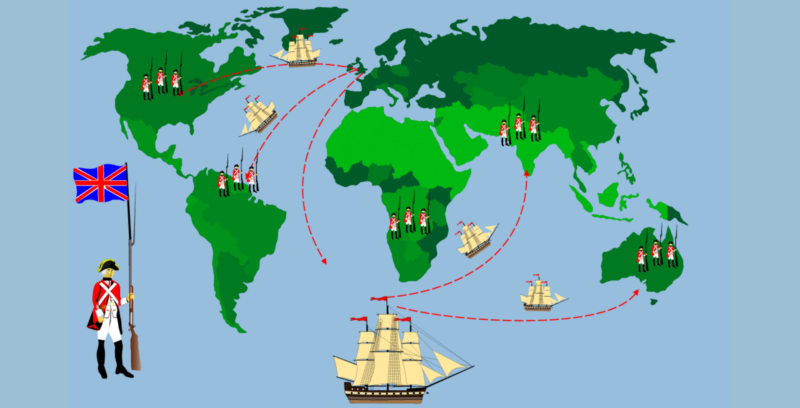
The British They built one of the largest colonial empires in history through the conquest of territories in Europe, America, Africa, Asia and Oceania. The Empire came to control an area of more than 33,000,000 km2. In this way, he spread his culture, technology and form of government throughout the world.
Until the end of the 18th century, colonial expansion focused on American territories . After the independence of the United States (1776), the Empire directed its conquests to Africa, Asia and Oceania. The imperial government was characterized by establishing different levels of domination according to the characteristics of each colonial territory.
The end of the British empire was a consequence of the growth of nationalist movements in the colonies. During the 1920s and 1930s, the Empire recognized the autonomy of some territories (such as Canada, Australia, New Zealand and South Africa). After World War II (1939-1945), the movements in Asia and Africa gained strength and during the following decades were achieving their independence.
British Empire Origin

British expansion outside Europe It began in the 16th century and took a great boost during the reign of Isabel I of England (1558-1603). It was carried out in a context of competition between the different European powers for the control of commercial territories, resources and networks.
In this first stage, The main British adversaries were the Spanish empire and the French empire . The objective was to control the trade routes that linked different parts of the world, especially those that connected Europe with East Asia. The crown encouraged different private companies to initiate expeditions and supported the establishment of British colonial settlements for commercial purposes.
The navigator and merchant John Hawkins directed expeditions on the western coast of Africa and laid the foundations of the British African slave trade. In addition, the East India Company (British Eastern Indies) guided colonization to the east and established different commercial settlements in India.
In North America, the first colonization attempts commanded by Humphrey Gilbert (in Newfoundland) and Walter Raleigh (in Virginia) failed. In 1607, after stopping hostilities with the Spanish Empire, The British Empire managed to permanently found the settlement of Jamestown, in Virginia . This began the colonization of the north of the continent and some of the Caribbean islands.
The new colonies could be maintained under the protection of the great British Naval Navy and strong commercial restrictions were imposed.
Causes of the British Empire
There are different causes that explain the reasons for the territorial expansion of the kingdom of England and its transformation into a colonial empire. Among the most prominent reasons are:
- Mercantilism . Between the fifteenth and sixteenth centuries, the ideas of mercantilism were disseminated, an economic ideology that maintains that the richness of a state is measured by the accumulation of material goods (especially precious metals). Consequently, monarchical governments began to intervene more and more in the national economy with the aim of achieving wealth and promoting commercial companies.
- Search for new lands . In the fifteenth century, all the lands of Europe were under the control of a state. Therefore, the different kingdoms sought to expand their territories on other continents. This encouraged investments in exploration campaigns and in the development of navigation and military technology. The main objectives were to obtain natural resources and control trade routes.
- Competence . The competition for the control of territories, trade routes and natural resources led to the confrontation between the different European states. They also sought to strengthen the domain of possessions of strategic and economic interest, which gave rise to different forms of control and government (for example, colonies and protective).
British Empire Political Organization

The British Empire was governed by the British Crown, settled in England . It dominated all local crowns, such as the Scottish or Asian sultanates and kingdoms. This continued until 1926, when some British domains were granted the Statute of Autonomous Communities under the Commonwealth Commonwealth, a British organization that establishes ties between the United Kingdom and its old colonial possessions.
The British crown is product of the union of the kingdoms of England, Ireland and Scotland at the beginning of the seventeenth century during the reign of Jacobo VI, after the death of Isabel I of England, the last of the lineage of the tudor. These countries remained as separate entities that shared a monarch until the union act of 1707 formalized the unification.
Mercantilist economy
British colonial expansion It was characterized by establishing an economic regime known as mercantilism in their domains . This system is based on the perception that the riches of a state are measured by the amount of material goods it has, especially precious metals.
On the other hand, with the development of the industrial revolution, the British Empire extracted from its colonial domains the raw materials and goods that were necessary for industrial production. This gave the United Kingdom an advantage over the rest of the European powers.
In the 18th century, The Empire tried to increase taxes to colonies trade, which caused (together with other factors) the independence of the United States . From now on, the United Kingdom adopted a liberal economic philosophy (the Laissez-Faire or “let do”), so direct state action was limited.
During the nineteenth century, with the conquest of new territories in Africa and Asia, a colonial economic system was established based on the creation of commercial commercial companies of British origin in the new colonies. These companies were dedicated to the extraction, exploitation and marketing of natural resources. Thus, this system benefited the British to the detriment of local economies.
Territories that made up the British Empire
The British empire came to occupy territories on all continents. In 1921, he had reached its greatest extension, controlling territories in:
- Africa . Namibia, Ascension, Botsuana, Lesoto, Ghana, Nigeria, Gambia, Mauricio, Kenia, Malaui, Sierra Leone, Zambia, Zimbabue, Suazilandia, Seychelles, Tanzania, Uganda, South Africa, Sudan and part of Cameroon, Egypt and Somalia.
- America . Guyana, Belize, Canada, the United States, Malvinas Islands, Anguilla, Antigua and Barbuda, Jamaica, Bahamas, Barbados, Caimán Islands, British Virgin Islands, Dominica, Granada, Trinidad and Tobago, San Cristóbal and Nieves, Santa Lucía, San Vicente and the Grenadines, Turkish Islands and Caicos, South Sandwich Islands, South Georgias Islands.
- Asia . Chagos Archipelago, Kuwait, Bahrain, Bután, Brunéi, Burma, Catar, Sri Lanka, Singapore, Tianjin, United Arab Emirates, Hong Kong, India, Bangladesh, Pakistan, Maldives, Iraq, Israel, Palestine, Nepal, Oman, Jordan, Jordan, Jordan, Malaysia and part of Yemen.
- Europe . Cyprus, Gibraltar, Canal Islands, Malta, Isla de Man and the United Kingdom of Great Britain (the headquarters of the Empire).
- Oceania . Australia, Tuvalu, Fiyi, Cook Islands, Kiribati, New Zealand, Nouru, Pitcairn, Solomon Islands, Tokelau, Tonga, Papua New Guinea, Vanuatu and Samoa.
British India

One of the most important colonial territories of the British empire was India. The Empire controlled much of the Indian subcontinent from 1858 until its independence in 1947 .
Before the creation of a colonial administration, the British company of the Eastern Indies (a private company for commercial purposes) controlled the region and had obtained territorial sovereignty over India. This company imposed its commercial interests on local populations through private armies. In 1857, the Indian population carried out a great rebellion against the company’s government. The following year, the imperial government assumed the administration of the region and dissolved the company.
The British RAJ (as the colonial government of India is known) It included territories that cover the current countries of Bangladés, Burma, Bután, India, Pakistan and Sri Lanka . The government was headed by a viceroy and assisted by an Executive Council.
As in the rest of the colonial domains, the legal, administrative and economic system benefited the crown and British commercial interests. A commercial monopoly was established that forced India to export raw materials with the United Kingdom already import your manufactured goods. In this sense, the development of infrastructure and capital investments were convenient for British interests. In the long term, this economic exploitation system generated structural poverty in the region.
The movements for Indian independence grew in the nineteenth and twentieth centuries. Nehru Jawarhal and Mahatma Gandhi were two of the main leaders who guided resistance struggles against the British government . The region obtained its independence after World War II, within the framework of the decolonization of Asia. In 1947, the British RAJ was dissolved and, instead, the sovereign countries of India and Pakistan were created.
End of the British Empire
After its maximum expansion period after World War I (1914-1918), the British Empire faced legal transformations in the status of some of its domains. The Republic of Ireland achieved its independence after the Anglo-Irish war (1919-1921) . For their part, Iraq and Egypt also obtained their sovereignty in this period, although they remained under the protection of the British government. In addition, the imperial government recognized the autonomy of its domains in Australia, New Zealand, Canada and South Africa.
On the other hand, In 1931 the Commonwealth Commonwealth was created . This association sought to maintain political, economic and cultural ties with the nations that became independent of the British government.
During World War II (1939-1945), the British Government made different promises of autonomy to independence movements in their colonies in exchange for obtaining their military support. At the end of the war, the consequences of these promises were different in each colonial territory.
In some cases, the imperial government met and the countries obtained their independence. However, in other places he faced independence movements or caused wars between the different groups of local populations. Among these cases are those of Kenya, India and Palestine.
British Empire Flag

The British Empire flag is known as the Union Jack or Union Flag (union flag). It combines the colors and shapes of the crosses of the patron saints of England (San Jorge), Scotland (San Andrés) and Ireland of the North (San Patricio), the regions that make up the United Kingdom, together with Wales. These crosses appear with red, white and blue colors.
Current overseas territories of the United Kingdom
Although the British government lost most of its colonies in the twentieth century with independence movements, At present, the United Kingdom maintains control over different territories . In some cases, these are military bases in geographical points of great strategic value. In others, English sovereignty is disputed or is not even recognized by the international community.
The overseas territories that the United Kingdom controls or on which it claims sovereignty today are:
- Eel
- Bermuda
- South Georgia Islands and South Sandwich Islands (claimed by Argentina)
- Falkland Islands (claimed by Argentina)
- Pitcairn Islands
- Gibraltar (claimed by Spain)
- Santa Elena, Ascension and Tristán de Acuña
- British Islands of Chagos (claimed by Mauricio)
- Cayman Islands
- Turkish Islands and Caicos
- Montserrat
- British Virgin Islands
- British Antarctic territory (not recognized by the international community)
- Akrotiri and Dekelia (military bases in Cyprus)
Continue with:
})
References
- Ackermann, Me (2008). Arabian Peninsula and British Imperialism; British Empire in Southern Africa. Encyclopedia of World Historyvol. IV: Age of Revolution and Empire: 1750 to 1900. Facts on File.
- The editors of enyclopaedia Britannica. (2024). British Empire. Britannica Encyclopedia.
https://www.britannica.com/ - Wright, Tef and Wright, E. (eds.). (2015). British Empire. To Dictionary of World History. Oxford University Press.


