We explain what a chimera is and what the origin of the term is. Furthermore, what is its meaning in architecture, in mythology and in biology.

What is a chimera?
Normally, when we say that something is a chimera, or that someone is chasing chimeras, we mean by this term something that does not exist, an illusion or something that appears to be what it really is not . This is what is also understood by the adjective chimerical, and it is a word inherited from Greek khimairawith which in Ancient Greece they called a certain type of fantastic beings whose life was barely one winter long.
Thus, the majority use of this word has to do with the ephemeral, the fallacious, the illusory, that which ends up being very different from what was promised. However, a second meaning derives from the description that the ancients made of this mythological monster, to which they attributed human parts and different animals.
Consequently, in certain contexts a chimera or something chimerical has to do with the hybrid, that which is composed of different parts or that exists on the border between different species . This use is especially common in the biological sciences.
In other areas, such as architecture, certain decorative figures placed on buildings, also called gargoyles, and which usually have animal or monstrous features, are known as chimeras; and also to certain hybrid fusion systems of systems or parts.
Chimera in mythology
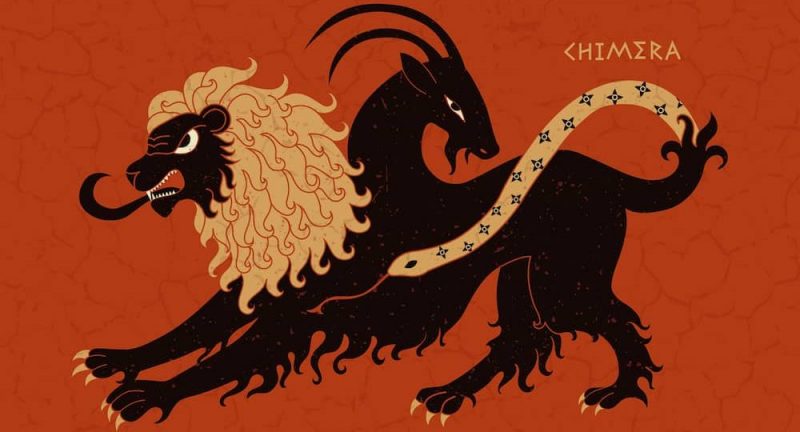
According to the mythological sources of Greek Antiquity, the chimera It was a fabulous-looking monster, a mixture of different animal species and human features. .
In some cases it is described as having the body of a goat, the tail of a snake and the head of a lion, or even having three different heads: a lion, a goat and a dragon or snake. It is almost always attributed a breath of fire and is associated with the feminine, that is, it was a female monster.
Some sources say that the chimera was the result of the union between Echidna and Typhon, two other monstrous beings from mythology, and in others it would be the offspring of the Hydra of Lerna. It is assumed that the creature roamed Asia Minor, eating entire flocks and spreading terror among the inhabitants, until the king of Lycia, Ióbates, entrusted its death to the hero Bellerophon. The latter killed the beast riding the famous Pegasus, the mythological winged horse.
Chimera in biology

In biology and medicine we speak of chimerism to refer to a genetic condition in which two independent zygotes end up fusing in the womb each one with its respective DNA. Thus, they give rise to an individual that has two types of its own cells, each one with its own genome, as if they were two people in the same body.
This condition can occur in different margins, that is, different percentages of mixing of the two genomes, and although the remaining individuals develop normally, their condition can bring with it medical problems (allergies, sensitivities) or, in the case of human society , legal (for example, in demonstrations of paternity and maternity).
References
- “Chimera (mythology)” on Wikipedia.
- “Chimera (architecture)” on Wikipedia.
- “Chimerism” in Wikipedia.
- “Chimera” in the Language Dictionary of the Royal Spanish Academy.
- “Chimera, expansion of meaning” at Fundéu BBVA.
- “Chimera (Greek mythology)” in The Encyclopaedia Britannica.