We explain what are the communist countries that exist today. In addition, the characteristics of each government and the leaders of each country.

What are the communist countries of the 21st century?
Communist countries are states in which The Government consists of a unique party and in which a communist economic system is implemented (in his Marxist-Leninist branch).
The first communist state was the Soviet Union (USSR) that emerged in 1917, when the Tsarist government of the Russian Empire was overthrown by the Russian revolution. Then, throughout the twentieth century, communist political movements were obtaining victories in different countries of the world.
During the Cold War (1945-1991), The communist states were under the influence of the USSR and formed the communist bloc .
However, at the beginning of the 1990s, the USSR dissolved and most communist countries began the transition to capitalism and democracy.
There are few communist regimes that have survived the fall of the Soviet block. Currently, countries that maintain a communist regime are China, North Korea, Cuba, Laos and Vietnam.
See also: communism
China

The Popular Republic of China is, since 1949, A socialist state governed by the Communist Party of China (PCCH). Since the first half of the twentieth century, the Kuomintang (a faction that represented the urban bourgeoisie and the highest classes) and the Communist Party of China (peasant and workers’ base) faced the control and government of the country.
After World War II, the Chiang Kai-Chek government (from Kuomintang) was losing popular support and, in 1948, the Chinese revolution unleashed. Between 1949 and 1976, Mao Zedong ruled the Popular Republic of China and implemented a regime called “popular democratic dictatorship” in which the PCCH and the State acted on behalf of the people to maintain the “dictatorship of the proletariat.”
Mao was based on Marxist-Leninist ideology, but He considered that in China the peasantry had a fundamental role as a revolutionary agent . During his government, he managed to gather China and recover his independence and sovereignty against Japan and the Western powers.
After Mao’s death, Deng Xiaoping assumed as a supreme leader between 1978 and 1989. During his government, political control continued to be centralized in the hands of the party but in the economic field he introduced key reforms that led China to become one of the world’s greatest growth economies.
Deng carried out the transition from a “planned economy” to a “mixed economy” with certain commercial opening elements and gave rise to the system known as “socialism of Chinese characteristics.”
During the second half of the twentieth century, China became the first industrial power and the largest export and import country . In addition, he managed to maintain his sovereignty against the Soviet Union. Currently, he has The most numerous army in the world And it is a nuclear power.
North Korea
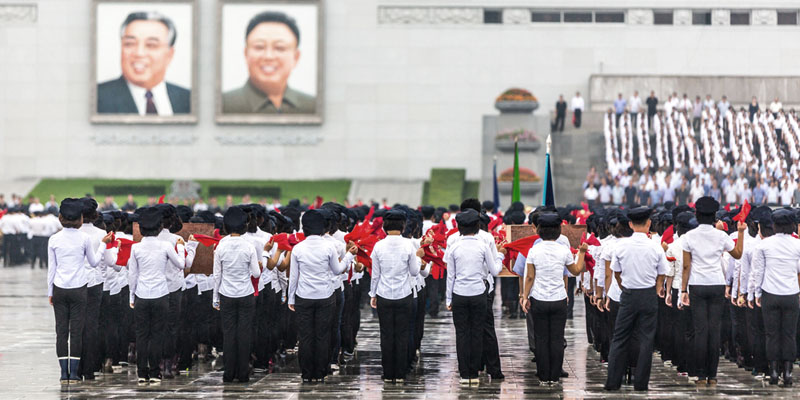
The Democratic Popular Republic of Korea, also known as North Korea, He was born in 1948 when the Korean division was consummated in two countries : a communist in the north (area that had been occupied by the Soviets, after World War II, in 1945) and another pro-western and capitalist in the south (North American occupation zone).
Between 1950 and 1953, The two countries faced the Korean War . At the end, an armistice was signed and a demilitarized area was established to separate the two countries.
Since 1948, North Korea was governed by Kim Il Sung, whom his son Kim Jong-il happened to his death in 1997. The Kim Il Sung government defined himself as a self-sufficient socialist state.
However, international organizations consider it An autocratic and totalitarian dictatorship in which the personality cult of the leader had a central place.
Cuba

Cuba was The first country to implement a communist political and economic system in America . After the Cuban revolution that overthrew the Fulgencio Batista dictatorial regime, Fidel Castro assumed power in 1959. The revolutionary movement was socialist, populist and nationalist.
From the beginning of his government, he carried out political and economic reforms such as the nationalization of numerous service companies and the centralization of the press . These measures affected the upper classes and, especially, the interests of the United States on the island.
Before the rebellions and the American threats, Castro harden his government with dictatorial features established relations with the Soviet Union (USSR) and deepened the transition to communism.
In the context of the Cold War, Cuba became a fundamental element of relations between the United States and the USSR, since it became a communist country in the middle of the western bloc and in front of the United States. The 1962 missile crisis was a key event that strengthened relations between Cuba and the USSR .
During the 1960s, it was formally created The Communist Party of Cuba, which monopolized political power on the island until today . In the economic field, the American embargo, which prevents any trade with the island, was counteracted with the Soviet mass help.
However, the Cuban economy failed to remain in growth. This difficult situation was very aggravated with the dissolution of the USSR in 1991, which ended with the economic, material and resources aid that reached Cuba.
As a consequence, the government initiated the “special regime”, characterized by the deprivations of property of the population. With the new millennium, it sought to undertake reforms and modernize the economy of the country. To do this, International relations with new countries were stimulated and some economic regulations were flexible for the creation of new commercial links.
In 2006, Fidel Castro gave power to his brother Raúl Castro, due to his illness. The government continued to be controlled by the party and the economy intervened from the State.
Laos

The Popular Democratic Republic of Lao It was founded after the civil war that crossed the country between 1964 and 1975 . During the war, the communist groups, aligned in the known movement Pathet Lao (officially called as Laos Liberation Army), faced the constitutional monarchy established by the French who, during World War II, occupied the country.
Laos was involved in the Second Indochina War (also known as Vietnam War), when The communist Norvietnamese army occupied part of the country and established operation bases there. The United States bombed and destroyed these territories.
The Pathet Lao, supported by the Norvietnamese army, China and the USSR, managed to overcome the divisions of the Royal Army and the United States, and take the city of Saigon. Finally, in December 1975 he forced the abdication of King Savang Vatthana, He took control of the country and established a communist government of the single party under the Popular Revolutionary Party of Laos (PPRL). In that context, the government of the new popular democratic republic of Lao was linked and under the influence of Vietnam.
Only in the 1990 laos signed its new Constitution. It consolidated the power of the PPRL and the country’s state organization was certified, with the legislative power in the hands of the National Assembly (controlled by the party) and the Executive Power led by the President and the Prime Minister.
It was also determined A new economic direction, with a controlled opening towards foreign investment and the creation of private companies, which allowed to improve the economic growth of the country.
However, at present, 80 % of workers are used in subsistence agriculture. On the other hand, Infrastructure and technology are almost non -existent, electricity is only available in urban areas and the means of transport and communications are very limited.
Vietnam
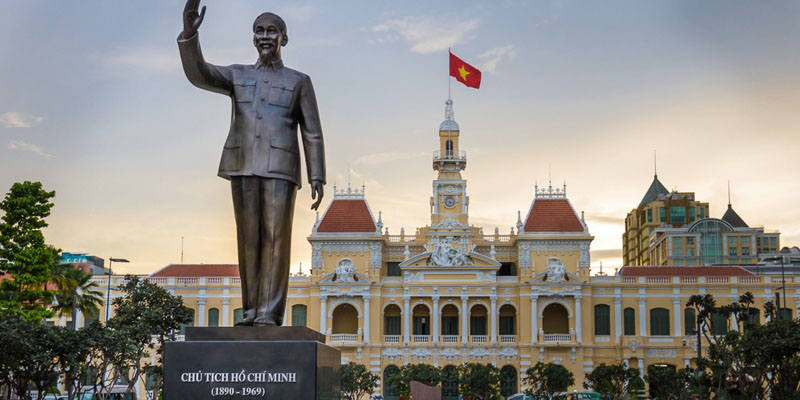
During the nineteenth century, the Indochina Peninsula (where Vietnam is currently located) was occupied and colonized by France. Then, during World War II, The Japanese army occupied the Peninsula but ended up removing its troops at the end of the war and be defeated by the side of the allies.
In that context, the nationalist Vietnamese led by Ho Chi Minh (in Vietnamese Hồ Chí Minh) began the war for their independence of France (known as Gran War of Indochina). In 1954 the nationalists managed to expel the French.
However, Western powers wanted to prevent every Vietnam from being under the leadership of communist Ho Chi Minh. At the 1954 Geneva Conference, They managed to impose the division of the Vietnamese territory in two independent sovereign states with the commitment that in 1956 elections were held for the Vietnamese population to decide the final reunification or separation.
Vietnam of the North was in the hands of the communist forces, organized around Ho Chi Minh and Vietnam del Sur was controlled by a pro-western government, political and economically supported by the United States. In this context, The Vietnam War (1955-1975) was unleashed that lasted almost twenty years and resulted in the death of about three million Vietnamese .
South Vietnam prevented the elections for the reunification referendum. In 1957, the South Communists grouped in the National Liberation Front (also known as Viet Cong) began a military insurrection, supported by the Norvietnamese. The South Vietnam Government repressed and persecuted the communists.
In 1959, the North Vietnamese troops invaded South Vietnam and the United States began to intervene directly in the conflict through a massive military intervention. The war ended in 1975, with the victory of Northern Vietnam and the reunification of the entire territory in the Socialist Republic of Vietnam.
The Government was in the hands of the Communist Party of Vietnam (PCV), which established a common and uniparty regime. The Government was formed by the general secretary of the PCV, the Prime Minister and the President of the State, appointed by a general assembly whose members belong to the PCV.
During the first years, A fully communist economy was established, with centralized planning by the State and maximum production control . Its primary objective was to recover the food production and assets rates, to alleviate the harsh living conditions and the serious economic situation of the country, devastated by twenty years of war. The lands were nationalized and divided into agricultural work cooperatives .
However, since the end of the 1980s, the PCV began to apply reforms for moderate market liberalization, known as “renewal” (in Vietnamese Ổi mới). These measures involved the controlled appearance of private property in the field and in the industry, and the opening to foreign investments. Since then, the economy is in gradual growth, especially improving agricultural production.
In recent years, Vietnam stood out for being one of the countries with the lowest population in unemployment situation . Poverty has been drastically reduced in recent decades. In turn, the constant annual increase of GDP makes it one of the fastest growing economies.
Continue with:
})
References
- Ball, Terence and Dagger, Richard. (2023). “Communism”. Britannica Encyclopedia.
https://www.britannica.com/ - Tato, Mi, Bubello, JP, Castello, AM and Campos, E. (2011). History of the second half of the twentieth century. Estrada
- Van Dijk, R., Gray, WG, Savranskaya, S., Suri, J., & Zhai, Q. (eds.). (2013). “Communism”, “” China, People’s Republic of “,” Cuba “,” Laos “,” North Korea “and” Vietnam “. Encyclopedia of the Cold War. Routledge.