We explain how fish reproduce in an oviparous, viviparous and ovoviviparous way. Also, what are reproductive migrations.

How do fish reproduce?
Fish are the largest and most diverse group of vertebrate animals. There are around 28,000 species known, but it is estimated that there may be around 34,000. These aquatic animals live in both marine and freshwater environments : oceans, seas, lakes, lagoons, swamps, streams and rivers, among others.
Fish are characterized by breathe through gills and by having fin-shaped limbs . However, there are exceptions, such as lungfish or those with leg-like limbs (e.g. Thymichthys politus).
In this diverse group, cartilaginous fish (which include rays and sharks) are distinguished from bony fish. However, this category does not include other aquatic animals, such as whales, dolphins and sea lions (which are mammals), or octopuses, squid, lobsters and jellyfish (which are invertebrates).
The enormous diversity of fish means that different forms of reproduction occur. Nevertheless, The vast majority of species reproduce sexually and have separate sexes . This makes courtship strategies to attract a mate, such as dances and nest building, common.
Almost all fish are oviparous (embryos develop in an egg, external to the mother's body) and ovuliparous (fertilization is also external). There are also a considerable number of viviparous and ovoviviparous species.
Species have developed different strategies throughout evolution to guarantee their perpetuity. In general, species that do not take care of their eggs lay large quantities while those that provide greater parental care have fewer offspring per litter.
Types of fish reproduction

Fish reproduction can be classified as oviparous, viviparous or ovoviviparous depending on how the embryos develop.
Fish with oviparous reproduction
Most fish exhibit oviparous reproduction, which is one in which each embryo develops inside an egg outside the maternal body. In particular, fish (like some amphibians) are considered ovuliparous because they have external fertilization.
Generally, The female deposits her eggs in the atmosphere and the male fertilizes them with his sperm . These eggs have the characteristic of being soft, something that is possible only in aquatic environments. Some are released directly into the water, while others are placed on the bottom (sandy or silty), on submerged algae or plants, or in bubble nests.
There are only a few cases in which the eggs are fertilized inside the female. However, these are expelled into the environment long before they hatch.
Fishes with viviparous reproduction
Some fish have viviparous reproduction similar to that of mammals, such as the lemon shark (Negaprion brevirostris) and the list or mother (Jenynsia lineata). This type of reproduction involves internal fertilization of the female and the development of the embryo inside .
Depending on the species, embryos can be nourished from ovarian tissues or through a placenta. Compared to oviparous, These fish usually have fewer babies per litter but they are born more developed and larger. This guarantees greater survival.
Fish with ovoviviparous reproduction
Ovoviviparous reproduction occurs in many sharks and rays, as well as seahorses, guppies, and mollies, among other fish. This reproduction method combines oviparity and viviparity in a certain way.
The female produces eggs that are fertilized internally by the male during copulation . These eggs remain inside the mother's body and provide all the nutrients to the embryos. When they are ready to hatch, the female expels them into the water moments before or after birth.
Fish hermaphroditism
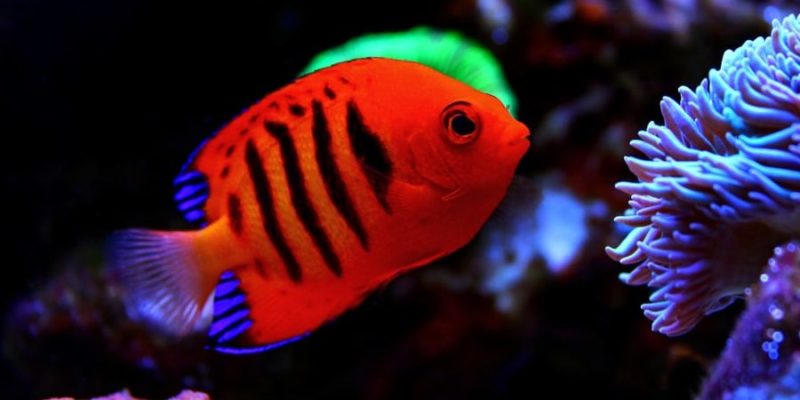
90% of fish are dioecious, that is, they have separate sexes. Some species, such as betta fish, are sexually dimorphic . This means that males and females differ morphologically in their size or color. In other species, such as tunas, both sexes are similar.
However, There are also hermaphrodite species, whose individuals produce both sperm and eggs . Some fish have simultaneous hermaphroditism, because they generate both gametes at the same time. However, they do not self-fertilize but rather mate with another individual of the same species.
The most common thing is that hermaphroditism is sequential that is, individuals change sex at some point in their life cycle. Proterogynous species, such as the grouper (Epinephelus marginatus) and the maiden (Coris julis), are born as females and later mature as males. The opposite happens in proteandrous species, such as the sea bream (Sparus aurata) and the salpa (Sarpa salpa).
Reproductive migrations of fish

Migratory species are those that make long trips or movements. Reproductive migration is one that has the purpose of reproducing and spawning (lay their eggs). This allows them greater survival of their offspring.
Some species make short journeys between lakes and rivers, or between different parts of the ocean. Others travel between fresh and salt water, something they do not do at another stage of their life cycle.
Marine species that make reproductive migrations to freshwater bodies are called anadromous. The classic example is salmon, a sea fish that upon reaching sexual maturation travels up rivers against the current until it reaches its spawning grounds.
During this movement you can see salmon jumping over river slopes, an opportunity that many terrestrial predators take advantage of.
In contrast, freshwater species that migrate towards the sea are called catadromous. For example, eels begin their journey downstream when they are ready to spawn. They can even travel stretches out of water thanks to the abundant mucus on their skin.
References
- Hickman, C.P., Roberts, L.S., & Parson, A. (2000). Comprehensive principles of zoology. (10th ed.). McGraw-Hill / Interamericana de España.
- L'Aquàrium Barcelona. (September 13, 2017). fish reproduction. Aquariumbcn
- Piferrer, F. (2009). Sexual determination and differentiation in fish. In MA Carrillo Estévez, Fish reproduction: basic aspects and their applications in aquaculture (pp. 247-336). Spanish Aquaculture Observatory Foundation. Observatory-Aquaculture
- University of Granada. (sf). Reproduction in fish. In The coast of Granada. Granada Coast
- Douglas Wilkin, J.B. (April 20, 2020). Fish reproduction. CK-12 Foundation. Ck12
- Weitzman, SH and Parenti, LR (March 31, 2023). Reproduction. Encyclopedia Britannica. Britannica
- Zachos, E. (January 29, 2018). A new colony of fish with “hands” discovered in Tasmania. National Geographic Latin America. National Geographic