
We explain how the history of Mexico is from pre -Hispanic era until the beginning of the 21st century. In addition, its main events.
What is the history of Mexico?
The history of Mexico includes the facts that occurred in the territory of the current Mexican nation since the emergence of the first Mesoamerican civilizations, almost 4000 years ago, to the current era of the Mexican Republic.
This story Includes periods of predominance of pre -Hispanic cultures Olmeca, Zapoteca, Maya, Tolteca, Mixteca and Azteca (or Mexica), the Spanish conquest in the 16th century, the colonial era until the beginning of the 19th century, the War of Independence (1810-1821) and the history of the history of the Independent Mexican State since 1821 until today.
During the independent period, some outstanding events were the formation of a republican regime throughout the nineteenth century, the loss of territories against the United States, the Mexican revolution initiated in 1910 and the promulgation of the 1917 Constitution that is still in force.
Mesoamerican civilizations
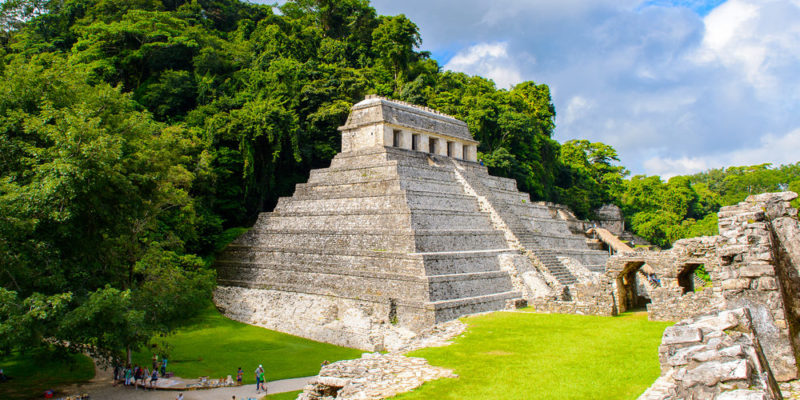
The first indications of inhabitants in the region that today constitutes the Mexican nation date from approximately ten thousand to thirty -five thousand years. They were nomadic populations of hunters and collectors until, around 5000 a. C., began the establishment of a sedentary agricultural culture in Mesoamerica (The area comprising the center and southern Mexico and much of Central America).
Mesoamerican civilizations covered various cultural areas and produced important artistic and architectural works that showed great organizational capacity. Some of these cultures were those of the Olmecs , Zapotec Maya, Toltecs and Mixtecs .
Many of these cultures left important archaeological remains that allowed researchers to recognize the transmission of ideas from each other. This resulted in a more or less common imaginary, as evidenced by the predominance of some gods, such as the feathered snake (Quetzalcóatl), and by pyramid architectural designs.
The last Mesoamerican civilization that extended over a wide territory was the Mexican or Aztec which founded an empire focused on the city of Tenochtitlán (current Mexico City) at the beginning of the fifteenth century.
Conquest of Mexico
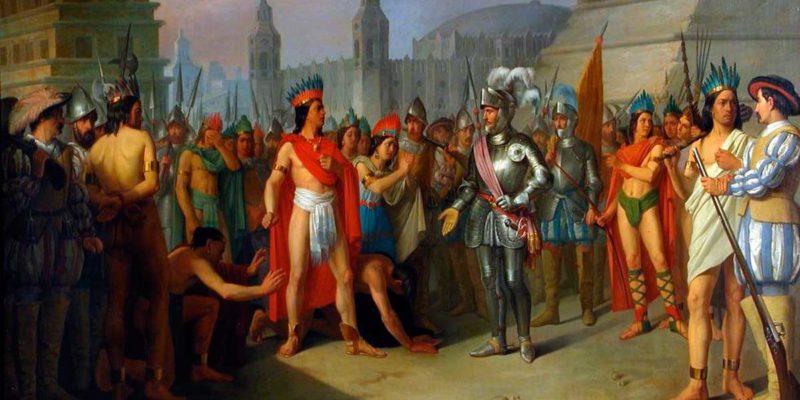
The Conquest of the Aztec Empire (or Mexica ) by the Spanish conquerors, headed by Hernán Cortés , It occurred between 1519 and 1521 . It was achieved after a war in which the Spaniards allied with other indigenous societies that had been historically oppressed by the Aztecs (such as the Totonacas) or who were enemies of said empire (such as the Tlaxcaltecas).
After the death of Emperor Mexica Moctezuma in 1520 and the Spanish shot of Tenochtitlán in 1521, the Aztec empire ceased to exist. Its population was decimated by the effect of war and the diseases introduced in the New World by the Spaniards (such as measles).
The Spaniards called New Spain to the conquered territory and continued extending their conquests during the following years. In 1535 the New Spain Viceroyalty .
Foundation of Mexico City
The Mexico City capital of the viceroyalty of New Spain, was founded on the ruins of the Mexican city of Tenochtitlán . From it the Spanish occupation of the Mexican territory was organized, whose agricultural and mining exploitation began quickly.
Mexico City grew during the colonial era and played a central role in the establishment of the Independent Republic in the nineteenth century, until it became one of the great metropolis of the continent to this day.
Currently, Mexico City retains samples of its indigenous and colonial past, which explains its cultural and architectural wealth. Is A modern city of about 22 million inhabitants (If the metropolitan area is included). Mexico City is also known for its traditions, for its levels of urban violence and for having been the stage of tragedies such as the Tlatelolco killing of 1968 and the 1985 earthquake.
Colonial era
The colonial era of Mexico, such as the rest of Latin America, It was characterized by the organization of society in estates based on differences of origin Interpreted at the time as racial: The “whites” peninsular and Creoles, the “Indians”, reduced to hard work (except for the nobles), and the “blacks” of African origin, who were traded and exploited as slaves.
The indigenous population that survived the diseases and the harsh working conditions of the first years of colonization It was subjected to an evangelization process. By the end of the 16th century, most indigenous people had been converted to Catholicism.
This at the same time generated a phenomenon of syncretism that merged some local religious traditions and symbologies with the Spanish while there was a miscegenation that led to the use of categories such as “mestizo”, “zambo”, “mulatto” or “castes” to refer to the descendants of parents of different ethnic groups.
Colonial Mexico was governed by a viceroy who responded to the instructions in Spain . The viceroyalty system aimed to obtain resources from the viceroyalty to send them to Europe and guarantee the interests of the Spanish monarchy. This imposed limits on the political and economic possibilities of Creole elites, generally dedicated to trade.
War of Independence
The growing economic tensions between the colonies and peninsular Spain reached their maximum point at the beginning of the 19th century. The ideas of the Enlightenment and the example of American independence influenced the thought of colonial elites, disagreement with commercial monopoly and with the Bourbon reforms that had increased taxes and restricted the access of the Creoles to public offices.
The key moment was The capture of King Fernando VII of Spain which was forced by Napoleon Bonaparte to abdicate during the French invasion of the Peninsula in 1808. This fact It caused a series of revolutionary movements in the American colonies. In the case of Mexico, the War of Independence began in 1810 with the cry of Dolores a call to weapons made by Creole Manuel Hidalgo from the Parish of Dolores in Guanajuato.
The war lasted until 1821, when the realistic general Agustín de Iturbide decided to join the insurgents led by Vicente Guerrero and proclaimed the Iguala Plan. According to this plan, Iturbide forces met with the insurgent features and formed the trigrator army with the support of the clergy and the aristocracy. The entrance of the trigratante army in Mexico City On September 27, 1821, he marked the beginning of the independent stage which was formalized the next day with the signing of the Independence Act.
First Mexican Empire
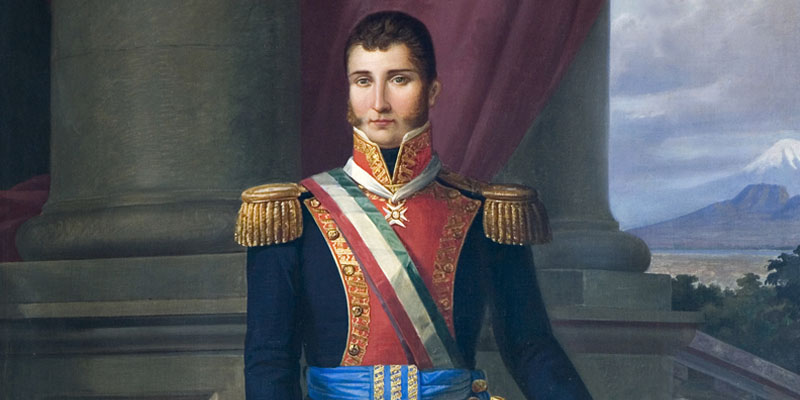
The first independent government of Mexico was a brief monarchy headed by Agustín de Iturbide (crowned as Agustín I) that took the name of Mexican Empire. Its territory coincided with that of the Viceroyalty of New Spain (except for the general captains of Cuba, Santo Domingo, Puerto Rico and the Philippines), so it included the provinces of the General Captaincy of Guatemala (almost all of Central America) and the territories of California, New Mexico and Texas.
Iturbide coronation as Emperor took place in 1822, after being chosen by a congress that aspired to a moderate constitutional monarchy. Iturbide established the flag Tricolor as National Pavilion with vertical stripes in green, white and red and the real eagle crowned on a cactus, taken from a Nahuatl legend.
Soon there were plans to overthrow the monarchy and establish a republic by leaders such as Vicente Guerrero and Antonio López de Santa Anna. After a series of revolts and conspiracies, Iturbide abdicated in March 1823 and escaped to Europe. At that time the dissolution of the empire also began from the emancipation of the Central American provinces. In 1824 the Federal Constitution of the United Mexican States with which the Mexican Republic was born .
Foreign interventions
Independent Mexico faced with several Spanish attempts to reconquer its territory (1821-1829) until the Spanish government recognized the independence of Mexico in 1836. He must also face two French interventions and an American:
- The first French intervention . It took place between 1838 and 1839 and was called the “Cake War.” He faced the Government of Mexico with the Army of France following a series of economic claims made by French citizens, affected by the destruction of properties due to civil conflicts in Mexico. With British mediation, The signing of a peace treaty was agreed after months of armed struggle and the payment of 600,000 pesos by Mexico.
- American intervention . Known in the United States as Mexican-American War, it happened between 1846 and 1848. It was a consequence of the expansionist claims of the United States that declared the annexation of Texas (1845) and militarily crossed territory that belonged to Mexico (1846). The result was the Mexican assignment of a huge portion of its northern territory, corresponding to the current states of Texas, California, Nevada, Utah and parts of New Mexico, Arizona, Colorado, Wyoming, Oklahoma and Kansas.
- The second French intervention . It happened between 1862 and 1867, after the government of Benito Juárez decided to suspend external debt payments due to lack of resources. A new French invasion led to the fall of the Liberal Government of Juarez and the establishment of the second Mexican empire (1864-1867), headed by Maximiliano de Habsburg. This empire was supported by the Mexican conservative sectors that were unhappy with the liberal measures enshrined in the Political Constitution of the Mexican Republic of 1857. Already without the support of France, in 1867 the Empire was overthrown, the Republic was restored and Benito Juárez was elected president.
Mexican Revolution

Between 1876 and 1911 Mexico crossed a stage known as Porfiriato, which consisted of a dictatorship headed by General Porfirio Díaz. In 1910, the discontent generalized by the economic crisis and by the antidemocratic character of the government led to the outbreak of a revolutionary movement that forced Díaz to resign in May 1911.
Thus began what is known as The Mexican Revolution, which continued over ten years and confronted some of the revolutionary leaders who aspired to power or the application of different economic and political models.
This period of political instability and armed struggle cost the lives of some of the main revolutionary leaders, such as Francisco I. Madero (1913), Emiliano Zapata (1919), Venustiano Carranza (1920) and, shortly after, Francisco “Pancho” Villa (1923). One of the main consequences of the Mexican Revolution was the promulgation of the 1917 Constitution which is currently in force.
Modern Mexico
After the revolutionary stage, In the 1920s the governments of Álvaro Obregón and Plutarco Elías Calles followed . Streets promoted a series of anticlerical measures, inspired by some of the principles of the Mexican Revolution, which led to the Cristero war between the government and a group of Catholic militias (1926-1929).
The period between 1928 and 1934 is known as Maximato and was characterized by the influence of streets in the government. In 1929, streets founded the National Party of the Revolution (current Institutional Revolutionary Party or PRI) which ruled Mexico for seventy consecutive years between 1930 and 2000.
Between 1934 and 1940, the Mexican Republic was chaired by General Lázaro Cárdenas who implemented a series of reforms such as the nationalization of the oil industry, the distribution of land between some farmers and the intervention of the State in the economy. In 1943, under the presidency of Manuel Ángel Camacho, the Mexican National Anthem, composed of Francisco González Bocanegra and Jaime Nunó, used since 1854.
In 1992 it was signed The North American Free Trade Agreement With the United States and Canada, which entered into force on January 1, 1994. That same day, there was an uprising of the Zapatista National Liberation Army in Chiapas.
The PRI monopoly concluded when The candidate Vicente Fox, of the National Action Party, won the 2000 presidential elections . Since then, a stage of political alternation began. In 2018, Andrés Manuel López Obrador, of the National Regeneration Movement.
References
- Britannica, Encyclopaedia (2023). Mesoamerican Civilization. Britannica Encyclopedia. https://www.britannica.com/
- De la Torre Villar, Ernesto (1992). The independence of Mexico. Economic Culture Fund.
- Parkes, H. et al. (2022). Mexico. Britannica Encyclopedia. https://www.britannica.com/ von Wobeser, G. (coord.) (2014). History of Mexico. Economic Culture Fund.


