We explain what the Huari culture was, the stages that compose it and its society. In addition, what are its characteristics, religion and economy.

What is Huari culture?
Huari culture (also known as “Wari”) was An Andean pre -Columbian civilization which existed between the 5th and XIII centuries d. C. in the central Andes of the current Peru. For centuries, Wari culture has been considered as part of Tiwanaku’s culture, due to the similarity of its architectural and ceramic styles. However, with the advancement of archaeological studies, specialists consider that the Huaris were a people with their own political, social and cultural identity.
At the moment, More than 50 archaeological sites belonging to this culture are recognized . Archaeologists still discuss what the nature of the expansion of Huari culture in the region was. Some consider that the Huaris managed to build an empire that ruled the conquered peoples with a centralized political and administrative structure. Instead, other specialists argue that from the political growth of the city of Huari, neighboring peoples assimilated their culture but maintained their political autonomy.
Geographic and temporary location of the Huari culture

Huari culture It developed between the eighth and thirteenth centuries d. C. within the average horizon period (600-1200 d. C.) of Andean chronology. This town founded the Huari city in the territory of the current department of Ayacucho, in Peru, and extended to the north (department of Lambayeque), El Sur (Department of Moquegua) and the East (Department of Cusco). This region is an arid zone, with little influx of water slopes.
Archaeologists divide Huari history into various stages, according to the development of their main city:
- Stage 1 . During this stage the construction and growth of the city of Huari was given. Ceramic and textile production was influenced by iconography and ceremonial motifs of the Tiahuanaca culture. Towards the end of the stage the Huaris and Moquegua settlements arise.
- Stage 1b . In this period, social differentiation within the city of Huari was deepened, which continued to grow and received an immigration wave of the surrounding regions. This growth promoted the construction of commercial routes and other urban centers such as Wiracochapampa and Pikillaqta.
- Stages 2nd and 2b . In these periods there was a greater expansion, and the influence of the Huari culture reached its maximum extension.
- Stages 3 and 4 . This stage was characterized by the demographic fall of the city of Huari and the increase in the autonomy of the other urban centers, with a break in the domination and political influence of the capital city over the rest of the region.

From the study of archaeological remains, specialists consider that the Huari people had a stratified society. Although it is not known in detail how social strata differentiated, government and religious functions were monopolized by an elite that lived in urban centers. The city of Huari came to occupy 1500 hectares And it is believed that it had more than 20,000 inhabitants.
Between the eighth centuries and x d. C., the Huari culture expanded through the region and He came to cover the current territories of Lambayeque, Cajamarca, Moquegua and part of Cusco . It is believed that this expansion was the product of a process of military conquests, through which the city of Huari imposed a system of taxes in kind and at work (subsequently known as Mita). However, there is no certainty of the level of dominance exerted by the rulers of the city of Huari over the other urban centers.
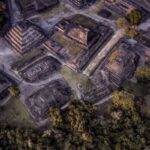
In the planned organization of the Huaris urban centers, the temples and some walled government buildings were differentiated. The cities were built according to a north-south axis and The different centers joined through a network of roads . The peasant population lived in villages in the region and went to cities to fulfill the tasks imposed by the central government and attend religious ceremonies.
Huari economy
The Huari people developed agriculture in an arid zone with few water slopes . To do this, they built a network of channels that allowed to maintain irrigation and extend the crop area. These construction works required a centralized organization of materials and work.
With the domain of the city of Huari over the region, taxes were established in kind and at work . The Huaris created a work shift system (which the Incas later used with the name of mita), From which they capitalized the labor of the conquered peoples and achieved the construction of large -scale works.
The basis of agricultural production was potato, corn and quinoa . For the production of their textiles they cultivated cotton. In addition, they took advantage of the grasslands of the upper areas for the livestock of vicuñas, flames and alpacas.
Elements of Huari culture

- Influences . During the first period in their history, the Huaris were influenced by the cultures of Tiahuanaco and Nazca. This is seen through the iconography and the reasons they used in their ceramic and textile productions. The Huaris represented images of the “God of the Báculos”, which the specialists link with the images of Wiracocha, god of the culture of Tiahuanaco. Nazca influence was seen in polishing shapes and colors used in Huaris ceramics.
- Architecture . The Huari people built walled urban centers in a planned manner, with temples and government buildings that came to have 3 floors and underground cameras. The building was made based on stones together with mud. Some urban centers had squares, north-south runners, galleries and rectangular base squares.
- Ceramics . The Huaris created a ceramic style that continued to be used by later cultures. They made bottles, vessels and other elements of everyday use. Double peak bottles and pitchers decorated with human faces are characteristic of Huari culture.
- Textiles . Huari culture is recognized for the elaboration of cotton and wool textiles: tapestries, clothing, bags and blankets. The fabrics were dyed with a variety of bright colors such as blue, red, white, gold and yellow. In addition, some textiles were decorated with a special iconography for ceremonial use. The specialists believe that through the fabric, the Huaris codified different concepts in a visual way, which allowed them to express content of social rank, their beliefs and even their ethnic affiliation.
- Town planning . The Huari society was differentiated by the growth of urban centers in which government elites resided, while the rest of the population lived in villages and small agricultural settlements. In addition to the city of Huari, the main urban centers of this culture were: Pquilacta, Moquegua, Cerro Baúl, Huaricoto and Wilcahuain.
References
- Schreiber, KJ (1992). Wari Imperialism in Middle Horizon Peru (No. 87). University of Michigan Museum.
- Mcewan, GF (ed.). (2009). Pikillacta: The Wari Empire In Cuzco. University of Iowa Press.
- Pérez, I. (2000). Funeral megalithic structures in the Huari complex. PUCP Archeology Bulletin(4), 505-547.
- Venturoli, S. (2006). Construction and spatial organization of the city of Huari: between myth and history.
- Calderón, IP Wari, complex pre -Hispanic city in the Andean area. Ayacucho in the perspective of culture sciences201.
- González Carré, E. (2004). The chancas manors: history, myths and legends.
- “They find in Peru an imperial tomb of the completely intact Huari culture” in National Geographic.
- “Huari” in The British Encyclopeedia.