We explain what inhibition is and what its causes may be. Furthermore, its meaning in psychology, biology and law.

What is inhibition?
Inhibition, effect of inhibiting or being inhibited, It is the action of preventing, repressing or prohibiting an action, a habit or a faculty . The term is frequently used in the areas of psychology, biochemistry and law, and comes from the Latin verb I will inhibitand with which it formerly referred to the action of rowing against the movement of a boat, in order to slow down or stop its progress.
Inhibition can be motivated by factors or powers external to the individual, or by factors specific to himself, and in the latter case it is possible to speak of self-inhibition. In both cases, however, the result is the delay, hindrance or impediment of an action or conduct, which from then on can be considered inhibited.
Inhibition in psychology
In psychological terms, inhibition is understood as the suspension or repression of a behavior in the individual either due to external contextual factors, or due to internal emotional or psychological factors. This mental phenomenon can be understood in two very different ways, one more “positive” and another more “negative”, that is, one that benefits social performance and another that hinders it.
- In the first case, inhibition is understood as a cognitive executive function that allows us not to react automatically or unconscious when faced with a stimulus, but we are capable of inhibiting certain responses to carry them out at a more favorable moment, or repressing them completely and not giving them an outlet. This is key to social peace and community treatment.
- In the second case, however, inhibition is understood as a pernicious psychological factor, which hinders free social exercise and leads the individual to repress perfectly normal expressions of his personality. These inhibited people tend to withdraw and isolate themselves socially, as a result of some type of social trauma or lack of self-esteem necessary to assert themselves in front of others.
Inhibition in biology
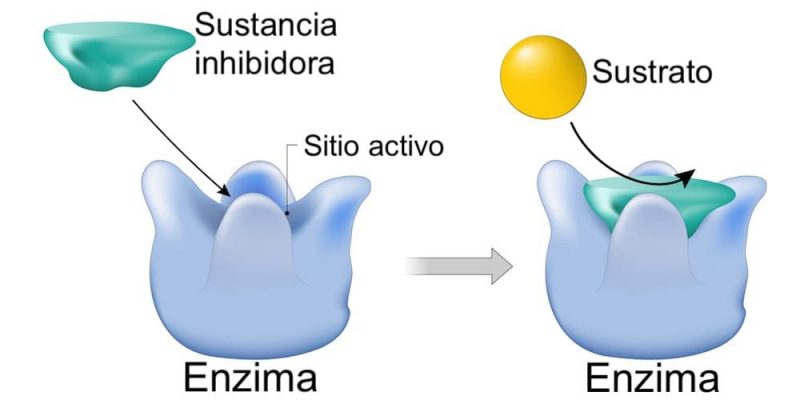
In the field of biology and especially biochemistry, the concept of inhibition is applied to impediment or interruption of chemical reactions controlled, as a consequence of the action of certain proteins (enzymes, for example) or pharmacological substances. In fact, this is a term widely used in the medical and pharmacological field: many medicines inhibit a certain protein or a certain process.
Biochemical inhibition can therefore be of two different types:
Enzyme inhibition which consists of the action of specific molecules capable of binding to an enzyme (that is, a specialized protein with catalyst functions in the organism), to reduce the intensity of its actions, that is, attenuate them. This type of action is very common in pesticides and medications, since once introduced into an organism, these molecules promptly modify the behavior of natural enzymes, for better or worse. These inhibition processes can be of three types, in turn:
- Competitive inhibition when the inhibitory substance takes the place of the usual substrates with which the enzyme interacts, preventing it from fulfilling its usual role.
- Non-competitive inhibition when the inhibitory substance does not prevent contact between the substrate and the enzyme, but does reduce its effectiveness through parallel biochemical processes.
- Mixed inhibition when the inhibitory substance does not prevent the union of the substrate and the enzyme, but does act as a bridge between them, that is, it modifies or modulates said interaction, as long as the concentrations of the substrate allow it.
Lateral inhibition for its part, is a non-enzymatic cellular procedure in which one cell inhibits another adjacent cell in its growth, differentiation or activity, thus exercising a type of cellular control through the Notch signaling pathway (that is, intercellular communication through through the exchange of transmembrane proteins).
Inhibition in law
In the field of law and legal action, inhibition is understood as the action of preventing a judicial body (a judge, a court, etc.) from exercising its role in a specific case considering that he is prevented from doing so due to loss of impartiality or lack of competence.
References
- “Inhibition” in the Dictionary of the language of the Royal Spanish Academy.
- “Etymology of Inhibition” in the Online Spanish Etymological Dictionary.
- “Inhibition (disambiguation)” on Wikipedia.
- “Inhibition of behavior” on Wikipedia.
- “What is inhibition” in Altea Psychologists.
- “Inhibit” in Legal Encyclopedia.