We explain what the Inquisition was, its origin and how its development was in the world. In addition, what were its characteristics and consequences.
What was the Inquisition?
It is known as inquisition or holy Inquisition to a series of Judicial institutions and procedures dependent on the Catholic Church or of clergy at the service of secular governments that emerged in Europe in the Middle Ages and the Modern Age.
Its function was the detection, persecution and condemnation of heresy through interrogations, torture and other test techniques. The term “Inquisition” comes from the Latin “Inquisitio”, which refers to the action of inquiring, that is, to carefully examine something.
The processes were conducted by inquisitors, ecclesiastical agents with the power to submit faith to trial of people and to exercise judicial and research roles. When death sentences were dictated, the execution of the punishment fell to the civil authorities.
In general, three stages are recognized in the history of the Inquisition:
- The medieval Inquisition, which arose at the end of the 12th century and was consolidated in the thirteenth century.
- The Spanish Inquisition, which was established at the end of the fifteenth century.
- The Roman Inquisition, which was born in the 16th century.
The number of people who lost their lives burned in the bonfire is unknown by order of the Inquisition or that were under physical torture To obtain heresy confessions. In addition to human victims, books were prohibited and destroyed.
Origin of the Inquisition
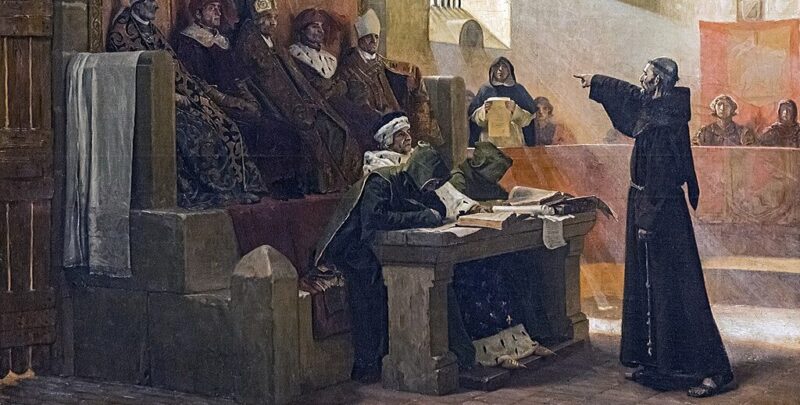
The Inquisition It emerged as a judicial procedure of the Catholic Church in 1184 When Pope Lucio III promulgated the bull Ad abolendam in which he commissioned the bishops to investigate and persecute suspicious people of heresy (that is, contrary to ecclesiastical dogma) in their diocese.
The Inquisition of this era was directed mainly against Cathars and other heretics such as the Valdense but it worked intermittently and was not organized by a central institution but by the bishops. For this reason it is usually called episcopal inquisition.
In 1231 Pope Gregory IX promulgated the bull exommmunicamus in which it established the creation of ecclesiastical courts and the appointment of the first inquisitors subject directly to papal authority, mostly Dominican and Franciscan friars. This group of institutions is usually called papal or pontifical inquisition.
Over time The Pontifical Inquisition extended its persecution to other heretics Already cases of alleged sorcery in various parts of Europe, such as France, Italy and Germany. The dissemination of inquisitorial manuals, such as Inquisition practice by Bernardo Gui (1261-1331), allowed the standardization of procedures.
The Inquisition in the Middle Ages
The courts of the Pontifical Inquisition in the Middle Ages were chaired by an inquisitor who acted as delegate of the Pope . The processes by heresy could begin without a formal accusation, so a mere suspicion was reason enough to start them.
The inquisitor offered the suspect the possibility of confessing Its guilt under oath and also testify against others, which extended the list of people to investigate and interrogate. These judgments used to be secret and the suspect lacked a lawyer or a defense, although a written record was maintained that scored a notary. From the bull Ad remirp (1252) of Pope Innocent IV, the Inquisitor was authorized to use torture to obtain confessions, a task of which lay assistants were dealing with.
The suspects used to remain locked in prisons while the process lasted. The inquisitor also interrogated witnesses and consulted with lawyers. The sentences to those who were found guilty of heresy were issued in a public homily . Those who manifested repentance could receive religious penances, the stigma of wearing yellow crosses in their clothes or prison. Those who refused to abjure were condemned to die at the bonfire and delivered to the secular authority to fulfill the execution. The assets of the conviction were confiscated and employees to cover the expenses of the process and execution.
The Spanish Inquisition
Although it had already been introduced in the kingdom of Aragon in the thirteenth century, the Inquisition It was formally established in the kingdom of Castile in 1478 For the bull SINTERAE DEVOTIONIS AFFECTUS of Pope Sixtus IV. This bull empowered the Catholic Monarchs to appoint inquisitors who had to investigate and punish alleged cases of heresy in the territory of the crowns of Castile and Aragon.
The peculiar of the Spanish Inquisition was that, although the papal authority recognized, It depended directly on the Spanish monarchy . The Portuguese Inquisition, which was born at the beginning of the 16th century, imitated this model and was under the main authority of the Crown of Portugal.
The first inquisitors of the Court of the Holy Office of the Inquisition (as the Spanish Inquisition was called) were appointed in 1480 and served in Seville, where the first “Faith Auto” took place in 1481 that condemned six people to die at the stake. The “cars of faith” were public ceremonies in which the defendants could abjure their alleged errors or be delivered to the “secular arm” (that is, to the civil authority) for their execution.
The main objective of the inquisitors were the converts and their descendants who, although they had become Christianity, believed that they continued to secretly practice Jewish religious rituals.
In 1483, the Pope authorized the appointment by the Spanish monarchy of a general inquisitor, who subsequently went on to preside over the council of the Supreme Inquisition (known as “the supreme”). The first general inquisitor was Tomás de Torquemada (1420-1498) and under his authority it is estimated that around 2000 people died at the stake.
At the beginning of the 16th century, the Muslims who remained in Spain were forced to become Christianity and this caused a persecution of converts (called “Moorish”) suspected of keeping Islamic faith secret. The Spanish Inquisition was definitely abolished in 1834 .
The Inquisition in America
Both the Spanish and Portuguese Inquisition extended their authority over the colonies in America. Initially the inquisitorial authority used to fall on Dominican or Franciscan friars. During the 16th century Courts were established in the big cities or capitals of viceroyalty such as Mexico City, Lima and Cartagena de Indias. In Brazil, inquisitorial visitors dependent on the Lisbon court acted.
In Mexico, inquisitorial processes began to be carried out from the moment of the conquest in 1521, as part of the “spiritual conquest” of the natives. But the first cars of faith were carried out in 1528 and led to the execution in the bonfire of two conquerors suspected of being Judeoconversos, which confessed under torture that continued to practice the Jewish faith.
Mayan codices were also destroyed and Indigenous people accused of polygamy were investigated Bigamia, Amancebamiento, Sorcery, Divination and Superstition.
In 1571 The Court of the Holy Office of the Inquisition in Mexico was created which depended directly on the Council of the Supreme Inquisition of Spain. Courts were also created in Lima (1571) and Cartagena de Indias (1610).
The charges used to be directed against people considered “Judaizantes”, Protestants (among these, some were English and French pirates) or heretics of various characteristics.
In Protestant America there were also cases of condemnation and execution of people for religious reasons. The famous Salem judgments are only an example of several that took place in the seventeenth century in the British colonies.
The Roman Inquisition
In 1542 the Roman Inquisition was created with the objective of chasing the promoters of the Protestant reform Christian movement opposed to Catholic orthodoxy that emerged in Europe in the 16th century. He also acted against thinkers who were considered suspected of questioning the religious doctrine of the Church (for example, Giordano Bruno and Galileo Galilei).
The Roman Inquisition, also called the Congregation of the Holy Office, It was part of the call counter -reform and aspired to have jurisdiction over all Christianity, although its action focused mainly on Italy. Their courts were controlled by a group of cardinals appointed by the Pope who integrated the congregation with other prelates. Among its activities were also the elaboration of a prohibited book index entitled Index auctorum et liborum prohibitorum.
Tortures and executions of the Inquisition

Torture, public humiliation and death due to execution were practices used by the Inquisition. Torture, in particular, could have two functions : Obtain confession during the process or serve as exemplary punishment before an execution was consummated.
In the inquisitors manuals it used to recognize that obtaining confessions through torture could lead to false powers, as The tortured was willing to confess or betray other people as long as his torment culminated. For this reason, it was sometimes recommended to reiterate questions without the use of torture. In practice, the fear of experiencing supplications could lead the defendants to confirm their confession.
Some of the best known torture methods were The foal, the garrucha and the torment of the water introduced during the years of the Spanish Inquisition.
When the death penalty was issued, reserved for the cases considered more serious, the defendant was delivered to the “secular arm” and generally burned alive in the bonfire in a public space. If he regretted, he could be executed by hanging by the vile club before the pyre burned. On many occasions the defendant was executed “in effigy”, that is, a substitute image or doll was used because he had been judged in absence or died during the trial.
Witch hunt
In the Modern Age, One of the positions investigated by the Inquisition was that of witchcraft . The figure of the sorcerer and, above all, of the witch as people who embodied religious deviation and the association with the demon arose from popular beliefs and the way in which the theologians interpreted these beliefs. Witch hunting was especially intense in countries like Germany and even reached regions of America.
In 1484 Pope Innocent VIII promulgated a bull in which he authorized the Inquisition to pursue and condemn the suspicious people of witchcraft.
The years of greater activity of the pursuit of witchcraft were between 1580 and 1630 . Often, the complaints were born of mere suspicions or neighborhood rivalries and gave rise to greater del one product of collective hysteria. The courts that were in charge of the process could be ecclesiastical or lay. Who were found guilty used to be burned in the bonfire by secular authorities. In England and in the British colonies there were also witch fighters led by Protestants, particularly Puritanos, as in the famous Salem judgments in Massachusetts.
Other common positions in the processes conducted by the Inquisition were those of alchemy, sodomy (homosexuality), paganism, apostasy (renunciation of the Catholic faith) and various forms of heresy (disobedience to Catholic orthodoxy).
In 1657 the Catholic Church recognized in an instruction entitled Pro forming that The Roman Inquisition had incurred excessive torture and unfair sentences for alleged cases of witchcraft. Anyway, the courts continued to execute people in various countries and the last execution took place in Switzerland in 1782.
Galileo Galilei’s conviction

Galileo Galilei (1564-1642) was One of the most important thinkers of the Modern Age . Born in Pisa (Italy), he dedicated himself to mathematics, astronomy, physics and also contributed to laying the foundations of the scientific method.
Through the use of the telescope he made astronomical observations that allowed him He affirmed that the earth was not the center of the universe but that it revolved around the sun (What is known as “heliocentric theory”). This statement was against the doctrine of the Church, which defended the geocentric model that stated that all the stars revolved around the earth.
The heliocentric theory was considered heretical and, in 1633, Galileo was Convened to Rome by the Inquisition .
He was questioned, considered suspicious of heresy and had to retract his ideas . He was sentenced to life imprisonment and spent the last years of his life locked in his home in Florence.
An anecdote argues that after abandoning the Inquisition, Galileo murmured “EPPUR SI MUOVE” (“And yet it moves”), in relation to the rotation of the earth that had just been forced to deny. Anyway, there is no evidence that you have pronounced these words.
The process against Juana de Arco

A famous case led by an ecclesiastical court during the Middle Ages was the process against Juana de Arco, A young peasant from the beginning of the fifteenth century who headed troops from the French army in his fight against the English and facilitated that Carlos VII was a crowned king of France.
Juana It was captured by the Burgs during a military campaign in 1430 and was delivered to the English. Since Juana argued that she had divine visions, the English submitted her to the examination of an ecclesiastical court chaired by the French bishop Pierre Cauchon, and was found guilty of around seventy positions, including blasphemy, dressing as a man and being suspicious of heresy.
She was sentenced to die at the stake and executed by the secular arm in the Old Market of Ruan in 1431, when she was 19 years old.
See more at: Juana de Arco
Malleus Maleficarum

He Witch Hammer (In Latin, Malleus Maleficarum) it’s a exhaustive treatise on witchcraft and witch hunting written by the German Dominican friar and inquisitor Heinrich Kramer with the possible co -authorship of the friar Jakob Sprenger.
It was originally published in Germany in 1486 and had numerous reissues during the 16th and 17th centuries . Together with the bull Summis deidsenating Affectibus (1484) of Pope Innocent VIII (who gave his approval to the persecution and punishment of “witches” by the Inquisition), Malleus Maleficarum It contributed to spreading the vision of witchcraft in Europe and parts of America as a form of Satanism and as one of the most dangerous heresies.
This book describes the phenomenon of witchcraft through a collection of pre -existing beliefs and details the procedures to discover, interrogate (resorting to torture) and especially judge women suspected of being “witches.” Besides It presents women as particularly inclined to fall into the temptation of the devil .
References
- Broedel, HP (2003). The Malleus Maleficarum and the Construction of Witchcraft. Manchester University Press.
- CAMPAGNE, FA (2009). Hispanic Strix: Christian demonology and folk culture in modern Spain. Prometheus.
- GIVEN, JB (1997). Inquisition and Medieval Society. Power, Discipline, and Resistance in Languedoc. Cornell University Press.
- “Inquisition” Peters, E. & Hamilton, B. (2020) in British Encyclopedia
- “Spanish Inquisition” Ryan, EA (2020) in Britannica Encyclopedia