We explain what the life cycle is when it refers to a product, a project and various living beings, including humans.
What is a life cycle?
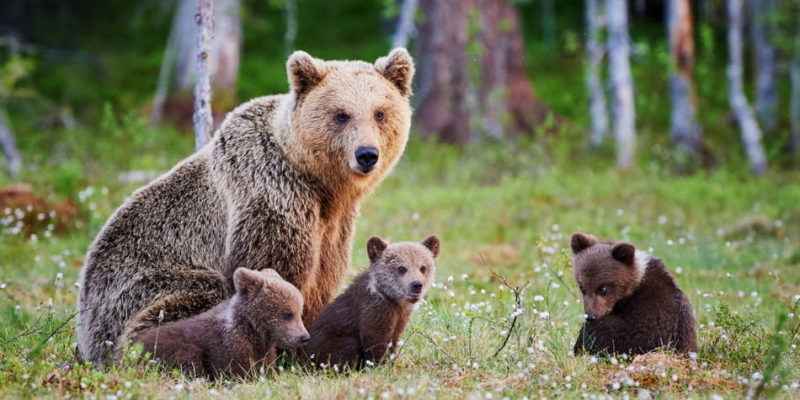
When talking about a life cycle or vital cycle, we commonly refer to the span of existence and usefulness of things or vitality in the case of a living organism.
This period is made up of different stages, periods or transits. Generally begins with creation or birth, and culminates in death, obsolescence or uselessness . From this point of view, absolutely everything has its own life cycle.
Therefore, this term can be used in very different areas of life, from biology (where it is called the biological cycle), dividing in that case by type of living being, to marketing (where it is usually nicknamed CVP or PPC) and the world of productivity.
Product life cycle
In the world of marketing and commercialization, we usually talk about the life cycle of a product (CVP) to refer to the trajectory that describes the number of sales of a product, from when it enters the market for consumption.
In other words, it is the evolution of product sales over time as their consumption dynamics vary and, therefore, so do the sales, distribution and promotion strategies that encourage their purchase in the different target markets.
This life cycle It is different for each type of product . Some have quick launches with high sales in a short period, but most have long periods of maturity, that is, slow but sustained sales over time.
Eventually, when sales decline, the product can either be eliminated and its production stopped/replaced by a different version, or it can be relaunched with some promotional effort or some modification that generates new enthusiasm and allows it to restart its cycle.
Project life cycle
In the administrative world, projects also comply with a specific life cycle, marked by a set of stages or phases that mark their natural evolution, as they take shape and become a reality.
This circuit can always be interrupted beforehand, in case the project is abandoned, but if everything goes well, it will lead to the achievement of the general objectives with which it was originally conceived.
The stages or phases of the life cycle of a project are:
- Planning or initialization. This is the stage of studies and analysis prior to launching the project, in which the objectives are outlined, their feasibility is evaluated, a route plan is prepared and the basic implements necessary to take the first step are obtained.
- Execution or development. This is the growth stage of the project, in which it is put into practice, following the previously planned steps, to make the project work. If the previous step was done with sufficient thoroughness, the failure rates at this stage will always be lower.
- Control or monitoring. Many projects do not reach this stage, only those that satisfactorily complete the execution will then be able to begin to evaluate their own performance taking into account the variables of the case, such as time, effectiveness, etc., to make a diagnosis. Then, the system can be fed back to plan future decision making (a new project).
- Compliance or closure. Once the previous stages have been achieved, the project will have been successful and can be closed, which is nothing more than the compilation of the pertinent conclusions, and the beginning of a new project to continue, update or correct the one carried out so far.
Life cycle of living beings

In the case of living beings of all types, the biological cycle It is the circuit of existence that goes from coming into the world to death . It includes reproduction, that is, the gestation of new individuals of the species, which can be considered, at least from a biological point of view, the purpose of life.
The cycle can be very different depending on the type of living being. An animal, a plant, a microorganism, a fungus or a virus, all are living beings that complete cycles of different lengths, some very brief, others lasting many years. Sometimes they involve different habitats (such as amphibians, which have an aquatic stage and a terrestrial stage) or even different modes of existence prior to the adult form.
However, these life cycles all comply, in their own way, with the following stages:
- Birth. Living beings are born from other living beings, either emerging from eggs laid in some strategic location, being born from the bowels of their parent, or as a result of a division process of some nature, in the case of unicellular organisms. In any case, the living being is first born, and immediately begins to feed and grow.
- Maturation. This is the resource accumulation stage of living beings, in which they will grow to their adult size, even if this means first going through some profound physical changes, as occurs in the case of insects that undergo metamorphosis. Throughout this stage the living being learns to live autonomously, defend itself, control a habitat, and prepare to reproduce.
- Reproduction. Individuals that have reached maturity, that is, are successful adults, will begin their different reproduction dynamics, which aim to perpetuate the species. Some look for a mate through various and complex mating rituals, others build nests or dig burrows, produce flowers full of pollen, or simply initiate the biochemical processes necessary to divide in two. Some organisms reproduce multiple times throughout their lives, others barely manage to do so once. It all depends on how long their life cycles are.
- Death. The inevitable destiny of all life is to perish. When the time of the life cycle begins to run out, in what human beings call old age, the body begins to show its deficiencies, as a result of wear and tear, and begins to be less capable of sustaining vital dynamics, leading to illness and eventually to death.
Life cycle of a butterfly
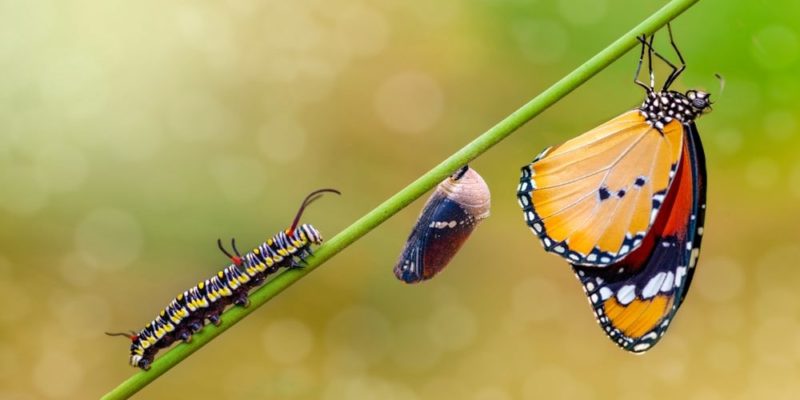
The life cycle of a butterfly is similar to that of many other insects, and can be organized into the following stages:
- The egg. When adult butterflies reproduce, they lay differently shaped eggs, inside which a tiny caterpillar grows. These eggs have all the contents and nutrients that are needed for a new individual to grow, which once the time to hatch is reached, breaks the membrane of the egg and goes out into the world in the form of a small, hungry caterpillar.
- The caterpillar. The caterpillar is a larva, that is, the first autonomous stage of the butterfly's life, in which it has a cylindrical, elongated shape, of different colors and textures depending on the species. The sole mission of these multi-footed terrestrial larvae is to eat and grow, until they have accumulated sufficient food resources to begin their metamorphosis, that is, their transformation into an adult. To do this, it must change its skin several times before it is ready.
- The chrysalis. When the time comes to mature, the caterpillar looks for a suitable place and begins to weave a cocoon, known as a chrysalis. There he locks himself up and isolates himself from the outside world, without needing further food or water, as his body undergoes a rapid and violent series of changes.
- The adult butterfly. Eventually the chrysalis begins to crack, and from within emerges an animal very different from the one that entered: an adult, winged butterfly, with a rigid, chitinous body, ready to live an adult life, reproduce, and restart the cycle.
Continue in: Butterflies
Life cycle of a plant
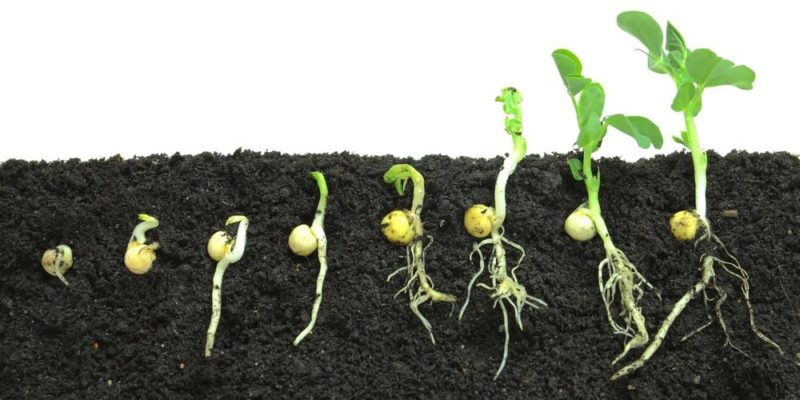
Plants, in general, have long and slow life cycles, the stages of which depend on the type of plant we are talking about. Let us remember that some reproduce sexually, through flowers, seeds and fruits, and others asexually, through shoots, rhizomes, spores and other mechanisms.
But very broadly, the life cycle of plants goes through the following stages:
- Germination. The seeds, spores or shoots that have the necessary resources to be born will do so gradually, through the slow development of the structures necessary for nutrition (roots) and then for photosynthesis (leaves).
- Growth. The new individuals grow and conquer space around them, as they carry out photosynthesis and develop the structures of their body, such as branches, a strong trunk to support it, etc. Depending on the species, this stage can take a few weeks, or dozens of years, and is never really interrupted. Plants grow until their last moment of life, or at least until the available resources allow it.
- Reproduction. When biological resources allow it, plants will begin their reproduction, whether sexual or asexual. In the first case, it will be through flowers, as the wind or the action of animals (such as bees) allow the exchange of pollen and sexual cells between one plant and another, producing fertilization. Then seeds will be produced and, in certain cases, fruits wrapping them, and thanks to animals that devour them, or to the action of the wind and other elements, these seeds will be spread throughout other territories, allowing new plants to be born far from the parent. In other cases, plants will simply produce new shoots, or spores for the wind to spread, or different asexual reproduction mechanisms that will give rise to a new identical individual.
Human life cycle

The life cycle of human beings is much simpler than that of other animals, since we do not go through any type of metamorphosis. Our life cycle is summarized in:
- Birth. As we know, humans are born from our mothers, after they have gone through nine months of pregnancy and we are fully formed, ready to start an independent life. Then we are expelled from our mothers' bodies through the birth canal, although still in a very helpless state, since our body still requires a lot of care to reach the fullness of its functions.
- Childhood. Childhood is our first stage in the world, and goes from birth to entering adolescence. During this stage our body will constantly grow and get ready at full speed, making it the ideal learning stage: we learn to walk, we learn to talk, we learn to recognize ourselves in the mirror, and many other activities that will accompany us for life.
- Adolescence. Eventually, a little beyond the decade of existence, our body will have grown enough to initiate a series of physical, mental and biochemical changes that will aim to prepare us for reproduction. Although adulthood in human terms comes much later, an adolescent is already physically ready to father another member of his species, and this is manifested in the physical differentiation of the two sexes (male and female), as well as a series of changes. of a social, emotional and psychological nature, which will barely finish occurring when we are well into adulthood, and which in the meantime tend to translate into a lot of impulsivity and imbalance.
- Adulthood. The maturation of the human body occurs somewhere between the ages of twenty and thirty, although these limits are not always exact or precise. In any case, at this stage the human being begins to take his place in society and the world, is capable of leading his life responsibly, and may have plans to reproduce. Adulthood is the stage of greatest balance for human beings, as their energy and rationality levels finally begin to equalize.
- Old age. The declining stage of life, in which the body begins to resent its many years of use, and strength begins to decline. This stage usually occurs after 60 years of age, and depending on the individual it can be more or less peaceful. Many people get sick or suffer from illnesses.
References
- “Biological life cycle” on Wikipedia.
- “Product life cycle” on Wikipedia.
- “Life cycle of a project” at the School of Industrial Organization (EOI).
- “Product Lifecycle” in Shopify Encyclopedia.
- “What are the stages of a project? We tell you about it in this infographic” at OBS Business School.
- “Life cycle of plants” in BIOpedia.