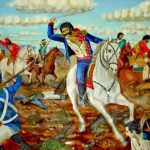
We explain what the May Revolution was, the main events and characters, its causes and its consequences.
What was the May Revolution?
The May Revolution was a set of historical events produced during the month of May 1810 in the city of Buenos Aires, capital of the Viceroyalty of the Río de la Plata. These events began the revolutionary process that led to the dissolution of the viceroyalty, the declaration of the independence of the United Provinces of the Río de la Plata (1816) and the conformation of the Argentine Nation.
The events of the May Revolution occurred within the framework of the deposition of the King of Spain Fernando VII by the French Army of Napoleon Bonaparte. The crisis of the Spanish empire generated conditions of political instability in the colonies, which the Creole inhabitants (Spaniards born in America) took the opportunity to obtain greater autonomy.
In Buenos Aires, the English invasions (1806 and 1807) had led to the militarization of the city and the rivalry between Creoles and Spanish peninsular for the control of militias. In turn, the short experience of freedom of commerce under English domain motivated Creoles to get more and more autonomy.
With the progress of the French army in Spain and the suppression of the Central Board of Seville (held by the government of the colonies in the absence of Fernando VII), the Creoles of Buenos Aires met in an open council and defined the creation of the first national government on May 25, 1810.
Frequent questions
What was the May Revolution?
The May Revolution was the revolutionary process by which the Creoles of the Viceroyalty of the Río de la Plata proclaimed the first national government. It is a fundamental event of Argentine history and is considered the first step of the way to the independence of Spain.
Who were the main leaders and actors of the May Revolution?
Among the leaders and main actors were figures such as Cornelio Saavedra, Mariano Moreno, Juan José Castelli and Manuel Belgrano, who performed key roles in the organization and direction of the revolutionary movement.
What were the main socio -economic causes that led to the May Revolution?
The main causes included the militarization of Buenos Aires due to the English invasions, the discontent of the upper classes for the commercial monopoly imposed by the Spanish crown, and the crisis and dissolution of the Spanish empire after the deposition of Fernando VII.
What were the main consequences of the May Revolution?
The May Revolution led to the formation of the First Board, the first national government of Argentina, which marked the beginning of the process of independence of Spain and the search for greater political and economic autonomy for the American colonies.
Causes of the May Revolution
Among the main causes that led to the May Revolution are:
- The militarization of Buenos Aires. The English occupation attempts had caused the city of Buenos Aires to be armed and organized with urban militias, led by outstanding families. The events of 1808 and 1809 led to the preponderance of the Creole militias over the Spanish militias.
- The fragility of the Spanish colonial order. The English invasions demonstrated the inability of the Spanish crown to act in crisis situations and defend their colonies. In addition, the viceroy and the Spanish institutions lost authority and grew the prestige of Creole institutions, such as the council and the officers of the militias.
- The discontent of the upper classes of Buenos Aires. The Spanish crown monopolized trade and prohibited American merchants from doing business with English companies. In addition, the Bourbon reforms had left the members of the most important Creole families out of government positions, which caused disgust among the upper classes.
- The crisis and dissolution of the Spanish empire. Fernando VII’s deposition generated a crisis in the government of the colonial empire. The American colonies formed government boards, which were repressed by the viceregal armies. The dissolution of the Central Board of Seville in Spain, the last bastion of the Spanish resistance against the French army, was the trigger that led to the revolution.
Historical context of the May Revolution
In 1776, the Spanish crown created the viceroyalty of the Río de la Plata, with the city of Buenos Aires as capital. He established the monopoly of trade between the colonies and Spain, which generated discontent among the merchants of Buenos Aires, because they were banned free trade with other kingdoms, especially with Great Britain.
In addition, during the 18th century, the Spanish kings established the Bourbon reforms, which sought to strengthen Spanish control over the colonies against the growing autonomy of families and Creole authorities. In this way, the most important families in Buenos Aires and other American cities were remote from the high positions of the colonial administration.
In this context, at the beginning of the 19th century there were a series of events that changed the political, economic and social situation of the Viceroyalty of the Río de la Plata:
- 1806 and 1807: English invasions. The British Empire tried twice to occupy the city of Buenos Aires. During the first attack, Viceroy Rafael de Overmonte went to the city of Córdoba with the viceregal troops, and the Buenos Aires authorities had to defend themselves by their own means. The main families organized urban militias and defeated the English. Consequently, the Buenos Aires neighbors became aware of their power and inability of the Spanish crown to act in defense of their colonies.
- 1808: French invasion of Spain. The French army of Napoleon Bonaparte invaded the Spanish empire, overthrew King Ferdinand VII and appointed José Bonaparte as the new monarch of Spain. The main Spanish cities ignored the new king, organized resistance and formed autonomous government boards. In Seville, the Central Supreme Board was created, which declared itself the sovereign of the territories that were not controlled by the French army, including the American colonies.
In America, this political crisis was interpreted as a void of power in the Spanish Empire. In the most important cities, local government boards were proclaimed, but the Spanish Central Supreme Board did not recognize its legitimacy.
The political situation of Buenos Aires
In Buenos Aires, after the English invasions of 1806 and 1807, the viceroy Liniers began to compete with the Cabildo for the control of urban militias. With these tensions, two main political groups were formed.
- Creoles They were the children of Spaniards born in America, who grouped under the Independence Party. They wanted to gain autonomy with respect to Spain and for that they sought the help of other European powers, such as England. Juan Jose Castelli, Manuel Belgrano, Antonio Berutti and Joaquín Vieytes, among others belonged to this group.
- Peninsular They were the Spaniards born in Spain and other Creoles that benefited from the colonial system. They wanted to form a local government board under the control of the Spaniards. This group was led by Martín de Álzaga, and among its members were Juan Larrea, Antonio de Santa Coloma, Domingo Matheu and Julian de Leyva.
THE ASONADA DE ÁLZAGA
Martín de Álzaga, a Spanish merchant who had been a hero in the resistance against English invasions, directed a group of Spaniards who tried to depose the Viceroy Liniers, with the aim of creating a governing board controlled by the Spaniards. On January 1, 1809, a delegation of Spanish militias surrounded the Plaza Mayor and claimed the resignation of the Viceroy.
However, Cornelio Saavedra, a Creole merchant and a member of the Cabildo, opposed the dismissal of the viceroy and sent the Creole militias against the Álzaga group, which was defeated. In this way, the militias of the Spaniards who participated in the assonada (violent protest) were dissolved, and the Creole militias won power and authority.
On the other hand, the Central Board of Seville saw with concern the support of the Creoles to the Viceroy Liniers and decided to replace him with Baltasar Hidalgo de Cisneros. The new viceroy arrived in Buenos Aires with the aim of reaffirming the Spanish predominance, and for that he dissolved some Creole militias and restored those Spanish who had been dissolved after Álzaga’s assonada. However, he had to deal with the uprisings that occurred in Chuquisaca and La Paz, Cities of Alto Peru, which tried to form autonomous government boards.
To prevent the Creoles of Buenos Aires from taking the same path, Cisneros authorized greater commercial freedom: it allowed wholesale foreign trade with the English, but maintained the Spanish monopoly on internal trade and retail sale of merchandise.
The week of May

On May 13, 1810, an English frigate arrived in Montevideo with the news that the Central Board had been dissolved. In a few days, the information also arrived in Buenos Aires.
Faced with this, the Viceroy Cisneros released on May 18 a proclamation (an official document in which the population of relevant situations was notified) in which he asked the Buenos Aires to remain loyal to the viceregal authorities and King Fernando VII. It also highlighted the importance of not carrying out actions without agreeing with the rest of the provinces of the viceroyalty.
However, Cornelio Saavedra and the Creoles who made up the Independence Party declined the Viceroy’s request and claimed the call to an open council. A meeting was requested in the Cabildo with the participation of all the residents of the city. The popular discontent and the support of urban militias to the Creoles caused the viceroy cisneros and the council to accept the order and summon the open council for May 22.
The residents of Buenos Aires were those who resided in the city and had a high socioeconomic level. The category of neighbor It only applied to white male adults and homeowners, weapons and horses. This was accompanied by social prestige and belonging to the community of the richest and most important families in the city.
The open council
On May 22, 1810, an open council was held in Buenos Aires, with the participation of more than 250 neighbors. There, a general debate on the continuity of the viceroy began in his position, in which there were two positions found:
- Conservative position. Bishop Benito Lué defended the idea that, regardless of what happened in Spain, while there was a representative of King Ferdinand VII in America, the authority fell to him and had the right to exercise the government over any Creole.
- Revolutionary position. Juan José Castelli claimed that, since King Fernando VII had been captured by the French army, sovereignty had returned to the people. Therefore, the people of Buenos Aires had the right to decide and exercise the government that it considered appropriate, as the Spaniards had done with the formation of government boards to resist the French.
Some conservatives accepted the idea that sovereignty fell to the people, but argued that Viceroy Cisneros had to be kept in his position and call representatives of the different provinces of the viceroyalty, since Buenos Aires had no power over them. However, the revolutionary Juan José went on that before an emergency situation like that, the capital of the viceroyalty could make decisions until the representatives of other provinces could meet.
At the end of the debate, the participants of the open council made a vote. As a result, the dismissal of the Viceroy Cisneros, the Sovereignty Delegation in the Cabildo and the formation of a Government Board was chosen.
The formation of the First Board
In this context, tensions between peninsular and Creoles led to discord on who had to form the Governing Board. On May 24, the Cabildo formed a Government Board under the presidency of Cisneros, composed of four vowels, two peninsular and two Creoles. The Spanish authorities accepted it, since it restored the command of militias and political power to Cisneros as president of the new Board.
However, the revolutionaries pressed the two Creole vowels to renounce the Board and achieve the creation of a government that was not controlled by the peninsular. On the night of May 24, before the popular pressure, the Cabildo accepted the resignations.
On May 25, the revolutionary Creoles gathered in the Plaza Mayor and demanded the formation of a government that excluded the viceroy cisneros. The Cabildo and Cisneros tried to resist these demands, but the popular agitation and the presence of the Creole militias led them to accept the claims.
Finally, the Viceroy Cisneros resigned and a provisional government board was formed, which was subsequently known as the First Board. The First Board was made up of:
- President: Cornelio Saavedra.
- Secretaries: Mariano Moreno and Juan José Paso.
- Members: Manuel Belgrano, Juan José Castelli, Manuel Alberti, Miguel de Azcuénaga, Juan Larrea and Domingo Matheu (Librembistas merchants of Spanish origin).
The “Fernando mask.” The First Board was proclaimed autonomously with respect to the Regency Council, the Spanish Government Body that replaced the Central Board of Seville, but, in turn, swore fidelity to Fernando VII. In this way, the Creoles sought to delay the Spanish reaction, because independence was not proclaimed. This strategy was used in rebellions of the American colonies and historians call it the “Fernando Mask.”
The Government of the First Board
When the government assumed, the Board had to face two main problems. On the one hand, the rest of the provinces that made up the viceroyalty were integrated into the revolutionary process, recognized the new authority and sent representatives to form the new government. On the other hand, he had to prepare the militias to face the Spanish reaction, which would seek to recover control of the viceroyalty.
The provinces of Jujuy, Salta, Tucumán, Catamarca, La Rioja, San Juan, Santiago del Estero, Santa Fe, Missions, Corrientes and Entre Ríos immediately recognized the new Governing Board. Mendoza did it a few months later, after Buenos Aires sent troops to ensure adherence to the revolutionary process.
In Córdoba, the former viceroy Santiago de Liniers initiated a counterrevolutionary movement that resisted militarily to the troops of the First Board. However, this counterrevolution lasted little and culminated in the shooting of Liniers.
From the provinces of Alto Peru, Solo Cochabamba recognized the Governing Board, while La Paz, Chuquisaca, Potosí and Charcas denied their adhesion, as did Paraguay and Montevideo.
Given this situation, the Governing Board decided to send two military expeditions: one in the direction of Alto Peru and another in the direction of Paraguay. In this way, the war of independence began.
Important: The First Board is considered in Argentina as the first national government, because it was the first government institution that was made up of Creoles. This milestone marks the beginning of the process that led to the independence of Spain and the creation of the Argentine nation.
The ideals of the May Revolution
Many of the revolutionary actors of the May Revolution defended the political and social ideals of the Enlightenment. The French Revolution of 1789, which led to the overthrow of the monarchy and the declaration of the universal rights of man under the ideals of freedom, equality and fraternity, was a key antecedent for revolutionary ideas in colonial America.
One of the defenders of this revolutionary thought was Mariano Moreno, who argued that it was necessary to replace the old ideals of Spanish monarchy for more modern concepts, such as popular sovereignty that had inspired the French revolution and independence of the United States.
The role of the Catholic Church

The role of the clergy in this conflict was ambiguous. On the one hand, the official position of the American Church was condemned to revolutionaries and loyalty to the monarchical order. In Buenos Aires, in the open council, Bishop Benito Lué took a realistic position and defended the permanence of the viceroy cisneros in the government boards.
On the other hand, many priests and friars were in favor of the new order, and the revolutionaries continually insisted on conciliatory policies in religious matters, recognizing the influence of the Church in the culture of colonial America as a decisive human factor.
Consequences of the May Revolution
Among the main consequences of the May Revolution are:
- The dissolution of the colonial order in the territories of the Viceroyalty of the Río de la Plata and its fragmentation in small constituencies linked to the main city of each province.
- The beginning of the Wars of Independence, which led to the creation of four different national states: Argentina, Uruguay, Bolivia and Paraguay.
- The formation of a new political, economic and social order, based on the predominance of oligarchy, free trade, free expression and agricultural export.
Continue with:
References
- Chiaramonte, JC (2008). Autonomy and independence in the Río de la Plata, 1808-1810. Mexican historyvol. LVIII, no. 1, July-September, 2008, pp. 325-368.
- Herrero, F. (comp.). (2004). Revolution. Policy and Ideas in it River of the Silver during the decade of 1810. Cooperative Editions.
- Lynch, J. (1976). Hispano-American revolutions, 1808-1826. Ariel.