
We explain who the unitary and federals were, what were the reasons for their clashes and their general characteristics.

Who were the unitary and federals?
The representatives of Two conflicting projects of National Organization of the United Provinces of the Río de la Plata (later called the Argentine Republic) after the declaration of independence regarding Spain. These two sides were grouped respectively in the Unitary Party and the Federal Party and faced militarily into a civil war between 1828 and 1831.
The Unitarians proposed the organization of a national government based in Buenos Aires (former capital of the Viceroyalty of the Río de la Plata) and the subordination of the provinces to the central authority. They also defended free trade and modernizing reforms. The federals supported the almost total autonomy of the provinces with its own government and constitution but integrated into a confederation. His economic projects varied according to their regional belonging (to the coast, inside OA Buenos Aires).
The civil war ended with the military victory of the federals in 1831 and the consolidation of the power of Juan Manuel de Rosas in 1835, who assumed the Government of Buenos Aires with the sum of public power. Since then the Rosas era began at the head of the Argentine Confederation. The Unitary Party disintegrated and some unitary exiled exiled joined other opponents to rosism (liberals and federal), with which they conspired against roses until their fall in 1852.
Key points
- Unitarians and federal were two sides faced by the way in which the territory of the United Provinces of the Río de la Plata should be organized after the proclamation of independence (1816).
- The unitarians proposed a centralized regime, in which the provinces were subordinated to the central government installed in Buenos Aires.
- The Federals defended the autonomy of the provinces and a confederation regime that granted powers limited to the central government.
- The conflict between unitary and federals dominated the 1820s and resulted in a civil war (1828-1831) that concluded with the triumph of the federals.
What did the Unitarians raise?

The unit party was the side that integrated politicians and military who believed in the Organization of the provinces under the authority of a central government based in Buenos Aires . This party derived from the centralism that had emerged during the independence process and was consolidated during the Constituent Congress of 1824, when their ideas managed to impose themselves on those of the federals and led to the approval of the Constitution of 1826, of a unitary nature.
The unitarians They were inspired by the idea that the nation was before the provinces and these should only be divisions of the national territory. In addition, they proposed the elimination of internal customs, the promotion of free trade and economic and institutional modernization.
The majority of the unitary party members belonged to the Buenos Aires elite and some provincial capitals and had little influence in the rural population, especially in the low strata.
What did the federals raise?
The Federal Party issued from the precepts of the Federal League (also called the Union of the Free Peoples), headed by José Gervasio Artigas in the context of the struggles for independence. His project consisted of establish a federal regime in which the autonomy of the provinces was recognized with its own governments and constitutions, and in which the central power had a few delegated powers (for example, in foreign relations).
Therefore, federalism admitted the establishment of a republic but rejected the existence of a hegemonic central power, because I was looking to defend regional economic interests and the traditions of the provinces and their leading sectors.
The federal party leaders were members of the leading sectors of the interior provinces, the coast and Buenos Aires. Some defended protectionism (for example, inside) and others defended the free navigation of the rivers (for example, on the coast). In addition, they had many supports in the rural sectors, both well -off and gauchos and low social extraction groups. One of its characteristic military features was the use of rural militias called “Montoneras”.
Origin of the conflict between unit and federal
The confrontation between unitarians and federals had as a background the conflict between centralists and federals when the War of Independence was still fought against the Spanish domain in the territory that had belonged to the Viceroyalty of the Río de la Plata. These two sides were part of the patriotic group that since the formation of the First Government Board after the May 1810 revolution fought against the realistic army.
Although they agreed on the need to proclaim independence, both sides had different ideas about political and territorial organization:
- The centralists They defended the predominance of the central government established in Buenos Aires (called at that time directory).
- The federals headed by José Gervasio Artigas (leader of the Eastern Band), proposed a federal model based on the autonomy of the provinces integrated into a confederation.
This caused armed conflicts that occurred simultaneously with the struggles against the realists and the Portuguese. After the promulgation of the Constitution of 1819, which was rejected by the federal leaders of the coast due to its centralism, the clashes were intensified.
The Board of Directors sent the Northern Army to fight against the Coastal Caudillos but their troops rebelled in Arequito (Santa Fe). Finally, The federal side won in the battle of Cepeda in February 1820 headed by Estanislao López (de Santa Fe) and Francisco Ramírez (de Entre Ríos), ancient Lieutenants of Artigas.
The central authority disintegrated and the country was divided into thirteen autonomous provinces With their own institutions. From there, disagreements between unitary and federals regarding how to organize the territory of the United Provinces of the Río de la Plata were the main political characteristic of the 1820s. Traditional historians called this period “the anarchy of the twenties.”
The Unitary Constitution of 1826

After the dissolution of the Board of Directors, Buenos Aires became one more province and dedicated the income of his customs to local modernization policies, especially under the management of Bernardino Rivadavia as Minister of Government (1821-1824), a time that some called “the happy experience”.
In the other provinces the situation was more complicated, especially because of the conflicts between leaders and the shortage of resources in some of them. For example, the Argentine Northwest had lost its trade with Alto Peru after independence and had difficulty finding a market for its products.
In 1824 a Constituent Congress called by the Government of Buenos Aires met in which two different proposals were presented for the national organization:
- The unitarians They defended the formation of a centralized government.
- The federals They proposed a regime in which the provinces were granted greater autonomy.
Finally, The unitary position was imposed and a Constitution was promulgated in 1826 which adopted as a form of government “the Republican representative form, consolidated in regime unit.” The provincial governors were thus “under the immediate dependence of the president.” However, this Constitution was rejected by most of the provinces.
In the context of the war against Brazil initiated in 1825 and internal conflicts with the federals, Bernardino Rivadavia, appointed President of the Republic in 1826, resigned from position in 1827 . The unit regime collapsed. Buenos Aires was again considered one more province and had to choose a new governor. This position was assumed by Buenos Aires Manuel Dorrego.
The Civil War (1828-1831)
The shooting of Manuel Dorrego
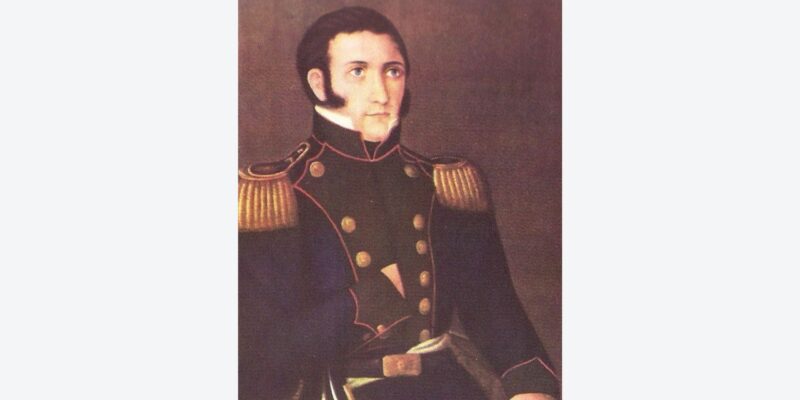
The Government of Buenos Aires dealt with the foreign relations of the provinces, so he led the war against Brazil (with whom he disputed the territory of the Eastern Band). The war ended in August 1828, when the governor of Buenos Aires, Manuel Dorrego, agreed to sign peace and recognize the independence of the Eastern Band with the mediation of the British government.
This fact generated discontent among some Argentine troops who had fought in Brazil, which was used by the unit leaders. The general Juan Lavalle returned with his army to Buenos Aires and led an uprising against the federal government of Dorrego who was overthrown December 1, 1828. of this modocomenated a civil war between unitary and federal.
Lavalle was proclaimed governor of Buenos Aires and began the persecution of Dorrego who formed an army with forces of the Buenos Aires campaign with Colonel Juan Manuel de Rosas. However, on December 9, Dorrego’s troops were defeated by the Unitary Army in the Battle of Navarro and the federal leader was arrested by two of his officers, who delivered him to Lavalle.
December 13, Dorrego was shot by order of Lavalle instigated by other personalities of the unit party, such as Salvador María del Carril. The federal leaders of the provinces expressed their disapproval and Rosas joined Estanislao López in Santa Fe to face the Unitary Army of Lavalle. Meanwhile, General José María Paz joined the unitary cause and invaded Córdoba.
The Interior League and the Federal Pact
Lavalle’s troops were defeated by the Federals in the Battle of Puente Márquez in 1829 and had to fold to the city of Buenos Aires. Next, Lavalle and Rosas reached an agreement by which the Board of Representatives of Buenos Aires appointed Rosas, which burn the end of the unit period in the province was restored.
In Córdoba, General Paz was proclaimed governor and continued to fight against federal troops headed by leaders such as Juan Facundo Quiroga. In 1830 he formed the Interior League (also called Unitary League) an offensive and defensive alliance composed of nine provinces that became identified with the unit party: Córdoba, Tucumán, Salta, Catamarca, Mendoza, San Juan, San Luis, La Rioja and Santiago del Estero. Paz was appointed supreme military power.
The response of federal governments was the signing of the Federal Pact in 1831 Between Buenos Aires, Santa Fe, Entre Ríos and, subsequently, Corrientes. Paz was taken prisoner in May 1831 and the unit army began to lose ground until its final defeat against Quiroga’s troops in the battle of the citadel on November 4, 1831.
End of the conflict between unitary and federal
With the end of the civil war in 1831, The provinces were in the hands of federal leaders and a complete adhesion was achieved to the Federal Pact. However, after Quiroga’s death in February 1835, Rosas was again appointed as governor of Buenos Aires in March 1835, this time with the sum of the public power. Rosas managed to impose his idea that the country was not in a position to be constitutionally organized .
The defeat of the Interior League and the exile to which the unitarians were forced due to the persecution of the Rosasprovocaron regime the end of the unit party. However, the struggles continued and some unitary unitary ones joined other opponents of rosism, both liberals and federal dissidents. Anyway, during the time of Rosas a federal Constitution was not established and the provinces were organized as a subordinate confederation to the political decisions of roses and the interests of Buenos Aires landowners.
Consequences of the conflict between unitary and federal
After the death of Facundo Quiroga in 1835, Juan Manuel de Rosas assumed the position of governor of Buenos Aires with the sum of public power and in fact ruled the country between 1835 and 1852. During this stage a regime of persecution and exile of political opponents, both unit and federal, was imposed.
Some exiles were the young people of the generation of 37, such as Domingo Faustino Sarmiento, Esteban Echeverría and Juan Bautista Alberdi. On February 3, 1852, Rosas was defeated in the battle of Caseros For the Grande Army, led by the Entrerriano Federal Caudillo Justo José de Urquiza, and was exiled in England.
Urquiza promoted the San Nicolás Agreement that led to the promulgation of the Constitution of 1853 which proclaimed a federal form of government and was approved by all provinces except Buenos Aires. Urquiza was then elected as the first president of the Argentine Confederation.
Buenos Aires subsequently joined the Nation and got the Bartolomé Miter, of Liberal Ideology, who had defeated the troops of the Confederation in the battle of Pavón in 1861 in 1861.
Leaders and battles of the conflict between unitary and federal

The main federal leaders of the time they faced with the unitarians were:
- José Gervasio Artigas (1764-1850)
- Estanislao López (1786-1838)
- Francisco Ramírez (1786-1821)
- Manuel Dorrego (1787-1828)
- Juan Facundo Quiroga (1788-1835)
- Juan Felipe Ibarra (1787-1851)
- Just José de Urquiza (1801-1870)
- Juan Manuel de Rosas (1793-1877)
Some of the main unit leaders were:
- Bernardino Rivadavia (1780-1845)
- Juan Lavalle (1797-1841)
- Salvador María del Carril (1798-1883)
- Juan Cruz Varela (1794-1839)
- Florencio Varela (1807-1848)
- José María Paz (1791-1854)
- Gregorio Aráoz de Lamadrid (1795-1857)
The most important battles of the civil war between unitary and federals were:
- Navarro (December 9, 1828), Unitary Victoria
- Las Palmitas (February 17, 1829), Unitary Victoria
- Las Vizcacheras (March 28, 1829), Federal Victoria
- San Roque (April 22, 1829), Unitary Victoria
- Márquez Puente (April 26, 1829), Federal Victoria
- Córdoba (June 21, 1829), Federal Victoria
- La Tablada (June 22 and 23, 1829), Unitary Victoria
- Pilar (September 22, 1829), Federal Victoria
- Oncative (February 25, 1830), Unitary Victoria
- Bishop’s tips (December 17, 1830), Federal Victoria
- Dead friar (February 5, 1831), Federal Victoria
- Fifth River (March 18, 1831), Federal Victoria
- The Citadel (November 4, 1831), Federal Victoria
The conflict between unitary and federal and the rosista regime were usual issues in Argentine literature . Some of the most outstanding works were Facundo or Civilization and Barbarie (1845), by Domingo Faustino Sarmiento, Amalia (1855), by José Mármol and The slaughterhouse (1871), by Esteban Echeverría.
In visual art, Carlos Morel’s paintings stood out (Cavalry load, Cavalry fight at the time of Rosas) and the lithographs of César Hipólito Bocle.
References
- Calvert, Par & Halperin Donghi, T. (2023). History of Argentina. Britannica Encyclopedia. https://www.britannica.com/
- Goldman, N. (dir.) (2005). Revolution, Republic, Confederation (1806-1852). South American.
- Luna, F. (1993). Brief history of Argentines. Planet.
- TERNAVASIO, M. (2009). HISTORY OF ARGENTINA 1806-1852. 21st century.
Continue with:


